Ministers of education and culture should take note of the competition organised by the Taiping Heritage Society and endorse or fund such competitions and forays into our living heritage in all schools.

In an era of rapid AI breakthroughs and globalised digital culture, the past – and anything related to it – can feel irrelevant, and interest in heritage a waste of time.
More so for schoolchildren who are already juggling exams, tuition classes, and a dozen extracurricular activities.
But the Taiping Heritage Society (THS) believes that this need not be so. It believes that getting young people excited about both tangible and intangible heritage isn’t nostalgia but training for becoming well-rounded, empathetic and culturally rooted citizens.
That conviction led them to organise the second Piala Pusingan Wira Warisan heritage video competition for secondary students recently. Participants had to pick any aspect of heritage in the Larut, Matang and Selama district, then conceptualise and shoot a video under five minutes in Bahasa Malaysia or English.
The best 20 entries were selected for screening. What impressed me most as a judge for this competition was the students’ creativity and range. While some entries lingered tenderly on the town’s storied history, many danced with fresh invention.
Two teams, for instance, used AI to paint vivid dramatic scenes in summoning the fiery clashes of the infamous Ghee Hin and Hai San secret societies—clashes that led to the town’s name.
It was a delightful reminder that the very technology people fear will kill tradition can actually help keep it alive; that the supposed enemy of tradition might be its unlikely saviour:
One video gently cradled a dying dialect from Batu Kurau, exactly the kind of fragile cultural item that AI tools – such as translation, speech synthesis, archiving – can help preserve.
Another evoked an old village dance once performed by maidens, a delicate ritual of courtship and longing. Yet another wondered aloud why the legendary Kota Raja Bersiong has faded from collective memory.
To be clear, these were not excellent videos: while some were better than average, others had poor content; some were not well shot and yet others were wanting in language fluency or editing. But then again, the judges did not expect screen excellence from students playing with simple cameras.
Entries included topics covering the famous Kapitan Chung Keng Quee (by SMK Hua Lian), “Peranan Kompang dan Hadrah dalam Masyarakat” (by SMK Bukit Jana), the popular Casual Market (SMK King Edward VII Taiping), Kuala Sepetang (SMK Simpang), “Pasar Pagi Sungai Bayor” (SMK Dato Haji Hussein), “Jejak Flora Kolonial: Nafas Hijau Taiping” (SMK Klian Pauh), “Dato Meor Abdul Rahman: Warisan Seri Seni Silat Gayong” (SMK Taman Tasik) and “Terung Oh Trong” a quirky take on how the village of Trong got its name (SMK Toh Johan).
SMK Kampung Jambu swept the lower secondary first prize (RM1,000) with “Dalam Dakapan Hujan Larut,” a charming piece on Taiping’s famous (or infamous – depending on your perspective) rain. The four students -Ahmad Hazwannuddin Ahmad Najib, Thivesha Kathiresan (no relation, I promise), Qaireen Zhafirah Dhaniyah Kairol Shahzwan and Ronald – were genuinely adorable.
They acted their parts with heart, explaining how the rain isn’t just weather here but “the heartbeat of the ecosystem.” The ending, where they cheerfully say “Welcome to Taiping—but don’t forget your umbrella!” while popping one open, drew smiles and knowing nods from the audience.
There was a problem with language fluency though. However, I took it as proof that the entry was the work of the students themselves, without teacher involvement – one of the rules of the competition.
In the same category, SMK Convent won second placing, and RM750, with its “Hadrah Warisan Seri Nilam” video, while SMK Jelai placed third with a piece on the captivating traditional “Tarian Tampi Ayer Itam, Batu Kurau.” It won RM500.
In the upper secondary category, SMK King Edward VII won top honours, and RM1,000, with a strong entry on Kuala Sepetang’s community-based eco-tourism “Kuala Sepetang: Warisan Ekopelancongan Masyarakat Setempat.”
The second prize of RM750 went to SMK Doktor Burhanuddin with its “Api Dalam Diam” while the third prize of RM500 was won by SMK Kampung Perak which came up with “Asal Usul Nama Batu Kurau”.
The competition, initiated last year under then-president Liew Suet Fun, was held in a cinema hall so that the students’ videos could shine on the big screen.
Current THS president David Chiang summed it up nicely: “We hope to inculcate in our young minds and future leaders the importance of heritage and culture, while cultivating a passion and love for what makes our beloved Taiping what it is today. Through the lens of their camera, they have not only captured a glimpse of the past but have also brought in new and unique perspectives relevant to the present generation.”
Certainly, the THS and the organising committee deserve hearty congratulations for this initiative.
With its preeminent heritage attractions and numerous firsts, Taiping is well-positioned to run this competition. But it must not stop there. I hope our ministers of education and culture will take note and officially endorse or fund such competitions and forays into our living heritage in all schools.
Because when students learn to appreciate a 100-year-old building’s craftsmanship or the subtle beauty of a dance or how mining built a 152-year-old town, they’re not just looking backward, they’re developing empathy, critical thinking, and a deeper sense of identity.
In analysing how a historical site was built or why a specific tradition evolved, students are forced to navigate complex social, political, and environmental contexts. Suddenly, heritage is no longer something passive but an active investigation of human creativity, skill and resilience.
It is just possible that they may start seeing themselves as part of a living story rather than isolated individuals scrolling through life.
I believe that heritage can awaken young hearts to both the tangible stones and intangible songs of the past. It can quietly forge empathetic, rooted souls – citizens who carry yesterday’s wisdom into tomorrow’s uncertainties.
Importantly, shared heritage helps build social cohesion.
Handled correctly, shared heritage – something that all citizens can relate to and which is unforced – can become a bridge in multiracial Malaysia by fostering understanding, softening hearts, and gently loosening the grip of “us versus them” thinking.
And that’s exactly what Malaysia urgently needs. - FMT
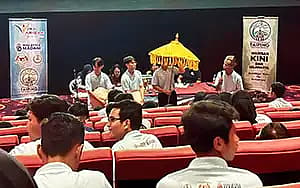
A group of students introducing their video clip with some play acting at a cinema hall in Taiping during a heritage appreciation competition for secondary students.
The views expressed are those of the writer and do not necessarily reflect those of MMKtT.
No comments:
Post a Comment
Note: Only a member of this blog may post a comment.