
It’s excitement season in the political arena - a hundred different dramas are unfolding all at once.
Amidst all this brouhaha, it is easy to let slip the case of the menteri besar of Johor.
I imagine one reason this case is not gathering heaps of attention is that it’s possible many people outside of Johor (and perhaps a good number within Johor even) do not truly care who the menteri besar is.
To be honest, I wouldn’t have been able to name the menteri besar of Johor a few weeks ago, and I had never really heard of the current one either.
Given what has been happening in politics - including some debate regarding the dissolution of parliament - perhaps it is a good time to revisit some key features of the Westminster system, employing a slightly more academic lens.
At the heart of the Westminster system is the concept of a constitutional monarchy - a rather interesting hybrid system that quite uniquely combines a number of elements.
The idea of a constitutional monarchy can be thought of as an evolution from its predecessor, absolute monarchies.
Constitutional monarchies maintain historical monarchs and give them certain roles to play in the governance of a country while using a democratic system to elect leaders that do the actual governing.
In this sense, we can think of a constitutional monarchy as a compromise of sorts, for countries that did not believe a monarch should hold absolute power, but for whatever reason, also wanted to maintain the idea of a monarch who plays some role in a country’s government.
This was the route taken by the UK, home to one of the most well-known monarchies in the world, and the system on which our own constitutional monarchy is very closely modelled.
Two things the British seem very keen on when it comes to governance and law are convention and precedent.
This seems to work fairly well for them, as to date, it looks like they have not had a severe crisis where political actors have dared to act in ways that challenge existing conventions - even when they are no strict laws explicitly prohibiting such actions. Where people are honourable, the honour system works.
One consequence of this is that in this tradition, there are many situations where it appears that the British feel they do not require codified law and procedures to be written down in painstaking detail because when these situations arise, they simply do things the way they’ve always been done. And for them - so far anyway - this system has not broken down.
Ambiguous wording
Let us look once again at the wording of Article 43(a) of Malaysia’s Federal Constitution which describes the power of the Yang di-Pertuan Agong to appoint a prime minister:
“(T)he Yang di-Pertuan Agong shall first appoint as Perdana Menteri (Prime Minister) to preside over the Cabinet a member of the House of Representative who in his judgment is likely to command the confidence of the majority of the members of that House;”
I am obviously not a lawyer, but I suppose anyone with a reasonable understanding of the English language may observe a number of ambiguities in the wording here.
In particular, the phrases “in his judgment” and “is likely to command the confidence of the majority” seem unnecessarily ambiguous.
Again, the British seem to deal with such ambiguous language simply by trusting that everyone will religiously follow convention - and in their case, so far they have.
In Malaysia however, as we have seen in many crises starting from the Perak crisis of 2009, the lack of clearly set out laws and procedures regarding how such a determination of who exactly is likely to command the confidence of the majority has given rise to a number of very controversial cases - including Perak in 2009 and post-Sheraton in 2020.
My own personal interpretation - which I doubt is too far from generally accepted norms - is that in the Westminster system, the process is ‘supposed’ to work as follows.

The citizens vote for members of Parliament; the MPs, in turn, decide who they want to choose to be prime minister; the monarch then confirms this choice by inviting said individual to form a government in their name.
This I believe, is the spirit of the law, and the spirit of constitutional monarchy.
In Malaysia, as we saw above, there is no letter of the law which strictly codifies how this is supposed to work; in the absence of such certainty, a number of uncertainties have in turn emerged.
Of course, there are cases of hung parliaments, where no clear majority can be determined. We are no stranger to such cases as well, but they are not the subject of today’s article.
Who determines the government?
When there is a very clear, unambiguous consensus from a majority of elected representatives within a legislature to elect one individual as head of government, however, it must surely be considered strange if a different individual is instead appointed by the monarch to be head of government.
From a public perspective, there are times we may be tempted to cheer on a monarch when they use their discretion to make a change that we personally like; or perhaps there are times when we simply don’t care because it hardly makes a difference to us whether it is one individual or another - perhaps, especially at the state level.
The principles and precedence at stake, however, can be viewed as quite serious indeed. This is especially true in a country like Malaysia, where the prime minister holds immense power.
Indeed, our power dynamics and recent history has shown that arguably the only question that truly matters in Malaysian politics is who the prime minister is. Given decades of over-centralisation of power, all effective power today arguably stems from the prime minister.
If it becomes accepted precedence that the clear, unambiguous choice of a majority of elected representatives in the legislature can be ignored in favour of another candidate being appointed instead, this turns the power dynamics of Malaysian politics completely on its head.
With the various political shenanigans that have taken place since the Sheraton Move, voters already feel that they do not actually influence the political process - because once they have chosen an elected representative, they have no real way to truly influence who that elected representative chooses to support as head of government (except to threaten to vote that representative out a long five years later).
If the scenarios described above become set as conventional precedence, then not only voters but elected representatives themselves will have even less say over who becomes head of government than they already do. Surely this is cause for concern, to say the least.
The proper flow of the dissolution process
Before closing, perhaps it is also worth briefly visiting this question of when a legislature like Parliament can be dissolved.
Article 40A (2) (b) of Malaysia’s Federal Constitution clearly states that the Yang di-Pertuan Agong may act in his discretion with regards to “the withholding of consent to a request for the dissolution of Parliament.”
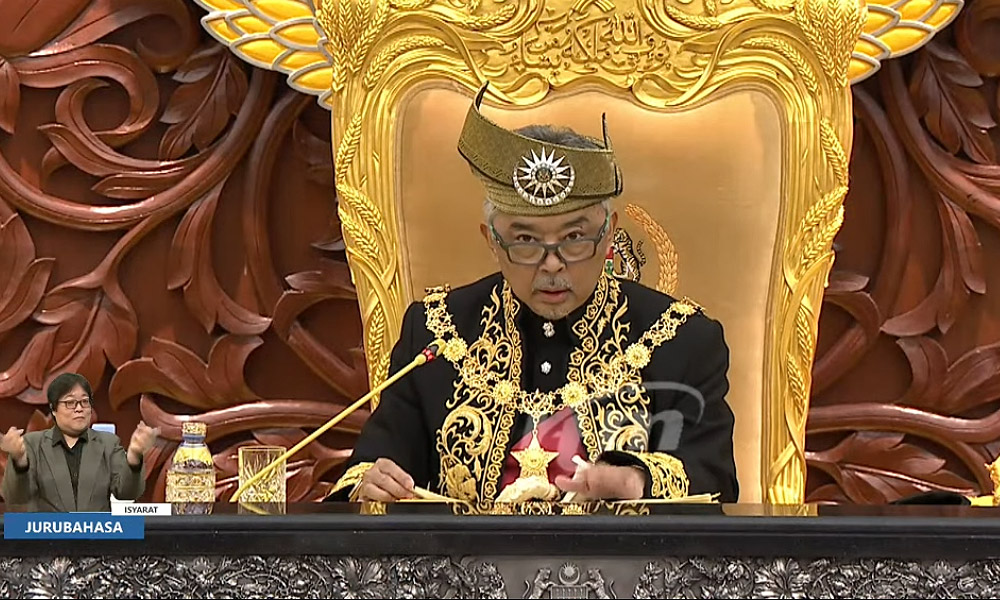
That is fairly clear and unambiguous.
It would likely be wrong, however, to imagine that a constitutional monarch is supposed to be part of a group of people who are discussing when elections should be held.
The Westminster system is quite different from the American system, which has very strict, predictable dates on which presidential elections must be held.
The head of government in a Westminster system meanwhile, is empowered to request for a dissolution of the legislature at any time during their tenure, up to the term limit of that legislature (which in Malaysia’s case is five years).
We will leave aside for the moment the question of which system is better.
Circle of influence
The way the Westminster process is supposed to work is that the prime minister, the cabinet, and whoever is in the prime minister’s circle of influence will together work to determine when they feel they should submit a request to dissolve the legislature.
Once this political decision is made, the request is then sent to the constitutional monarch, who has the clear power to approve or deny this request. This is the proper stage at which the monarch is rightfully involved.
This is the proper flow of events as envisioned in a Westminster constitutional monarchy.
What is not envisioned is some flow where the constitutional monarch is involved in the early stages of trying to determine the date of dissolution. This is instead ultimately a political question that must first be resolved at the political level, before being going to the next stage, which is submitting the request for dissolution to the monarch, whose role at that stage is to approve or deny the said request.
There are many debates surrounding how suited the Westminster system is for the world today; but whatever our feelings on this question, the reality is that this is the system we find ourselves with today.
It is a system that has survived a long time, and no system can survive that long without being functional at least on some level.
It can only remain functional however if we adhere to the exact constitutional and conventional principles which have made this system sustainable. Failure to do so may lead to considerable, troubling deviation from democratic ideals of self-determination. - Mkini
NATHANIEL TAN studies democracy. Twitter: @NatAsasi, Email: nat@engage.my.
The views expressed here are those of the author/contributor and do not necessarily represent the views of MMKtT.
No comments:
Post a Comment
Note: Only a member of this blog may post a comment.