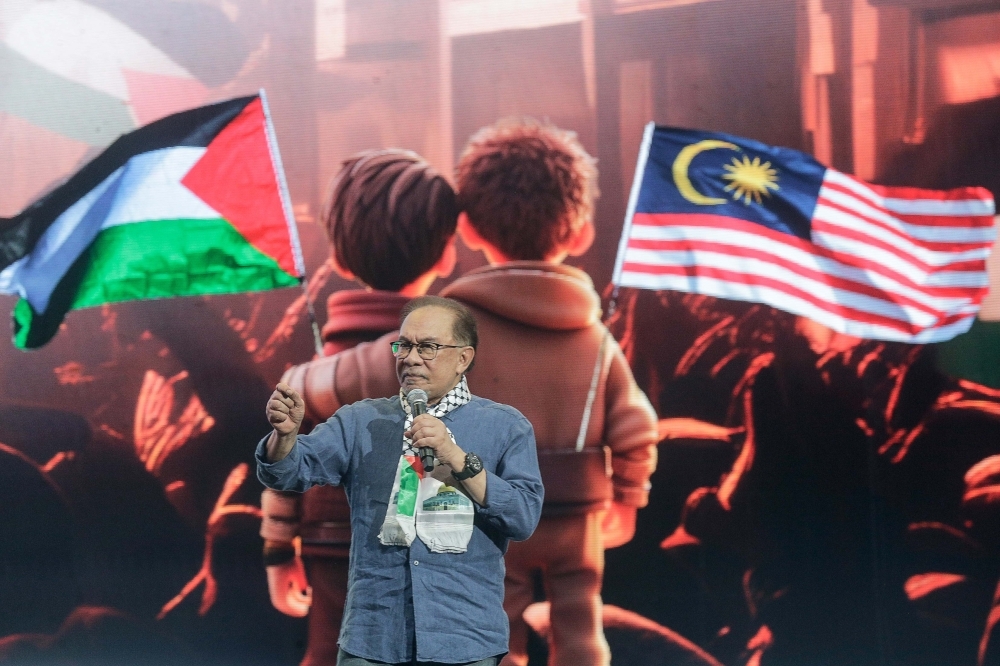
PRIME Minister Datuk Seri Anwar Ibrahim recently announced an additional RM100 mil allocation for Palestine on top of the RM100 mil already approved by the government in 2023.
The announcement was made before a crowd of several thousand who gathered for the Sumud Nusantara rally at Dataran Merdeka, a symbolic event held to send off a humanitarian aid flotilla to Gaza.
Malaysia, for decades—since the formation of Israel—has stood firmly in solidarity with the Palestinian people. Yet too often, contributions come as short-term relief: shipments of aid, fundraising drives, or diplomatic statements, without a coordinated, long-term framework.
But if Malaysia is to make a real and lasting difference, it must shift from piecemeal responses to a sustainable, systemic strategy that addresses both urgent needs and long-term recovery.
Instead of ad-hoc medical missions, Malaysia could establish a permanent health and relief corridor and through on-site missions and telemedicine links, could provide continuity of care for patients in war-torn Gaza.
This builds on real precedents. MERCY Malaysia has been active in Gaza since the early 2000s, sending medical teams and delivering mobile clinics.
In 2010, MyCARE coordinated a flotilla mission to deliver aid to Gaza, showing Malaysians’ deep grassroots commitment. A permanent structure would amplify these efforts and ensure consistency.
Equally important, Malaysia should commit to multi-year funding for the United Nations Relief and Works Agency for Palestine Refugees in the Near East (UNRWA) and the World Health Organisation (WHO) rather than making sporadic donations.
Predictable contributions will allow these agencies to plan better, ensuring food, healthcare, and education for millions of Palestinians.
Aid should not only relieve suffering but also rebuild hope by focusing on reconstruction and employment to build a future for the people of Palestine.
Malaysia could spearhead a reconstruction facility that pools state funds, zakat, corporate social responsibility (CSR) contributions, and diaspora bonds to rebuild critical infrastructure—water, power, housing, and clinics.
By involving Malaysian SMEs in solar power, water treatment, and housing, projects would not only restore essential services but also create jobs for Palestinians.
Crucially, reconstruction must follow green and resilient standards so new facilities are energy-efficient, sustainable, and repairable with local materials.
Malaysia already plays an active role at the United Nations and the International Court of Justice (ICJ). By consistently grounding its diplomacy in international law, particularly the Genocide Convention, Malaysia would strengthen its position.
To give its diplomacy more “teeth”, Malaysia should consider signing important international conventions.
Currently, Malaysia is not a signatory to several core international human rights conventions, including the 1951 Refugee Convention, the Convention Against Torture (UNCAT), and the International Convention on the Elimination of All Forms of Racial Discrimination (ICERD), often due to concerns about potential conflicts with domestic laws. Adopting these conventions would enhance Malaysia’s moral authority and legal
One of Malaysia’s most powerful contributions could be in human capital development through education and health.
A scholarships programme would enable Palestinian youth to study in fields like STEM, health, and governance, with guaranteed internships and return-service opportunities.
Already, several Malaysian universities host Palestinian students, many of whom return to Gaza and the West Bank to serve as doctors, engineers, and community leaders.
Malaysian hospitals could also expand treatment slots for complex Palestinian cases, while Palestinian clinicians receive training in Malaysia before returning to serve their communities.
In fact, Malaysian hospitals have in the past treated Palestinian children requiring advanced surgeries unavailable in Gaza—an inspiring model that should be systematised.
Lasting change requires more than government action. Malaysia can mobilise the private sector, zakat institutions, and civil society by creating incentives for businesses to support reconstruction efforts and by blending zakat contributions with state funding for humanitarian projects. This would unlock significant resources while ensuring accountability.
For instance, Malaysian corporates have previously partnered with NGOs to fund hospitals in Gaza, while zakat bodies have financed orphan sponsorship programmes. These ad-hoc efforts could be consolidated under a national framework to multiply their impact.
To be credible, Malaysia’s actions must be principled and lead by example. Establishing a humanitarian operating standard will ensure neutrality, transparency, and compliance with international norms.
Annual public impact reports could consolidate the outcomes of government and NGO contributions, building trust at home and abroad.
A phased roadmap must be formulated to ensure transparency for stakeholders who are aiding and supporting the projects.
Malaysia’s solidarity with Palestine should not remain symbolic or reactive. By combining humanitarian aid, reconstruction finance, education, diplomacy, and accountability, Malaysia can become a model of sustainable support.
Real-life examples of past Malaysian missions—like MERCY Malaysia’s clinics, scholarship alumni, zakat-funded projects, and the testimonies of Palestinians touched by them—prove that this vision is possible.
This shift from piecemeal aid to a systemic, long-term partnership would transform Malaysia’s role from donor to true ally—helping Palestinians not only to survive but to rebuild, thrive, and chart their own future.
Malaysia must navigate this path without becoming entangled in geopolitical maneuvering and manipulation that could jeopardise its good intentions.
KT Maran is a Focus Malaysia viewer.
The views expressed are solely of the author and do not necessarily reflect those of MMKtT,
- Focus Malaysia.
No comments:
Post a Comment
Note: Only a member of this blog may post a comment.