PETALING JAYA: Malaysia is generally safe from the direct formation of tropical storms due to the country’s close location to the equator, which is an area with a very weak Coriolis force, says the Malaysian Meteorological Department (MetMalaysia).
The Coriolis force makes things such as planes or currents of air traveling long distances around the Earth appear to move at a curve as opposed to a straight line.
Its director-general Dr Mohd Hisham Mohd Anip told The Star that without sufficient Coriolis force, tropical storms have difficulty rotating and developing into a strong system, namely a typhoon.
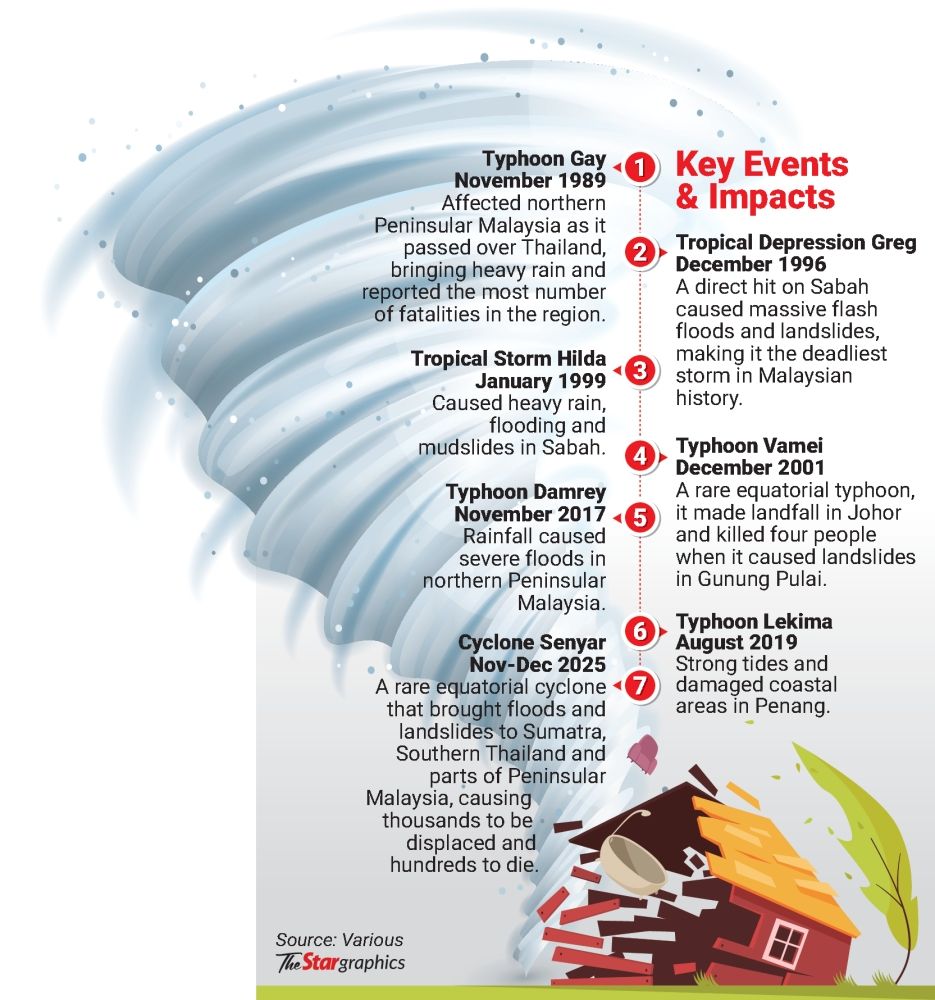
“Under certain circumstances, tropical storms can still potentially exist in the country’s waters, such as Tropical Storm Senyar, which hit the country’s waters near Selangor and Negri Sembilan on Nov 28.
“This tropical storm caused continuous rain and strong winds for areas near the west coast of Peninsular Malaysia.
“Tropical storms usually form in the Pacific Ocean, moving westwards across the Philippines and then turning northeastwards as they approach the Asian mainland. Tropical depressions that form in the South China Sea and the Straits of Malacca are rare but can still occur and affect Malaysia,” he said.
Previously, Malaysia has been hit by direct tropical storms – Dec 26, 1996 (Tropical Storm Greg) in western Sabah and five years later (Typhoon Vamei), which occurred in the south of the peninsula.
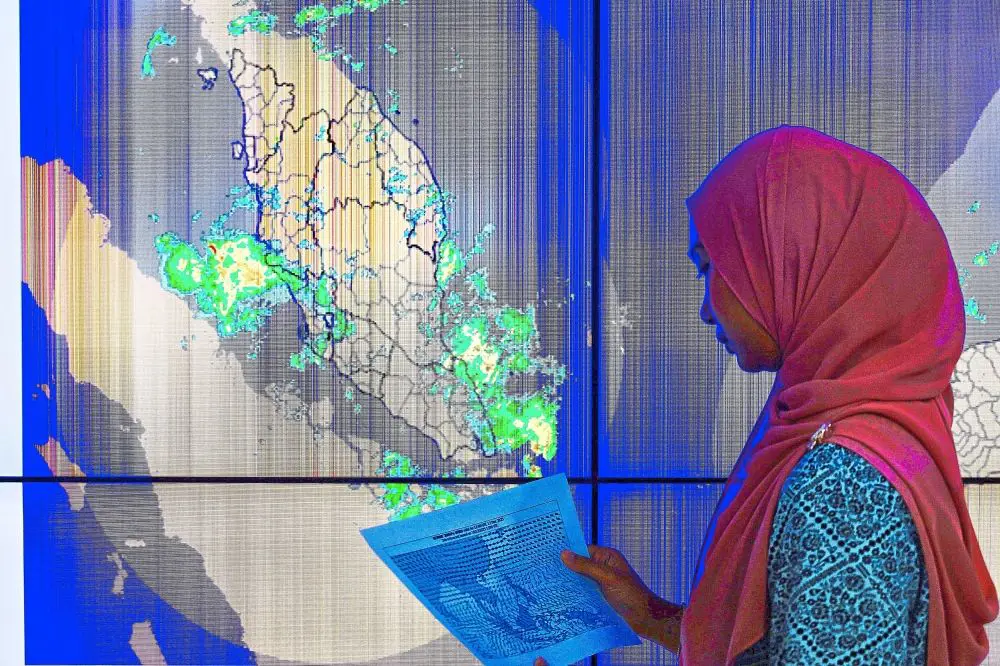
MetMalaysia uses a numerical weather prediction model (NWP-Numerical Prediction Model) in forecasting severe weather and warnings.
This model has taken into account all the parameters (such as wind direction and speed, air pressure, air temperature, air humidity) required to make weather forecasts and warnings in the next seven days.
The presence of continuous episodes of heavy rainfall caused by monsoon trough (an area of low pressure) during the northeast monsoon is also monitored using numerical weather prediction models, which are ultimately interpreted to make forecasts and warnings.
 'CLICK TO ENLARGE'
When asked about the most common storms in Malaysia, Mohd Hisham said thunderstorms occur throughout the year, especially in the evening to the night during the monsoon transition phase.
A thunderstorm is associated with the presence of lightning and thunder accompanied by strong winds and heavy rain from the formation of cumulonimbus clouds (heavy dense clouds).
“If the formation of such clouds are very large, extreme weather such as tornadoes and hail can occur.
“Apart from that, there is also the squall line, a band of thunderstorms that can stretch for hundreds of kilometres. This squall line can bring heavy rain and strong winds to the west coast of the Peninsula, northern Sarawak and western Sabah, especially in the early morning,” he added.
Additionally, Mohd Hisham said if a low-pressure weather system forms near the Malaysian region, it can become a tropical depression and then develop into a tropical storm.
In suitable atmospheric conditions, a tropical storm can become a typhoon, which is the highest category of tropical storm.
“Although the weather conditions in Malaysia are expected to improve over the next few days, there is no specific time frame to predict when the next episode may occur.
“This is because episodes of continuous heavy rain occur if there is a monsoon trough accompanied by moist air entering the country’s region,” he added.
Mohd Hisham said MetMalaysia will continue to monitor the situation and issue continuous heavy rain warnings if there are signs of severe weather.
“The intensity of heavy rain episodes depends on the strength of the monsoon, the presence of low pressure areas and air humidity in our region,” he said.
Meanwhile, the Malaysian Fire and Rescue Department is on standby and ready to respond in the event of extreme weather conditions or disasters.
“Our preparations to face the storm are subjected to the expected severity and the size of the area involved.
“From the aspect of logistical preparations, we are ready and it is closely related to cross-district and state mobilisation,” director-general Datuk Seri Nor Hisham Mohammad said.
More details on forecasts and weather warnings can be obtained via www.met.gov.my, myCuaca mobile application, official social media and the MetMalaysia hotline 1-300-22-1638. - Star
No comments:
Post a Comment
Note: Only a member of this blog may post a comment.