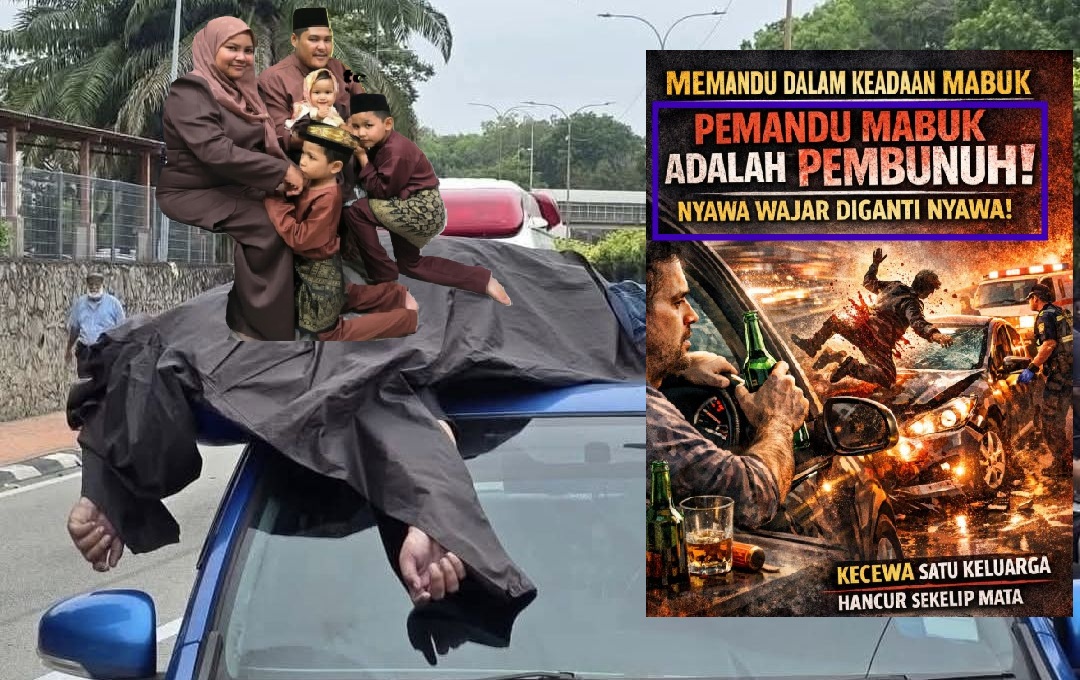
DEVASTATION and the heinous manner in which motorcyclist Amirul Hafiz Omar was rammed into by the car driven by a 20-something youth believed to be both intoxicated and tested positive for drugs has prompted the call for eye-for-an-eye punishment by Opposition lawmakers.
PAS Youth chief Afnan Hamimi Taib Azamudden likened the act of drunk driving as “one harbouring an intention to be a KILLER”.
“A person who kills another person intentionally without cause should be punished with a retaliatory death sentence! Life-for-a-life! This is the basic tenet of Islam,” fumed the Alor Setar MP in a Facebook post.
“Or if the family forgives the murderer, then the latter must pay diyat (fine in Arabic) to the victim’s family and serve a prison sentence. If the family doesn’t forgive, then kill in retaliation. A life-for-a-life. This is the Islamic method whereby fairness rules.”
Machang MP Wan Ahmad Fayhsal Wan Ahmad Kamal who berated failure of the existing law to curb recurrence of road fatalities stemming from drunk driving has pressed the Madani government to study the feasibility of imposing a death sentence on drunk drivers who cause fatal accidents.
What is diyat?
“This is not just a matter of punishment but as a clear message that human life cannot be taken lightly and that any action that endangers others will face the most severe consequences,” asserted the former Bersatu supreme council member who is now an independent MP after being sacked from his party on Feb 13.
“When someone is under the influence of alcohol but still chooses to drive, the law should assume that he has the intent to kill because his actions clearly pose a high risk of taking the lives of others.”
Deliberating on the diyat concept which may not be familiar to non-Muslims, tanyalahustaz.com CEO Amir ‘Izzuddin Muhammad said the former is an obligatory compensation under the Islamic law in the event of unintended death.
“The reality of victims’ families today is delayed insurance claims, civil lawsuits that take years and compensation that is often inadequate,” revealed the founder of Malaysia’s first AI-powered fatwa and Islamic rulings search platform.
“For families who have lost a single breadwinner, the process is excruciating. Diyat offers a clearer, fairer and more revealing framework.”
Expounding on the recent round table discussion (RTD) on the possible implementation of diyat in Malaysia’s road accident cases that was chaired by Religious Affairs Minister Senator Dr Zulkifli Hasan, Amir contended that non-Muslims can also derive benefit from diyat.
“Dr MAZA (Perlis mufti Dr Mohd Asri Zainul Abidin who was present at the RTD as a paper presenter) also emphasised something important in that diyat is not just for Muslims.
“Its benefits encompass all levels of society. It’s not about religion trumping civil law. It is about equipping the justice system with more just and humane instruments.”
While Transport Minister Anthony Loke Siew Fook has urged the police to expedite their investigation with a possible maximum punishment to be imposed on the suspect if he is found guilty, a non-Muslim opposition voice wanted the cops to treat the case as “a murder, not a traffic offence”.
Argued United Rights of Malaysian Party (Urimai) member and vocal lawyer Dr Shamsher Singh Thind:
According to Section 300(d) of the Penal Code, “culpable homicide is murder … if the person committing the act knows that it is so imminently dangerous that it must in all probability cause death, or such bodily injury as is likely to cause death, and commits such act without any excuse …”
You see, that culprit without any excuse, drove his car against the flow of the traffic and killed a rider after ramming his motorcycle.
That culprit must have known that his action is so imminently dangerous that it must in all probability cause death or such bodily injury as is likely to cause death.
So, the police should investigate this case as murder. Of course, whether to charge the culprit with murder or not, that depends on the outcome of the investigation. But investigate as murder!
As it is, the maximum sentence as suggested by Loke is that under Section 44 of the Road Transport Act 1987, offenders can be jailed for 10 to 15 years and fined RM50,000 to RM100,000 while repeat offences carry heavier penalties. – Focus Malaysia
No comments:
Post a Comment
Note: Only a member of this blog may post a comment.