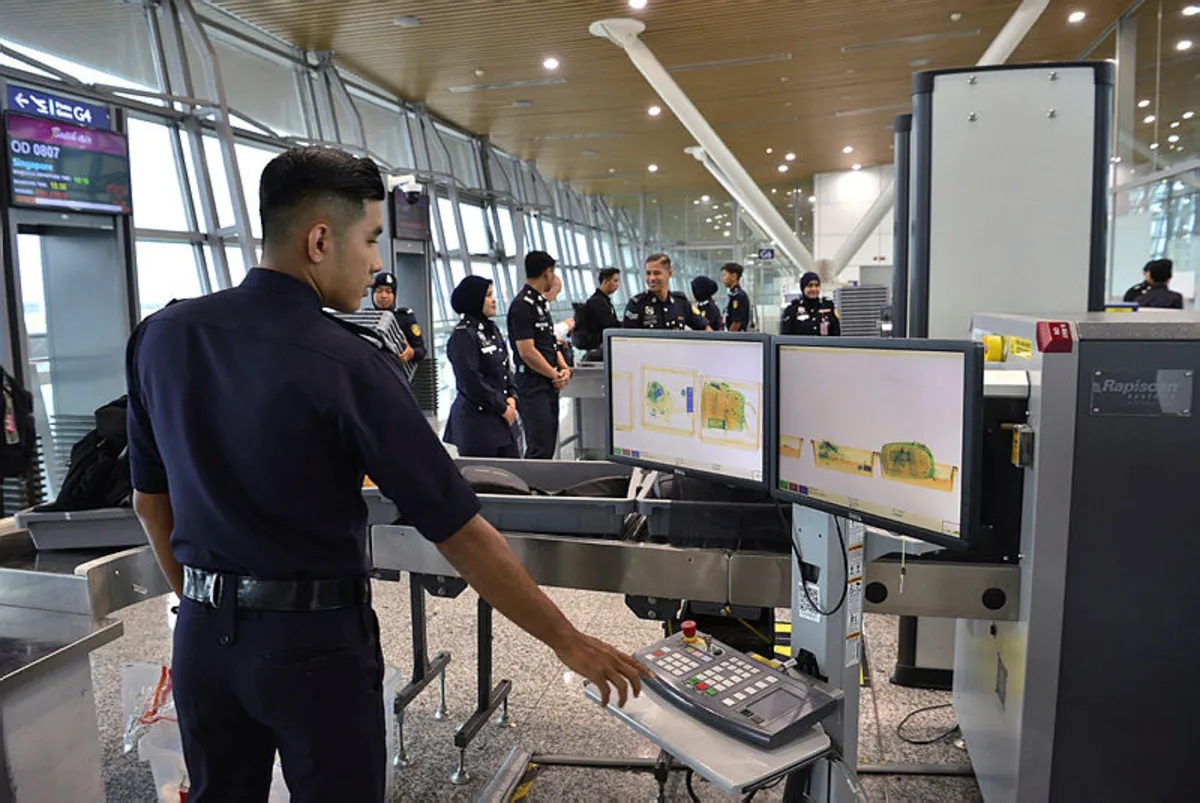
IN the aftermath of the Malaysia Airlines (MAS) pilot arrested at Terminal 3 of the Soekarno-Hatta International Airport in Jakarta on July 28 for attempting to smuggle narcotics by walking through the airport’s special lane reserved for cabin crew, numerous queries abound pertaining to border security on the Malaysian side.
This audacious attempt was followed by news of a 22-year-old Malaysian man that had been arrested after authorities allegedly found nearly 1kg of methamphetamine and more than 1,000 ecstasy pills concealed under a corset he was wearing at an airport in Surabaya, Indonesia.
Indonesian news portal Jakarta Globe reported that the suspect was nabbed at Juando International Airport’s Terminal 2 after arriving on a Batik Air flight from Kuala Lumpur on Monday (Aug 3).
The pertinent question many netizens are posing is how did these drug mules slip through Malaysian customs?
This was when Threader @iamhamsyy claimed that it wasn’t at all surprising that these peddlers of death had an easy passage through Malaysian borders.
It was her observation that all too often Malaysian Customs officials were too busy minding their mobile phone screens or having a chinwag rather than keeping a watchful eye on the comings and goings of travellers.
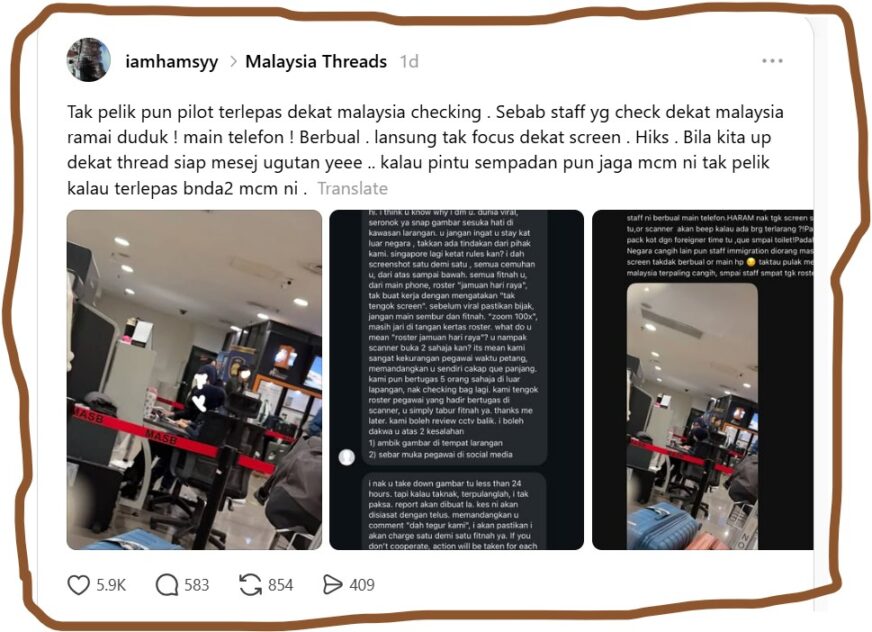
She also revealed that when such observations are uploaded on social media, she is faced with threats and unpleasant messages from anonymous cybertroopers to mind her postings.


The less-than-glowing report card on local custom officials’ alertness has generated 5.9K likes, 583 comments, 854 re-posts and 409 shares at time of writing with plenty of concerned citizens questioning the authorities’ effectiveness and efficiency in spotting drug traffickers.
Many shared what they perceived as unethical and unprofessional conduct from customs and/or immigration personnel tasked with keeping the Malaysian borders safe.
Tales of civil servants with lackadaisical attitudes at checkpoints were aplenty with Malaysians shaking their heads in disbelief at the complete lack of care that these officials have in performing their duties.
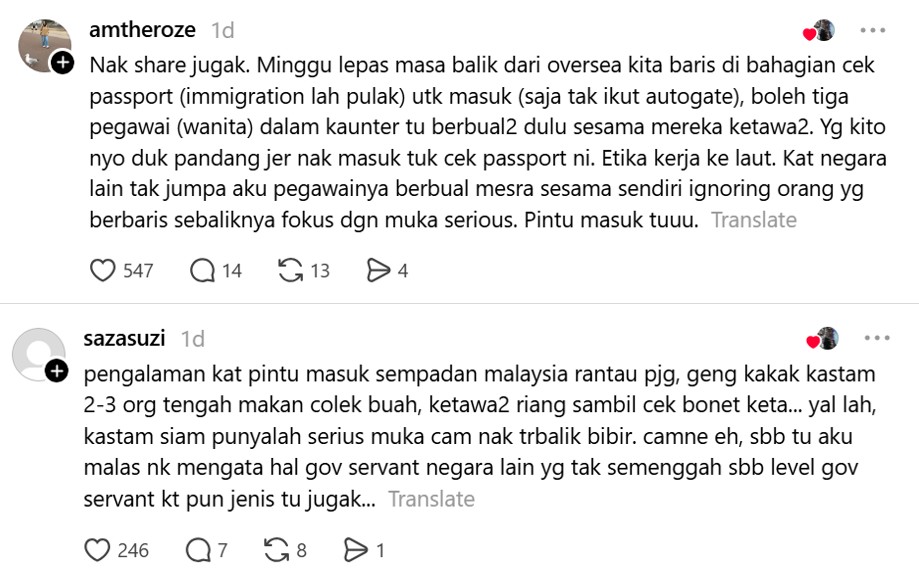
It was also noted that Malaysian customs and immigrations officials paled in comparison to their counterparts abroad who would be completely focused when screening passengers.
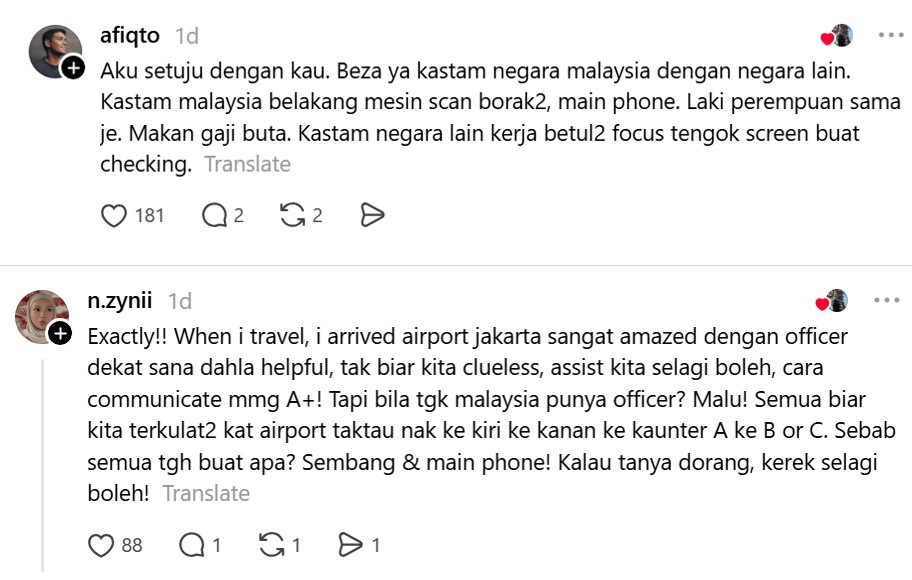
This poor work attitude among the civil service was further underlined when this poster sought to highlight the issue via the Sistem Pengurusan Aduan Awam (SISPAA). All she got for her trouble was requests to fill in numerous forms and that the matter had been “resolved”.

Editor’s Note: SISPAA is the Public Complaints Management System that serves as the official platform for citizens to submit feedback regarding various government ministries and agencies.
The unsatisfactory state of affairs highlights what many Malaysians seem to think about the organisations entrusted with our border security – not good enough.
However, one Threads user decided to give the men in blue the benefit of the doubt. It was noted by former radio announcer @jakeabdullah that arrivals would face tougher screening than departures.
The former would be scrutinised for materials that could endanger the safety of the plane and its passengers while the latter are eyeballed for potential contraband.
It was the opinion of the former Astro Malaysia CEO that “what leave’s the country is somebody else’s problem”, hence the drug mule pilot did not beat the system, he merely saw the opportunity and took advantage of it.
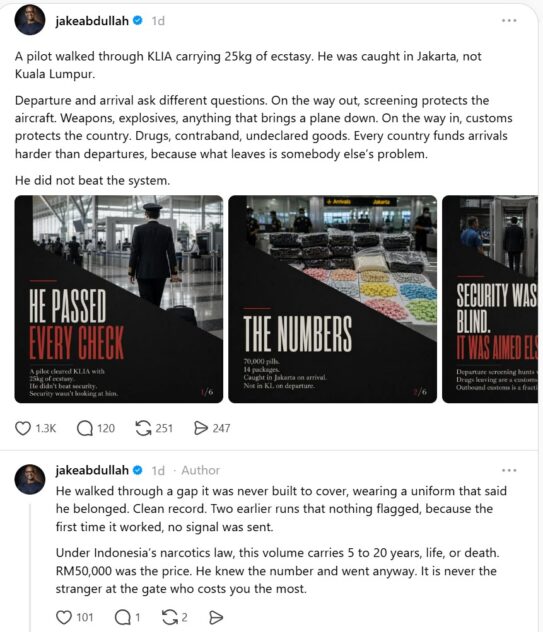
The broadcast media expert concluded that the system was not at fault as it was not designed to detect such drug mules leaving the country.
Both arguments do make perfect sense.
On the one hand, @iamhamsyy is right in flagging Malaysian border security personnel’s unprofessional work practices.
Many citizens can vouch that Malaysian customs and immigration officials are not the best at executing their tasks.
Quite simply, this is unacceptable and needs to change. But as shown by this poster, even when highlighted in a public complaint via SISPAA, the issue is given short shrift by those in charge.
On the other, it is also perfect feasible that the enforcement officials on the Malaysian border are indeed focused on other matters pertaining to aircraft safety and terrorist threats.
Yes, they do not take the eye off the ball but rather are staring at something else which distracts their entire focus (mobile phone).
The public, though, is entitled to ask and get proper answers. – Focus Malaysia
No comments:
Post a Comment
Note: Only a member of this blog may post a comment.