
Former religious affairs minister Mujahid Yusof Rawa has described Tabung Haji’s payment of dividends despite its losses as “haram” money for depositors to receive.
He said Muslims should not celebrate high dividend rates without asking whether the payments were lawful and complied with Islamic principles.
“Some Malays say, what’s wrong with giving high dividends?
“But what is the standard? If that is what your desires dictate, then you are happy receiving money from something that is haram.
“What I mean by haram here is that the law was breached and the accounts were not properly prepared. So, as Muslims, where is our dignity in happily accepting high dividends when we know the dividends were improper and amounted to deception?” he said on the “Kini Jelas” podcast produced by KiniTV.
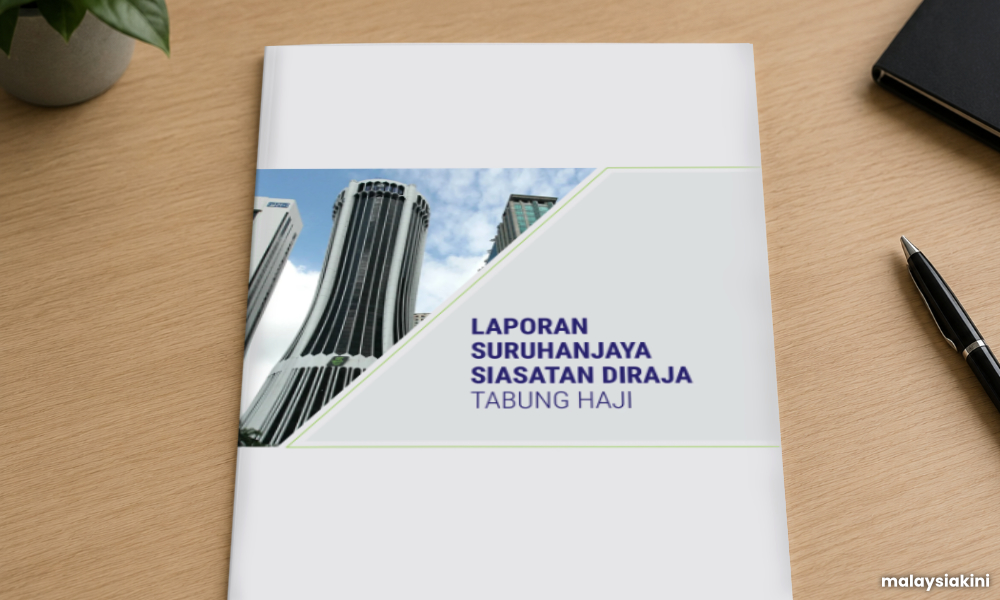
The interview centred on findings in the royal commission of inquiry report on Tabung Haji, made public on July 29, nearly three years after its completion.

Mujahid, who oversaw Tabung Haji as religious affairs minister from 2018 to 2020, was among those who testified before the RCI.
The commission examined Tabung Haji’s management from 2014 to 2020, including the restructuring carried out during Mujahid’s tenure, amid findings of a substantial asset-liability deficit and governance weaknesses.
Mujahid said the findings also raised questions about trust.
“First, this was already against the law. Secondly, you were also deceiving people. You manipulated all the profits, set different threshold values, and changed the threshold three times to make your year-end figures and accounts look good.
“And you did not record the losses.
“So this is a question of a lack of trustworthiness... it means you were not trustworthy in safeguarding Muslims’ money,” he said.
Rafizi questions Tabung Haji’s zakat practices
Separately, former economy minister Rafizi Ramli questioned Tabung Haji’s response to the RCI’s findings on its zakat practices.
Rafizi said Tabung Haji had yet to adequately address the commission’s findings on its 2016 switch from a mudarabah to a wadi’ah yad dhamanah deposit contract, which changed its relationship with depositors and had implications for zakat liability.
Under wadi’ah yad dhamanah, an Islamic deposit arrangement in which the institution guarantees repayment, Tabung Haji effectively became a borrower of depositors’ funds.
“Zakat imposed on depositors became savings zakat at a rate of 2.5 percent.
“The amount of zakat that Tabung Haji would have to pay, if it were paid as savings zakat rather than business zakat as practised by Tabung Haji, would be higher than what was actually paid,” he said.

Rafizi was among the first politicians to publicly raise concerns about Tabung Haji’s finances and governance, warning as early as 2015-2016 about negative reserves, weakening finances, and high payouts. Many of those concerns were later echoed in the RCI’s findings.
Tabung Haji’s defence
Tabung Haji has maintained that its zakat practices were valid and endorsed by the Muzakarah Committee of the National Council for Islamic Religious Affairs Malaysia (MKI).
Its Syariah Advisory Committee determined in September 2020 that zakat payments made for depositors before the introduction of the wakalah concept in 2019 were valid and complied with Islamic law.
Under wakalah, an Islamic agency arrangement, depositors authorise Tabung Haji to act on their behalf, including in paying zakat.
Tabung Haji also said the MKI Muzakarah Committee endorsed its zakat practices in June 2024, with the views subsequently presented to the Conference of Rulers.
Rafizi, however, said Tabung Haji’s explanation did not address the RCI’s findings and could give the impression that its management disagreed with or rejected them.
“I hope the relevant authorities will continue to provide explanations that can clarify the issues raised, particularly concerning the status of the zakat payments.
“Let us not repeat the episode from 10 years ago, when questions raised by ordinary people like me, similar to those I am asking now, were dismissed outright,” said the former Pandan MP.
Contract, zakat irregularities
The RCI found that under the wadi’ah yad dhamanah contract, Tabung Haji effectively became a borrower of depositors’ funds, changing the zakat implications.
“Under the wadi’ah yad dhamanah contract, Tabung Haji’s position became that of a borrower of the deposits held with Tabung Haji.
“Therefore, the zakat payment made by Tabung Haji at that time only represented Tabung Haji’s business activities as an institution, while depositors themselves should have paid savings zakat,” the report read.
It added that savings zakat, calculated at 2.5 percent of total savings, would have been higher than business zakat.
“The business zakat formula results in a lower zakat amount than savings zakat,” it stated.
The commission also found that the contract change was inconsistent with the Tabung Haji Act 1995.
“Under that contract, the zakat paid by Tabung Haji was in fact zakat payable by Tabung Haji itself, and not the zakat payable by depositors.
“However, under the Act, Tabung Haji is expressly not permitted to borrow and is not subject to zakat payments. Nevertheless, depositors considered the zakat paid by Tabung Haji to represent their own zakat payments,” the report read.
The RCI also found irregularities involving bonus payments by Tabung Haji Properties and recommended recovering RM2.19 million paid to its directors. - Mkini
No comments:
Post a Comment
Note: Only a member of this blog may post a comment.