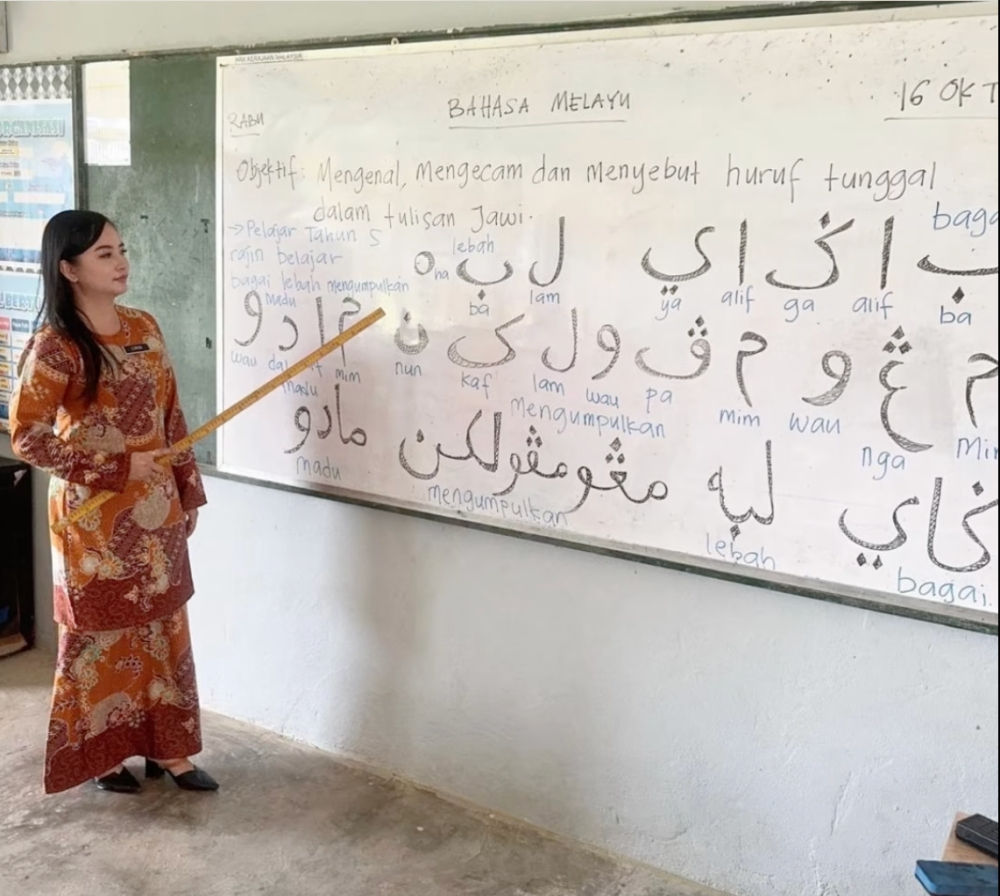
KOTA KINABALU, Aug 15 — For Lorenica Frenila Masundim, teaching Jawi script at a school in Sabah’s interior is more than a lesson in writing, it is a way of bringing students and the wider community closer while fostering understanding across racial, religious and cultural differences.
The 36-year-old teacher at Sekolah Kebangsaan Bawang in Beluran sees Jawi lessons as an opportunity to broaden students’ understanding of the national language’s heritage, particularly among those who initially viewed the script as foreign and linked it exclusively to Islam.
Lorenica said she found great fulfilment in seeing non-Muslim students who were once unfamiliar with Jawi gradually learn to read and understand their function as part of the Malay writing system.
“There were students who used to say Jawi was too difficult, but after using the transliteration technique in the application I created, they were able to read it in a short time. As a teacher, seeing their understanding of Jawi change gives me a satisfaction that is hard to describe,” she told Bernama.
Her Rungus background and Christian faith have never been an obstacle for Lorenica in learning about Jawi, with her role as a Bahasa Melayu teacher encouraging her to understand the script and its place in the national language.
“Just like the Malay language, I have never seen Jawi as belonging to any particular race or religion. To me, it is a national treasure that all Malaysians should learn and preserve,” she said.
Lorenica was first introduced to the Jawi script in 2009 when she took the Basic Introduction to Jawi Writing course for one semester at the Institute of Teacher Education, Gaya Campus in Kota Kinabalu.
Over the next 15 years, she continued to build her knowledge of Jawi before getting the opportunity to teach the script in 2024 and further develop her teaching approach through PhD research under the Ministry of Education’s Hadiah Latihan Persekutuan (HLP) sponsorship.
To help students master Jawi more easily, she developed the PANtaS baCA Jawi (PASCA-ج) application, combining transliteration techniques, interactive exercises and self-directed learning as part of her PhD research.
Lorenica said learning the language or writing systems of other communities not only broadened knowledge but also fostered respect, empathy and mutual appreciation, while helping to overcome prejudice stemming from a lack of understanding.
“Education is a bridge that brings us together despite our differences, and I believe cross-cultural learning can strengthen national unity, especially through Jawi, which is one of the writing systems used for our national languag,” she said.
Lorenica’s dedication to encouraging wider appreciation of the Jawi script has earned her several accolades, including the Tokoh Ibnu Uraiqith Maulidur Rasul 2024, IMTIYAZ MURABBI Award: Jawi Cross-Cultural Inspiration Teacher 2025 and Sabah Education Excellence Award 2025.
However, she said the Dewan Bahasa dan Pustaka Ikon Wibawa Jawi 2024 award held a special place in her heart, coming after a 12-second video showcasing her efforts to teach Jawi went viral on social media.
“I received this award when I was just starting to teach Jawi. At that time, I had not contributed much, apart from a 12-second video that went viral, but I took the award as a trust and responsibility, and it motivated me to keep going and achieve what I have today,” she said.
In conjunction with this year’s National Day and Malaysia Day (HKHM) celebrations, Lorenica said harmony in a plural society was about being able to live together despite differences in identity, with understanding and mutual respect.
“Sabah is a good example of how communities of different races and religions can live together in mutual respect. As an educator, I believe unity begins in the classroom, where students learn to accept, understand and respect each other’s cultures.
“That is the true spirit of harmony in diversity,” she said. — Bernama
No comments:
Post a Comment
Note: Only a member of this blog may post a comment.