
When Sabak Bernam MP Kalam Salan switched from Malay to Javanese during his parliamentary speech on the transboundary haze crisis, he had one audience in mind - Indonesian President Prabowo Subianto.
His message was straightforward: Indonesia should act urgently to contain forest and peatland fires, while Asean should strengthen regional cooperation to prevent the haze from recurring.
He did not expect his remarks to attract widespread attention, surprise, and admiration from both conventional media and social media users.
For the Bersatu lawmaker, however, speaking Javanese came naturally, even if he readily admits that his grasp of the language is far from perfect.
"My father came from Indonesia. I am a second-generation descendant of Javanese ancestry," he told Malaysiakini when contacted on Thursday.

Kalam said he noticed that some Indonesians had praised his Javanese, including his pronunciation, although he was quick to point out that he was not proficient in the language's more refined register.
"I would like to apologise to Indonesians because the Javanese I used was not the refined or polite form of the language.
"Normally, when speaking to someone older or of higher status, we should use the more respectful form of Javanese," he explained.
The distinction matters in Javanese culture, where people traditionally use different language registers depending on the relationship, age, and social standing of the person being addressed.
Kalam said older generations in Sabak Bernam could still speak refined Javanese, but he had grown up using a more familiar, everyday form of the language.
"I simply used the Javanese I understood so that I would not convey the wrong meaning and my message would get across.
"If I tried to use refined Javanese but got it wrong, that could also create problems," he said.
Warmer reception amid online tensions
The positive reactions to Kalam's speech also contrasted with the recent war of words between Malaysians and Indonesians, which escalated into calls to boycott Indonesian products.
The dispute began after Indonesia won the Fifa Asean Cup 2026, when Indonesian men's personal care brand Kahf published a Threads post portraying Indonesia as being on a "different level" from its regional neighbours.
The post triggered backlash among Malaysians and calls to boycott Kahf and other Indonesian brands. Kahf subsequently removed the post and apologised.

Against this backdrop, Kalam's Javanese appeal appeared to strike a different chord.
Indonesians on social media thanked the Sabak Bernam MP for his message to Prabowo, while others praised his intervention amid mounting protests in the Republic.
The reactions suggested that at least some Indonesians shared Kalam's frustration over the recurring haze, offering a moment of common ground amid the recent cross-border exchanges.
A connection spanning generations
Kalam's linguistic connection to Indonesia reflects his constituency's history, where communities of Javanese descent have maintained cultural and family ties with the republic for generations.
He estimated that about 70 percent of Sabak Bernam's population is of Javanese ancestry, alongside communities descended from Banjar migrants from Kalimantan and Kampar migrants from Sumatra.
"Before the arrival of the colonial powers, we were all part of the same Nusantara family," he added.
For Kalam, those ties are not merely historical.
He still has relatives in Indonesia and remains in contact with them, while his fondness for the country has also taken him back as a visitor.
"Just two months ago, I visited Probolinggo, Mount Bromo and Kota Batu. Indonesia is indeed a very interesting place to visit.
"So why would I suddenly want to mock a place that I myself enjoy visiting? That is simply not true," he said.

Indonesian media coverage, meanwhile, characterised Kalam’s parliamentary speech as a swipe at Jakarta over its handling of recurring forest and peatland fires.
Some outlets described his remarks as a “sindiran”, or veiled criticism, directed at Prabowo.
Kalam, however, rejected suggestions that he had intended to ridicule Indonesia or its leader.
"It is absolutely untrue if anyone claims that I was trying to mock or take a swipe at people there.
"Going viral in Indonesia was never my intention. It is just that we now live in the age of social media," he said.
He maintained that he spoke in accordance with the Dewan Rakyat’s Standing Orders, noting that deputy speaker Ramli Nor had given him additional speaking time during Wednesday's debate.

"If my words had been offensive or hurtful, the speaker would certainly have asked me to withdraw them.
"But instead, he gave me an additional 10 minutes because the haze issue is everyone's responsibility," he said.
When haze hits home
Beyond the attention from Indonesia, Kalam said he raised the issue because of the haze's impact on his constituents, particularly schoolchildren.
Although schools in Sabak Bernam had not been ordered to close, the retired teacher said attendance had fallen as parents became reluctant to send their children to school.
"Parents were reluctant to send their children to school because of the haze, but they did not have access to home-based teaching and learning (PdPR), so the students lost out.
"In other districts, PdPR was implemented because schools were completely closed.
"But in Sabak Bernam, those who did not attend school simply missed their lessons and fell behind," he said.
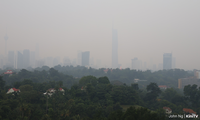
That situation, he explained, was what compelled him to speak in Parliament.
During Wednesday's Supply Bill 2027 debate, Kalam called on Prabowo to take urgent action against forest and peatland fires in Indonesia, which have contributed to recurring transboundary haze affecting Malaysia and Singapore.
He also questioned remarks suggesting that Indonesia's forests had supplied oxygen to Malaysia, sarcastically asking whether Malaysia's own trees were made of plastic.
Nevertheless, Kalam insisted his message was not intended to place blame solely on Indonesia.
"This is not about putting pressure on Indonesia. We regard what is happening in Indonesia as a disaster that could be prevented through good cooperation at the Asean level, chaired by the Philippines," he said.

He added that Indonesia should seek assistance from neighbouring countries if necessary, while enforcement should be directed at anyone responsible for illegal forest burning, regardless of nationality or corporate links.
"Arrest them all if there is evidence," he stressed.
For Kalam, the attention his speech received was ultimately secondary to the message he hoped would reach Indonesians - a call for neighbours with shared roots to work together to protect their environment.
It was also a message he hoped would not be mistaken for hostility towards a country he continues to regard as part of his own identity. - Mkini
No comments:
Post a Comment
Note: Only a member of this blog may post a comment.