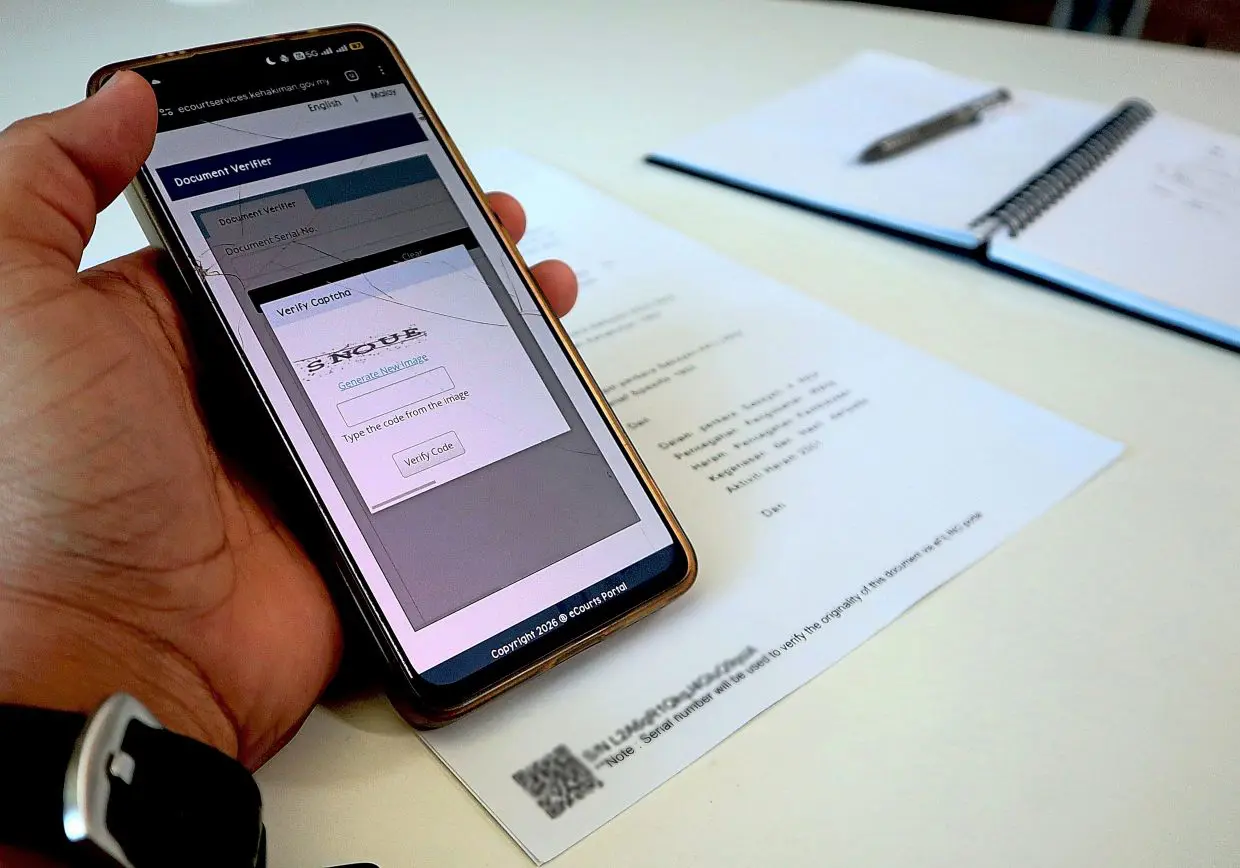
PETALING JAYA: As scammers become increasingly sophisticated, the courts are stepping up efforts to help the public distinguish genuine legal documents from forged ones through a QR code verification system.
The move comes amid growing concerns over criminal syndicates using fake court documents bearing convincing court seals, official logos and forged signatures of judges to intimidate victims into paying large sums of money.
With many people ignoring unsolicited phone calls, scammers are now sending fraudulent court papers via registered post and messaging apps, prompting alarmed recipients to contact fake numbers printed on the documents.
The Office of the Chief Registrar of the Federal Court of Malaysia (PKPMP) said all court documents generated through the e-Kehakiman system now carry a QR code that allows users to instantly verify their authenticity online.
According to checks by The Star on the official portal of the Chief Registrar’s Office, the initiative is expected to strengthen public confidence, curb document fraud and make it easier for both the public and enforcement officers to confirm the legitimacy of court documents.
“The Chief Judge, Registrar and officers of the Subordinate Courts and High Courts often receive enquiries from the public regarding court documents such as summonses, warrants and court orders, even though these documents have never been presented to the court for verification.
“This situation arises because forged court documents have been circulated. The public should note that only original documents issued by the court are valid,” said a post on the portal.
To address this issue, the post said the PKPMP has introduced an initiative that allows the public to verify the authenticity of court documents by simply scanning a QR code using an electronic device, without having to visit a court counter.
“This initiative also helps court officers, particularly bailiffs and enforcement officers, carry out their duties more efficiently.
“For example, during the execution of court orders such as seizure and sale orders, enforcement officers can immediately prove the authenticity of a document by allowing the public to scan the QR code instead of relying solely on the court’s official seal.
“Besides assisting the public in determining whether a court document is genuine, the initiative is also one of the PKPMP’s efforts to improve the court service delivery system and enhance access to justice for all.
“All court documents generated and filed through the e-Kehakiman system will contain a QR code. Users only need to scan the QR code using any electronic device with a QR scanner.
“The scan will direct users to https://esfs.kehakiman.gov.my where they can follow the instructions to verify the authenticity of the document,” said the portal.
The QR code verification system offers several advantages. It directs users to the official court website for document verification, is quick and convenient to use on any electronic device with a QR scanner and is provided free of charge with no fees imposed on users.
Users can verify both hard copy and soft copy court documents in four simple steps:
(a) obtain the court document;
(b) scan the QR code using a QR-enabled electronic device;
(c) complete the Captcha verification, and;
(d) the system will display the document, allowing users to compare it with the hard copy or soft copy in their possession. - Star
No comments:
Post a Comment
Note: Only a member of this blog may post a comment.