


ISIS may have gained less traction in Malaysia than in the Arab world or Western Europe, but Malaysia still has over six times the rate of Muslim citizens leaving for battle in the Middle East as Indonesia has.
Edward Delman, The Atlantic
Indonesia has certainly experienced its share of terrorism and jihadist movements since declaring independence from the Netherlands in 1945. After proclaiming an “Islamic state” in 1949, the organization Darul Islam denounced the Indonesian state as apostate and staged a series of armed rebellions against it in the 1950s and early 1960s, before moving underground. The militant Islamist movement then split into numerous groups, from Laskar Jihad, which led an anti-Christian campaign across Indonesia, to Jemaah Islamiyah, which executed the2002 Bali bombings. Indonesian jihadists have not solely focused on local targets; many went to Afghanistan during the Soviet invasion as mujahideen, though most only received training rather than engaging directly in the fighting there.
Moreover, there is clearly a base of support for ISIS in Indonesia. A September 2014 report by the Jakarta-based Institute for Policy Analysis of Conflict (IPAC) details the Islamic State’s aggressive recruitment and propaganda efforts in the country, as well as mass professions of allegiance to the group. (As the report and a more recent one from USAID caution, these public declarations—in which roughly 1,000 to 2,000 people have taken part—are not necessarily accurate measures of active support for ISIS.) IPAC notes in another reportthat “the conflict in Syria has captured the imagination of Indonesian extremists in a way no foreign war has before,” for reasons ranging from the suffering of Sunni Muslims there, to the prospect of restoring an Islamic caliphate, to the fact that “Syria is directly linked to predictions in Islamic eschatology that the final battle at the end of time will take place in Sham, the region sometimes called Greater Syria or the Levant, encompassing Syria, Jordan, Lebanon, Palestine and Israel.”
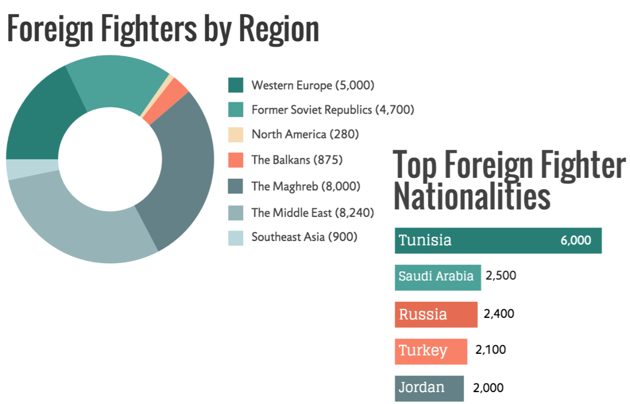
Whatever the extent of ISIS’s support in Indonesia, that support has not translated into Indonesians heeding the call of jihad and heading to the Middle East in large numbers. A recent Soufan Group report on foreign fighters in Iraq and Syria (not necessarily fighting with ISIS) cited an Indonesian-government estimate that 700 of those fighters hailed from Indonesia as of July 2015—a number that the group says is probably an overestimate. In comparison, the official estimate for France is 1,700; for Russia, 2,400; for the United States, 150; and for Tunisia, 6,000. In France, 18 people per million Muslim citizens are thought to be fighting in Syria and Iraq, according to the USAID study. In Tunisia, that number is 280. In Indonesia, it’s just over one.
Why are so few Indonesians traveling to Syria to fight? The statistics in Indonesia do conform to a degree with those of nearby countries. Official estimates indicate that only 100 foreign fighters in Iraq and Syria are arriving from Muslim-majority Malaysia, and that a minuscule 23 are coming from India, whose population includes 177 million Muslims. But explaining the phenomenon as a regional trend glosses over country-specific dynamics. ISIS may have gained less traction in Malaysia than in the Arab world or Western Europe, but Malaysia still has over six times the rate of Muslim citizens leaving for battle in the Middle East as Indonesia has. Polls also suggest that a higher percentage of Malaysians than Indonesians are sympathetic to ISIS and the tactic of suicide bombings, though in both cases that support is confined to a small minority of the population. In India, much of Muslim civil society has repudiated ISIS and other Islamic terrorist organizations, with nearly 70,000 clerics signing an anti-ISIS fatwa.
In November, The New York Times pointed to one factor behind the muted response to ISIS in Indonesia: Nahdlatul Ulama (NU), an Islamic organization that claims to have 50 million members. NU preaches an Islam of compassion, inclusivity, and tolerance of other faiths, as opposed to ISIS’s fundamentalist, Wahhabi-inspired theology. “We are directly challenging the idea of ISIS, which wants Islam to be uniform, meaning that if there is any other idea of Islam that is not following their ideas, those people are infidels who must be killed,” Yahya Cholil Staquf, the general secretary to the NU supreme council, told the Times.
Instead, Jones mentioned several other causes: “Indonesia is a country that doesn’t have a repressive government, is not under occupation, it’s politically stable, so there’s no social unrest or conflict, and the Muslims aren’t a persecuted minority. So when you put all of those factors together, it’s not all that surprising that it’s actually only a tiny minority of even the activist population that’s leaving for Syria.”
Indeed, the countries that send the largest numbers of foreign fighters to Syria and Iraq, either in absolute terms or on a per-capita basis, tend to be either politically repressive (Saudi Arabia, 2,500 fighters), politically unstable (Tunisia, 6,000 fighters), discriminatory toward a Muslim minority (Russia, 2,400 fighters), or a combination of the above. As further evidence for her point, Jones cited the tumultuous period immediately following the collapse in 1998 of the authoritarian Suharto government, which had ruled Indonesia for more than three decades. The resulting instability provided “the best recruitment tool radical groups ever had. They’ve never been able to get back to that level of attraction of joining a jihadi movement, because there’s not a local driver” for radicalization in the young democracy, she explained.
Jones added that Indonesia’s freedom of expression creates space within which radical communities can advocate for Islamic law and an Islamic state without feeling the need to resort to violent action in pursuit of those goals. While acknowledging that certain groups have taken advantage of that space, Jones said that “it does keep the numbers of violent extremists” to a “manageable” level.
Meanwhile, according to IPAC, “ISIS has triggered a bigger backlash than ever seen before in the Indonesian Muslim community, suggesting that support will stay limited to a fringe of the radical fringe.” And that backlash isn’t just coming from NU; other mainstream Muslim organizations, including a coalition known as the Brotherhood Forum of the Indonesian Council of Religious Scholars, have rejected ISIS’s ideology. Nor has ISIS received the warmest of welcomes from Indonesia’s jihadist communities. The Islamic State’s brutality and decision to proclaim a caliphate have drawn criticism from jihadist media outlets and radical clerics in the country; “most of the hardline Muslim community have distanced themselves from ISIS or have taken a wait-and-see stance,” IPAC notes, including Majelis Mujahidin Indonesia, which has declared ISIS a “deviant” movement. When asked about the possible impact ofderadicalization programs by the Indonesian government, Jones responded, “I think it’s the good sense of the Muslim majority rather than government programs that are keeping the numbers down.”

No comments:
Post a Comment
Note: Only a member of this blog may post a comment.