


“Oh, good. For a moment there, I thought we were in trouble.”
- Butch Cassidy (Paul Newman), the last line of “Butch Cassidy and the Sundance Kid”.
I really do hope that Parti Bersama Malaysia (Bersama) is on a kamikaze mission.
What does kamikaze mean? In this context, it means having nothing to lose, and I hope Bersama co-leaders Rafizi Ramli and Nik Nazmi Nik Ahmad, and whoever else joins them, embody this spirit instead of merely paying lip service.
I am not one of those hopeful voters who see Bersama as some sort of wind of change. I am one of those angry voters who are sick and tired of how the Madani swamp is destroying the institutions of this country, all done with a reformasi smirk.
Rafizi et al cannot play it safe. They have to slay sacred cows, and this means dealing with the issues facing Malaysia descriptively instead of prescriptively.
Every politician is doing the latter because mainstream politicians love telling us how it could be instead of how it is. The first step is recognising the problem.
Will people buy it?
The former Pandan MP was reported as saying that “Pakatan Harapan could still win 80 to 90 parliamentary seats even in its weakest state, thanks to the support of progressive-minded voters”, whom he estimated at 35 percent to 40 percent of the electorate.
“Bersama was to give this segment of the electorate, as well as young voters, a new option at the ballot box,” he said.

I get that Rafizi is beloved by progressive Malays and non-Malays, but the question remains.
Will his kamikaze mission resonate with the very people who say they want change but have never demonstrated that they are willing to give their votes to anyone except DAP, which is supposed to be the progressive red line of this country?
Furthermore, how is Rafizi, especially in a position of influence, going to counter the religiosity and racism of the Malay establishment under the guise of Malay rights?
How would he balance needed reform and the corruption of entitlement programmes while adhering to an egalitarian framework?
See, people on a kamikaze mission would have no problem pointing out that someone like former Damansara MP Tony Pua is standing up for the Constitution, while his critics have not only no respect for the Constitution but have also gone against the royal institution diktats.

Furthermore, it was Umno which curtailed the powers of the royalty under former prime minister Dr Mahathir Mohamad. It was probably the one utilitarian thing the party did, no doubt for self-serving reasons.
Where does Bersama stand?
I do not care which DAP faction Pua belongs to because I believe that the party has become part of the problem.
What I want to know is where Bersama stands on issues that affect the country, like fidelity to the Constitution.
Rafizi said, “We don’t care if the seats are held by PKR, DAP, Amanah, Bersatu, or Umno - if there is a need for us to fight, we will do so.” What does this mean?
Honestly, nearly every seat has been infected by Madani’s neo-BN-ism. How would this translate when it comes to his belief in multiethnic middle-ground politics?
To this, we should add that when Rafizi criticises PKR, it is welcomed with open arms, but supposing he is critical of the DAP, then what happens?

Data determining where candidates are fielded sounds suspect.
The urban areas, for instance, are rife with political and corporate corruption, which determines a kind of bureaucratic mafia controlled by ruling regimes, which is ultimately destroying this country.
And yet, urban voters, especially non-Malays, are willing to throw in their lot with legacy parties for various reasons.
Do not get me wrong. I will be more than happy if Bersama breaks up the monopoly in urban and semi-urban areas because power and policies flow down from these areas.
If Bersama even becomes a fly in the ointment that powers the gravy train, which is what is destroying the majority community, this would be a welcome change from what we have now.
Indeed, what we are witnessing is that our urban and semi-urban areas, which used to be somewhat progressive enclaves, are slowly succumbing to the religiosity of Madani.
Take the recent alarm raised by Petaling Jaya MP Lee Chean Chung about the guidelines regarding non-Malay houses of worship.

As usual, we are told these guidelines are suspended pending review, but it is the old game being played over and over again.
It might just work
If Bersama walks the progressive talk and the majority community sees leaders who are willing to slay sacred cows for the betterment of all Malaysians, who knows, this may affect the local politics of rural areas.
The majority have never really had an alternative when it comes to mainstream politics. While the non-Malays had to choose the lesser of two evils, the majority, for whatever reasons, were content with the status quo.
Except now, geopolitics is changing everything so fast, and the economic competition brought upon by migrant workers and encroachment into traditional Malay domains is fueling resentment.
Let us not forget that Nik Nazmi understands that appealing to the Malay far-right is not a viable strategy, especially since Perikatan Nasional does that so well.
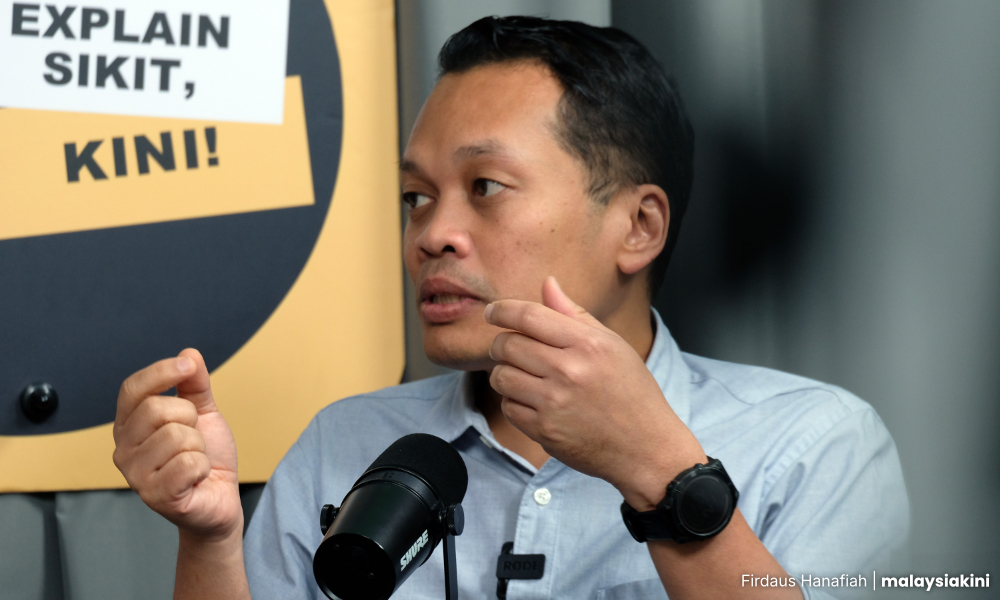
“At the end of the day, we can’t outflank PN in terms of playing the Malay or Islam card, because we know that that is their comparative advantage in a way.”
Nik Nazmi’s words were prophetic when he said this about PKR: “It’s always a challenging balancing act, and I think PKR feels it the most. We get squeezed out in the middle because our constituencies are multiracial.
“For many political parties, they have easy template answers or solutions. But for PKR, we can’t, because, you know, we have people who are very, very liberal on one end and you have people who are quite conservative on the other in our constituency.”
Now we have Bersama, which is supposed to be unabashedly progressive, which means there should be no balancing act.
Same old, same old doesn’t cut it
This is an important point because the mainstream political establishment is going to attack Bersama by trolling them on race and religion issues.
Blaming Umno or even the prime minister just doesn’t cut it. We do not need a collection of political types coming out and spewing bromides.
What is needed are leaders who are unafraid to speak out against those seeking to inflame communal tensions.
We need leaders who would understand that these so-called fringe voices are merely parroting mainstream policies of racial and religious superiority.
Keep in mind that policy decisions and implementation are based on race and religion, and it remains to be seen if Bersama will face these issues head-on or will quibble, which means it is not really on a kamikaze mission.
Rafizi seems to understand this. In 2017, he said that in order to save Malaysia, the Malays must be won over.
“We are partly responsible for the predicament we are in because we have taken the approach that they don’t understand. The more we talk down to them, the more they don’t trust us.
“We just have to convince the people enough that we can do a better job. We must honestly accept failings and offer solutions that may be controversial.”
If Bersama is really on a kamikaze mission, it would offer controversial solutions, which may even be controversial to the non-Malays.
Rational Malaysians have heard feel-good rhetoric, but action is what saves a country. - Mkini
S THAYAPARAN is commander (Rtd) of the Royal Malaysian Navy. Fīat jūstitia ruat cælum - “Let justice be done though the heavens fall.”
The views expressed here are those of the author/contributor and do not necessarily represent the views of MMKtT.

No comments:
Post a Comment
Note: Only a member of this blog may post a comment.