


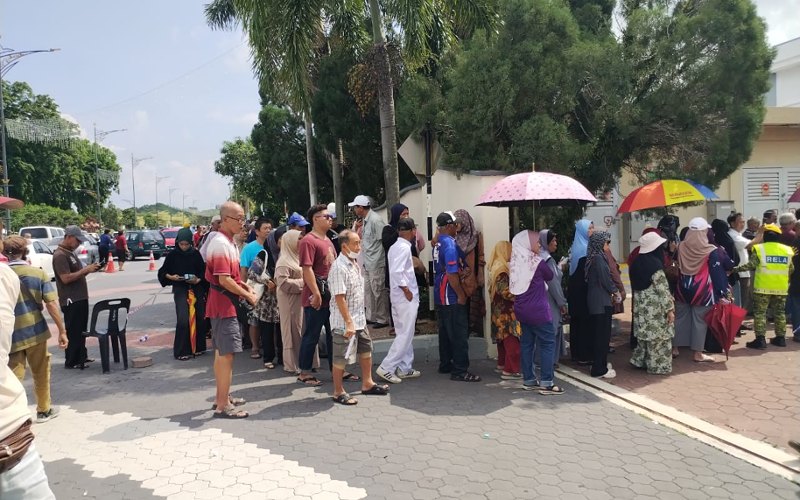
WHAT WAS meant to be a welfare initiative to help vulnerable Johoreans has instead triggered outrage after elderly recipients were allegedly forced to queue for hours under the blazing sun just to collect financial assistance.
That is the summary for the Bantuan Kasih Johor (BKJ) 2026, which was making headlines, for all the wrong reason.
The issue is best outlined by political commentator Jason Yew, who condemned the handling of the BKJ distribution exercise.
He further questioned why senior citizens were being subjected to such treatment in an era where direct bank transfers are commonplace.
“Kalau boleh masuk akaun, kenapa perlu jemur orang tua?” he wrote on X, referring to reports and images showing elderly recipients making a very long beeline by the roadside.
According to Yew, some senior citizens were reportedly unable to endure the heat and fainted while waiting for their turn to receive assistance, a deeply disturbing image for a programme carrying the word “kasih,” or compassion, in its name.
Malaysia has long implemented direct cash transfer mechanisms such as Sumbangan Tunai Rahmah (STR), where payments are credited straight into recipients’ bank accounts without forcing them to stand for hours in crowded public spaces.
Yet in Johor, a state often promoted as progressive, efficient and economically advanced, elderly citizens were allegedly still being subjected to outdated and physically exhausting collection methods.
“This is UMNO’s behavior from way back, from Najib’s time already,” said netizen @hjhairie in the comment section, adding that the RM200 was not worth it.

But some netizens defended the effort such as @faiz92_max who said people that don’t want to line up don’t have to come and take the money.

Then there was @JojaSuhadi sharing about his 80-year-old father who had no issue lining up. According to him, there is a fast lane for the elderly and the workers were sufficient.

Also @Geneka57 pointed out the hypocrisy of DAP, which at times, gives aid in cash too.
Chairman of Pertubuhan Kebajikan Islah Pontian Johor Darul Ta’zim, Salahuddin Jantan, said that although the BKJ initiative is seen as a positive effort by the state government to assist the people, the physical distribution method carried out in Pontian was poorly organised and burdensome for recipients.
According to him, many aid recipients were understood to have begun queuing as early as after dawn prayers to receive the assistance.
The long queue was said to have stretched from the MARA Building, passing the Public Works Department (JKR) building, continuing towards the Pontian Municipal Council building, before ending at Dewan Jubli Intan located near the Straits of Malacca.
While opinions remain divided over the fairness of the criticism, the episode has undeniably sparked a broader conversation about how welfare assistance should be managed in the digital age.
Few dispute the value of helping those in need, but many now argue that the process deserves equal scrutiny.
As Johor continues to position itself as a modern and forward-looking state, the expectation is increasingly clear. Aid should not only reach the people, but reach them with efficiency, dignity and genuine care. — Focus Malaysia

No comments:
Post a Comment
Note: Only a member of this blog may post a comment.