


When Prime Minister Anwar Ibrahim delivered his “Penghargaan Untuk Rakyat” speech on July 23, he painted a confident picture of Malaysia’s economic trajectory.
Growth stood at 4.4 percent for the first quarter of 2025, with expectations of 4.5 percent in the second. The ringgit had strengthened against the US dollar, climbing to RM4.23/US$.
Malaysia rose by 11 spots to 23rd place in the World Competitiveness Index, and total approved investments reached a record RM384 billion last year.
However, beyond the headline figures lies a more complex and fragile reality. Analysts have pointed out that Q1 growth underperformed market expectations.
Exports remain uneven. Domestic consumption is cooling, and Bank Negara’s recent rate cut reflects the underlying weakness that persists despite upbeat official messaging.
If this is truly a period of recovery, it should have been an opportunity for consolidation and structural investment. Instead, we were given a politically timed spending spree, RM2 billion for a one-off RM100 handout to every adult Malaysian, RM500 million to freeze toll hikes, and a surprise public holiday on Sept 15.
Together, these short-term measures reflect a government more focused on applause than economic strategy.

Populism at the expense of prudence
The national debt is already nearing the statutory ceiling of 65 percent of GDP. The deficit target of 3.8 percent for 2025 is now under pressure. Yet the government continues to introduce unbudgeted giveaways while delaying long-promised reforms such as targeted fuel subsidies.
These decisions contradict the very narrative of economic strength the prime minister wishes to project.
Even worse, they come just as Malaysians are bracing for a new wave of cost pressures. The impact of the sales and service tax (SST) expansion to a broader range of essential goods and services is expected to kick in within the coming months.
For many Malaysians, this means that any short-term relief from government aid will likely be wiped out by higher living costs almost immediately.
Businesses are already warning of cascading effects on prices, particularly in transport, food, and healthcare. For families already on tight budgets, a RM100 handout merely delays the pain.
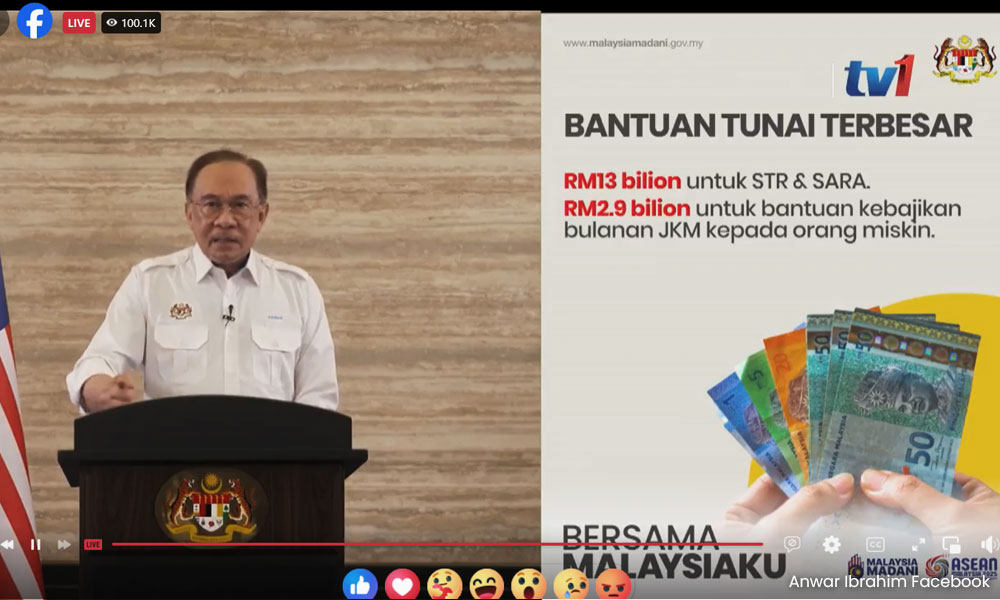
This makes the government’s recent “relief” announcements ring hollow. What we are witnessing is not economic empowerment, but a temporary “sugar high” offered just before the cost of living rises again.
When growth doesn’t translate into reform
If the government is serious about fiscal health and long-term resilience, then the focus must shift from consumption-based measures to structural investments.
The RM2.5 billion spent on short-term relief could have been used to enhance access to education and healthcare, digitalise SMEs, or build more robust cold-chain systems for food security. These are not glamorous announcements, but they are necessary for real progress.
Equally concerning is the government’s mixed messaging on fuel subsidy reform. On one hand, it continues to express a commitment to rationalising the RON95 subsidy without impacting the livelihoods of the majority of Malaysians, yet on the other, it has not provided any implementation details.
The promise of a targeted mechanism “by end-September” is not new, as this goalpost has been shifted multiple times, creating ongoing uncertainty for businesses trying to forecast fuel-related costs. At the same time, concerns raised about potential leakages, technical readiness and data integrity remain largely unaddressed.
The sudden declaration of Sept 15 as a public holiday may seem like a harmless gesture of goodwill, but such unplanned disruptions carry significant economic costs.
Estimates from past experiences suggest that a single day of lost productivity can cost the country up to RM3 billion, particularly in sectors like manufacturing, logistics, and export-oriented industries that rely on tight schedules and international commitments.
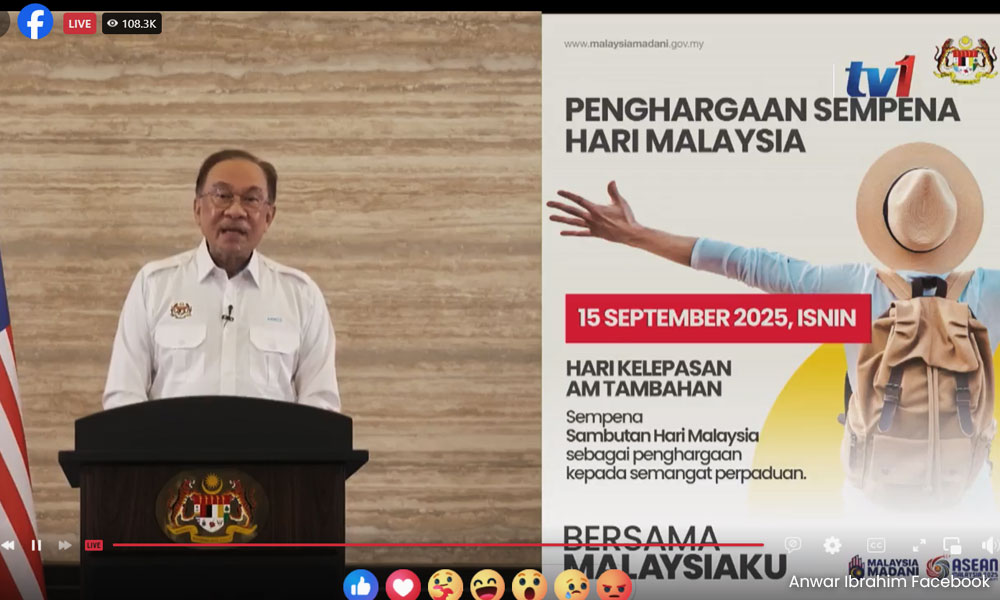
For small businesses and daily wage earners, the cost is even more immediate, such as lost income, disrupted operations, and overtime liabilities.
All this is occurring at a time when Malaysia should be thinking about how to future-proof the economy. Global markets are volatile, geopolitical risks are rising, and trade competition is intensifying.
Our policy responses, however, suggest that we are still stuck in a cycle of reactive decision-making, rather than strategic forward-planning.
Smarter alternative to blanket handouts
There is still room to do better. One step in the right direction would be to do away with the RM100 handout for higher-income Malaysians altogether, or to redirect it to targeted poverty alleviation funds, or improve public access to education and healthcare, without having to wait until the end of the year.
Such an initiative would be cost-free, civic-minded, and a signal that the government is willing to move away from one-size-fits-all populism.
This is not about being stingy with the rakyat. It is about respecting public funds and focusing on impact.
If even 10 percent of eligible recipients choose to opt out, hundreds of millions can be channelled into areas that deliver tangible benefits: education access, targeted nutrition and health screenings, reducing waiting times for medical procedures, and skills training.
This would not only stretch the value of government spending but also restore a sense of fairness and purpose in public policy.
Real test of leadership
The government’s economic narrative is becoming increasingly difficult to reconcile with its policy decisions. A government that claims to be reformist must do more than repackage cash handouts and giveaways.
Real reform is not about redistributing temporary cash. It’s about redesigning systems to improve resilience and upward mobility.
The upcoming months will test the credibility of the administration as Malaysians will begin to feel the full effects of SST expansion, rising service fees, and inflation on essential goods.
If these are not accompanied by stronger safety nets, efficient targeting, and serious structural reform, then no amount of short-term cash aid will soften the blow.
Malaysia cannot afford another cycle of fiscal evasion. Every time we delay tough decisions, the cost of catching up becomes higher.
It is not enough to tell Malaysians the economy is doing well while quietly shifting the burden onto households. It is not enough to frame populist spending as generosity when the long-term consequences will be borne by the same people who are supposed to be helped today.
Strong growth must be matched with stronger discipline. Relief must come with reform. And leadership must mean more than applause. This is what Malaysians deserve and what the economy needs to stay truly resilient. - Mkini
WOON KING CHAI is the director of Insap, a think tank established by MCA dedicated to developing sound public policy solutions and strategic insights for the nation’s future.
The views expressed here are those of the author/contributor and do not necessarily represent the views of MMKtT.

No comments:
Post a Comment
Note: Only a member of this blog may post a comment.