`


THERE IS NO GOD EXCEPT ALLAH
read:
MALAYSIA Tanah Tumpah Darahku

LOVE MALAYSIA!!!


16 SEPTEMBER 2026

Friday, October 30, 2026

RM3,000 is the median but what should your next job pay?


THE Department of Statistics Malaysia’s (DOSM) Employee Wages Statistics (Formal Sector), Second Quarter 2026, reported a median monthly wage of RM3,000 for Malaysian citizens in formal employment in June 2026, representing a 4.8% increase year-on-year.

The national median is a useful reference point, but it cannot tell a jobseeker what to expect from their next offer or an employer what constitutes a competitive salary for a particular role.

Those decisions require a closer look at the job, the experience required and the location. Jobstreet by SEEK’s platform data provides a complementary view of advertised salaries.

Among Malaysian job advertisements disclosing a monthly salary in ringgit, the median advertised minimum remained unchanged at RM3,000 in both Q2 2025 and Q2 2026.

These figures measure the minimum monthly salaries advertised in vacancies posted between April and June in each year. DOSM, meanwhile, measures wages received by formal employees, including bonuses, commissions and allowances.

The advertised figures also reflect the changing mix of vacancies. Retail and hospitality roles accounted for a larger share of salary-disclosing advertisements in Q2 2026, influencing the overall median.

The two datasets should therefore not be compared directly. Looking at individual job categories provides a more specific benchmark.

Banking and Financial Services recorded a median advertised minimum of RM4,000 in Q2 2026, up 14.3% from RM3,500 in Q2 2025.

Information and Communication Technology (ICT) also recorded an increase, rising 11.1% from RM4,500 to RM5,000 over the same period.

For candidates and employers, these differences reinforce the importance of benchmarking salaries against comparable roles, taking into account seniority, responsibilities and specialist skills.

Geography is another important consideration. DOSM’s latest findings show significant differences in wages across states, with Kuala Lumpur recording the highest median monthly wage at RM4,245 in June 2026.

pay
(Image: HRM Asia)

Sabah, at RM2,045, was among the states with the lowest medians, alongside Kelantan and Perlis.

Jobstreet’s separate advertised salary data provides further context for candidates assessing opportunities across locations.

In Q2 2026, the median advertised minimum was RM3,500 in Kuala Lumpur, compared with RM2,100 in Sabah and RM2,000 across Kelantan, Terengganu and Pahang combined.

These figures cover different mixes of advertised jobs and do not establish a pay gap for identical work. Candidates considering relocation should weigh any potential salary increase against housing and transport costs, as well as opportunities for career progression.

For jobseekers, the practical starting point is to compare salaries for positions with similar responsibilities and experience requirements.

Where better-paid opportunities require additional skills, this comparison can help candidates decide which training or professional development would be most valuable.

They should also ask how salaries are reviewed, what performance expectations apply and what career progression involves before accepting an offer.

For employers, publishing clear salary ranges alongside skills and role requirements helps candidates assess whether an opportunity meets their expectations.

Offers should be benchmarked against comparable positions in the relevant location, with a clear explanation of how employees can develop and progress.

A competitive offer needs to stand up to scrutiny today while giving candidates a credible picture of what comes next.

Employers should be able to explain not only the salary on offer, but also what employees need to demonstrate to grow and progress. 

Nicholas Lam is the Managing Director of Jobstreet by SEEK Malaysia.

The views expressed are solely of the author and do not necessarily reflect those of  MMKtT

Focus Malaysia.

MCA: Under-eight-hour bed waits don’t mean hospital congestion is over

 healthcare hospital

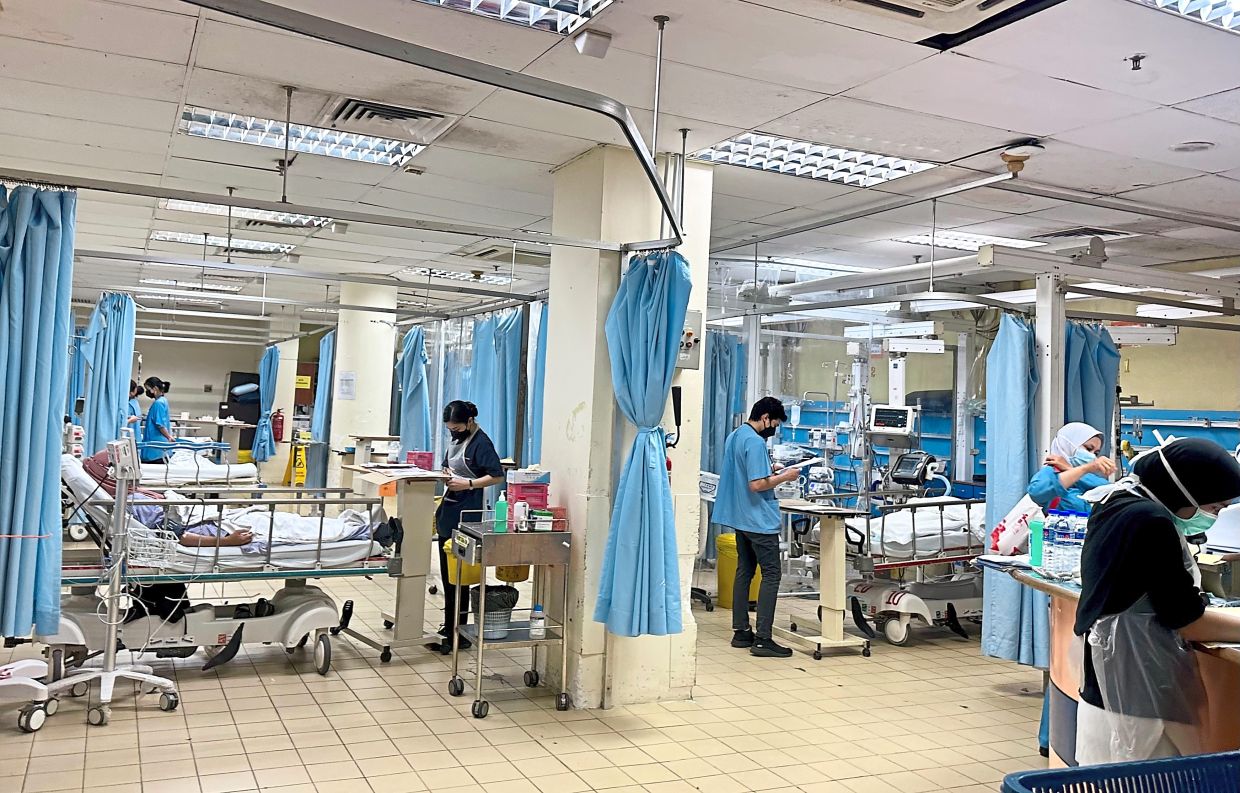
AN MCA leader has urged Health Minister Datuk Seri Dr Dzulkefly Ahmad to conduct regular, unannounced visits to public hospitals, saying improved bed-waiting statistics do not necessarily reflect conditions on the ground.

Party vice-president Datuk Seri Dr Wee Jeck Seng said the minister should personally inspect emergency departments, areas where patients wait for ward admission and hospital wards to assess whether overcrowding had eased.

“He ought to visit emergency departments, bed-waiting areas and hospital wards in person, listen to the actual experiences of patients, family members and frontline healthcare workers, and then assess the extent to which the situation has improved,” he stressed.

On Oct 27, Dr Dzulkefly told the Dewan Rakyat that 28 of 39 Type One and Type Two hospitals nationwide, or 71.8%, recorded average waiting times of less than eight hours for patients awaiting admission to wards from emergency departments as of June 2026.

This was an improvement from 55.26% in 2025.

The figures cover state hospitals and major specialist hospitals that handle high volumes of emergency cases and referrals from surrounding districts.

However, Wee said the remaining 11 hospitals that had yet to meet the eight-hour benchmark showed that congestion continued to affect major public hospitals.

“Statistics can inform the Health Minister the average waiting time, but they cannot convey what it feels like for an elderly person to lie in an emergency department for hours,” he said.

“Nor can they reflect the distress of family members waiting in corridors or the pressure on healthcare workers who are attending to large numbers of patients simultaneously.”

Dr Dzulkefly had also informed Parliament that 94 of 103 Type Three and Type Four hospitals, comprising minor specialist hospitals and hospitals without specialists, recorded average bed-waiting times of less than four hours.

The Health Ministry has said it is pursuing short- and long-term measures to ease congestion, including hospital outsourcing programmes, bed management units, day-care services and a cluster-hospital approach.

Its outsourcing programme, introduced in 2024, has benefited more than 50,000 patients across 75 ministry hospitals, according to the minister.

Wee noted the challenges facing the public healthcare system included shortages of hospital beds, healthcare personnel and specialist doctors, as well as excessive patient numbers in emergency departments.

He added that Dzulkefly had acknowledged the need to address overcrowding over the longer term through expanded facilities, renovation works, additional staffing and stronger primary healthcare services.

“Moreover, Dr Dzulkefly recently acknowledged that the government still has to address hospital overcrowding in the long term through the expansion of facilities, renovation works, additional staffing and stronger primary healthcare services,” he said.

Wee urged the minister to make regular, unannounced visits to major hospitals, particularly during night shifts, weekends and peak periods.

“MCA urges the Health Minister to conduct regular, unannounced visits to major hospitals to observe conditions in emergency departments during night shifts, at weekends and during peak periods, rather than relying solely on pre-arranged official visits in which the processes have already been prepared for inspection,” he said. ‒  Focus Malaysia

Kedah MB defends his “Sik-lish” during landmark global SG4 financial event to “just like Sing-lish”


COMMUNICATION is not a ruler. No need to bee too precise. As long as people understand, it’s okay, I’m a Sik, hence there’s a mix of Sik dialect in my English which makes it Sik-lish just like Singapore has Sing-lish.

Such is the justification of Kedah Menteri Besar Datuk Seri Muhammad Sanusi Md Nor after a barrage of ‘nasty’ comments was levelled at him by presumably detractors whose English proficiency, too, is in doubt to his keynote address at the recent SG4 Business and Economic Forum 2026.

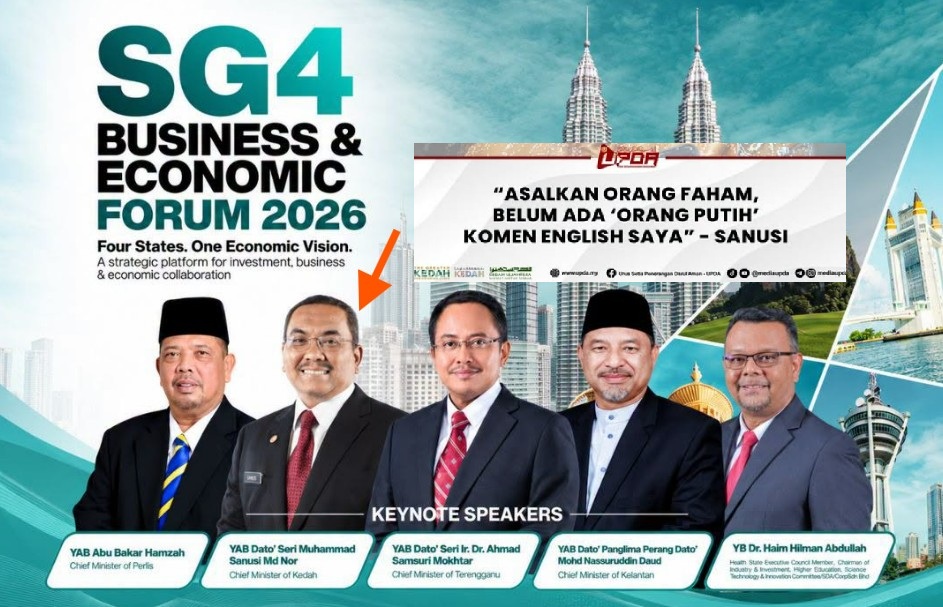
He was addressing “The Greater Kedah: Rising as Malaysia’s New Economic Powerhouse” before diplomats, foreign delegations and representatives of international organisations and companies, including representatives from the European Union (EU) at the Kuala Lumpur Convention Centre (KLCC) on Monday (Oct 26).

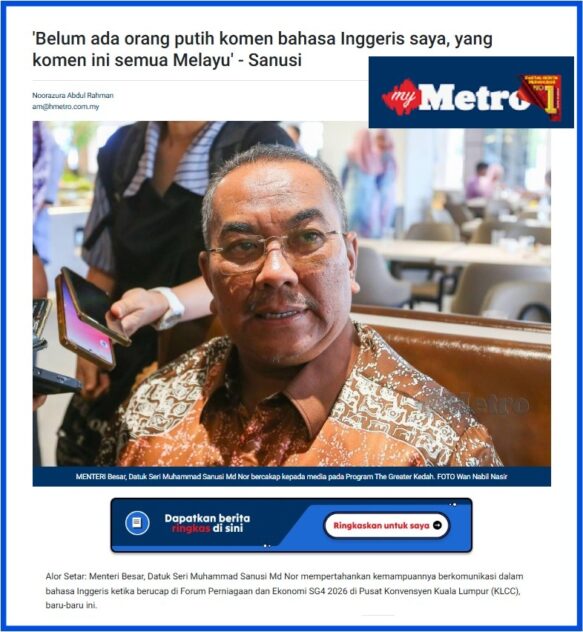
“No white person has commented on my English yet, all the commenters have been Malays,” the PAS election director jibed back when met after the The Greater Kedah Lecture Series Programme in Alor Setar yesterday (Oct 29).

“I talked to the US, Australian, Canadian and Indian ambassadors and they understand, they respect me – that’s the art of communication.”

Editor’s Note: Also featured as keynote speakers at the event were Sanusi’s Perlis counterpart Abu Bakar Hamzah, Terengganu MB Datuk Seri Dr Ahmad Sanusi Mokhtar and Kelantan Deputy MB Deputy Menteri Besar Dr Mohamed Fadzli Hassan.

Interestingly, SG4 adviser and twice former premier Tun Dr Mahathir Mohamad had prepared a special keynote address but was unable to attend in person as he was unwell.

His speech – which famously described the combined SG4 states as a “sleeping giant” with vast untapped economic potential – was read on his behalf by his son Tan Sri Mokhzani Mahathir.

His other son Datuk Seri Mukhriz Mahathir who is also the Pejuang president was also present at the event.

Delving further on criticism from social media users who are likely Madani backers on his delivery in English when raising the issue of rare earth elements (REE) at the forum, the Jeneri state assemblyman claimed to have travelled to 38 countries where he used English to communicate in various missions.

He stressed that he did not consider grammatical accuracy as an absolute measure in communication as long as the message conveyed could be understood by the recipient.

“Any language is important but more important is the performance and manner of delivery. As long as people understand and can accept it, Alhamdulillah,” justified Sanusi who is being hailed by political analysts and party figures as a prominent and influential leader within PAS.

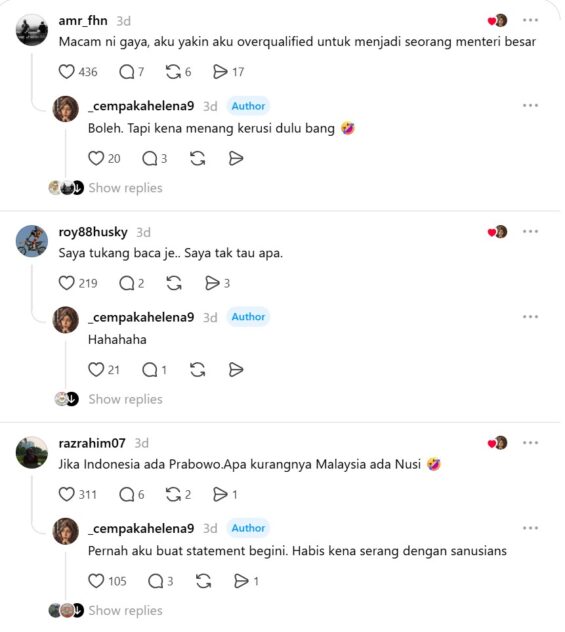
As he was mocked for his clownish and motor mouth demeanour with Madani backers likened him be “just reading blindly from script without understanding” to being “the Malaysian version of Prabowo (Indonesian president)”, a non-partisan Threader begged to differ in his assessment of the two-term Kedah MB.

“I’m no fan of PAS or Sanusi nor do I agree with him on this issue (the ‘just dig and sell’ rare earth elements a.k.a. RRE) but his speech is perfectly clear, understandable and it doesn’t seem that he doesn’t understand the text he was reading from,” observed amateur photographer and journalist Zikri Kamarulzaman (@zikrikmz).

This take was spot on with one commenter remarking “that’s why non-partisan people find it easy to understand what’s being conveyed”.

“If we’re biased towards a (political) party, we tend to look for perfect grammar and accent … but still won’t understand the context of the speech … 😊,” he rightly opined with another viewing Sanusi’s English as “just a typical Malay speaking a white man’s language”.
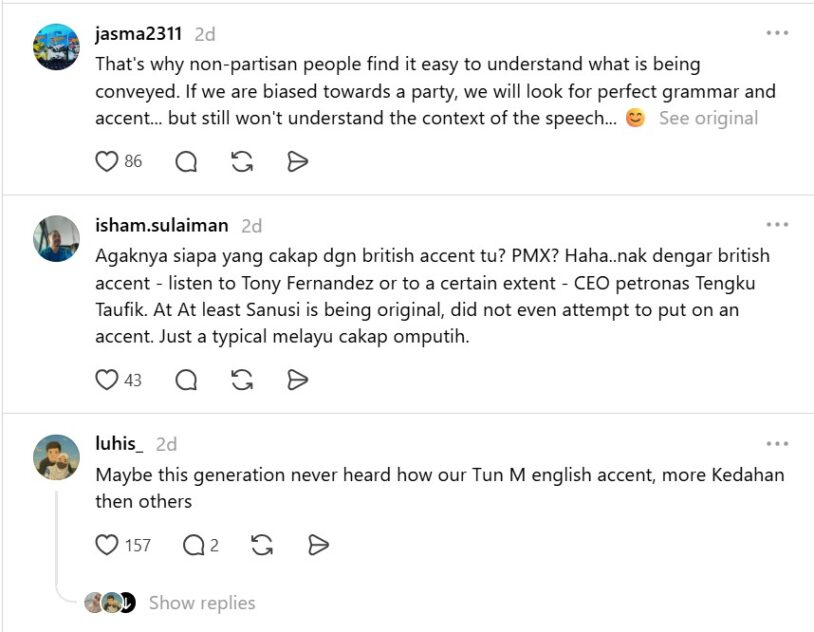
“Maybe this generation never heard how our Tun M’s (Dr Mahathir) English accent which is more Kedahan than others,” added one netizen. 

- Focus Malaysia