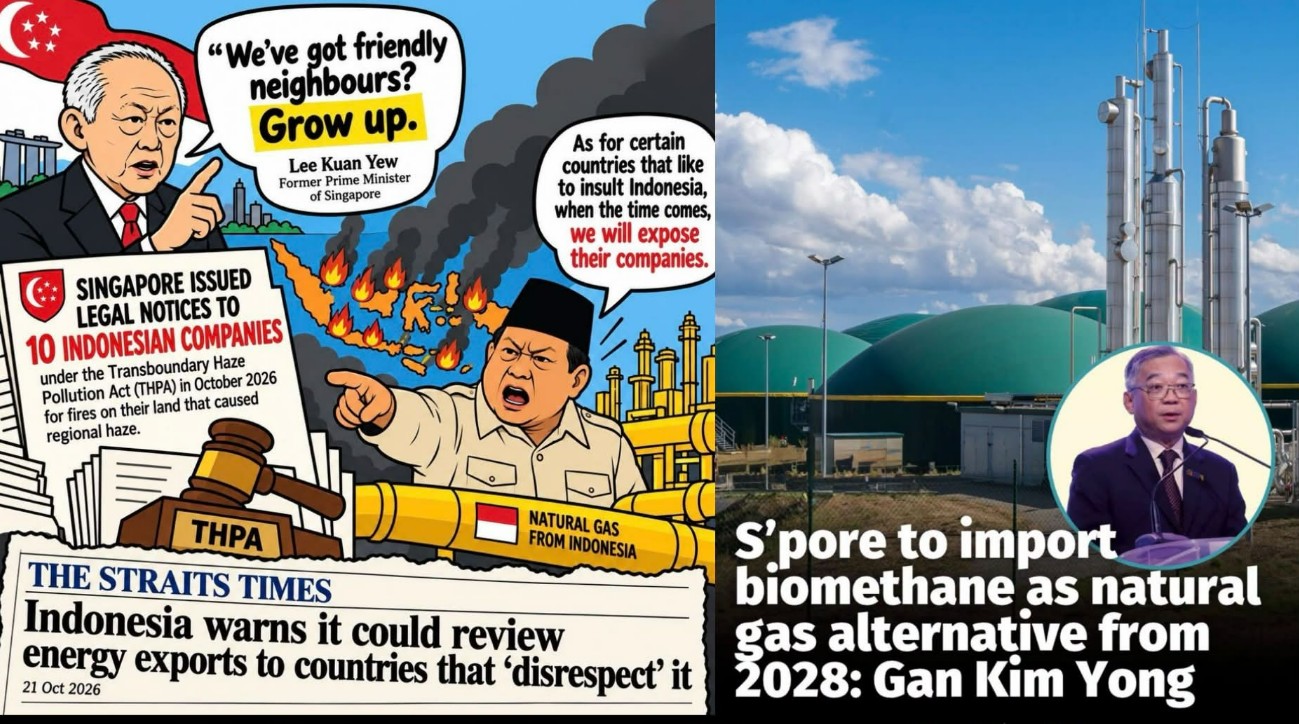
IN A shocking move, Indonesia has suddenly reduced the supply of natural gas to Singapore ostensibly to prioritise domestic demand and for reasons of energy security.
But the real motive is clear for all to see: the action is Jakarta’s answer to countries that “show disrespect” to Indonesia over the haze issue.
Indonesian President Prabowo Subianto had earlier reportedly rebuked countries that like to “insult his nation over the haze crisis”.
Although he did not point his finger at any specific countries, it was undoubtedly aimed at Jakarta’s ASEAN neighbours that have kicked up so much ashes in mounting frustration over Indonesia’s handling of the regional air pollution.
Days later, Indonesia’s Energy and Mineral Resources Minister Bahlil sounded a warning that Jakarta could “stop exporting energy to countries that failed to show it mutual respect”.
Shortly after, chief of Indonesia’s upstream oil and gas regulator SKK Migas, Djoko Siswanto, announced that his country will be cutting the exports of natural gas to Singapore from Oct 24. Singapore has become the first victim.
These co-ordinated “attacks” is not the response that ASEAN member states expect from big brother.
At the very least, Indonesia could have formally accepted the offer of aid from Malaysia and Singapore to combat the wildfires that have been spewing the toxic ashes across neighbouring countries for many months.
Tit-for-tat action
But there was only deafening silence which now could be interpreted as a complete rejection of this generous neighbourly gesture.
The silence was eventually broken by this unkindly cut administered on Singapore.
The island republic probably stirred the ire of Prabowo when it issued notices to 20 companies in Indonesia that allegedly caused the haze engulfing Singapore.
Of the number, 10 are Indonesian companies and the rest are Singapore-registered firms.
The action was taken by the Singapore’s National Environment Agency under the Transboundary Haze Pollution Act.
When they are served with these notices, the companies are required to send firefighters to extinguish or contain the fires on their land.
They are also required to stop any burning as well as submit plans on how they will douse the fires or prevent them from spreading or flaring up again, among other requirements.
Now, Singapore can take legal action against its own palm oil and forestry companies found responsible for igniting the fires, but when it comes to Indonesian firms, it appears that the transboundary haze law does not seem to be binding on them.
In short, Indonesia is telling the island republic: keep your hands off our companies. You are not showing us respect.
And it proceeded to promptly scale back the gas supply channelled through two undersea pipelines linked to the island nation.
In other words, Singapore is being taught a lesson on how not to interfere in the affairs of the vast archipelago.
It all boils down to the question of sovereignty. Only Indonesia can tackle haze in its own way without any input or advice from its neighbours.
Malaysia also agitates Indonesia
Malaysia may be next on the “hit list” although its import of natural gas from Indonesia is small.
Short of yelling at Prabowo, Prime Minister Datuk Seri Anwar Ibrahim has done everything he could to engage him to tackle the haze crisis. But his diplomatic approach did not produce any positive result.
However, it is the strident criticisms of the Malaysian public in general that might be galling to big brother. Many have urged the public to boycott Indonesian goods and brands to show their deep displeasure over the worsening haze choking the country.
Even an MP has gone to the extent of speaking in Javanese during a parliamentary session to get the attention of Prabowo to the transboundary pollution.
But Sabak Bernam MP Kalam Salan might have irked the Indonesian leader instead because the Javanese he used was not “refined or polite” as he is not proficient in the language.
He did not use a more respectful form of Javanese when addressing a person of higher status in public life.
Although he tendered a quick apology perhaps in response to the Indonesia-Singapore spat, it might not be enough to cool tempers down.
Jakarta might also want to teach Malaysia a lesson but it has to find a less drastic mode of action out of concern for the strong cultural and religious ties both countries share.
Perhaps, Prabowo can act against Malaysia-linked companies allegedly involved in starting the fires based on the finding of an Indonesian environmental group.
The group – Indonesian Forum for Environment – has identified 21 of these companies it claimed were linked to hotspots and fires within their concession areas.
In a show of authority, Jakarta can charge them in court or even revoke the concession permit and send them packing home.
Whatever it is, if Indonesia proceeds to take action against Malaysia, it will sour relationship with an ASEAN member and probably call into question the very existence of the regional grouping.
If ASEAN is no more an effective platform to solve regional issues, then it might as well be dismantled and all the member states go their separate, sovereign paths.
What Indonesia did to Singapore is tantamount to using natural gas as a weapon to probably destabilise or strangle the economy of the island nation. The weaponising of natural resources is bad business because it will escalate regional tension and eventually lead to open hostility.
Come next year, Malaysia and Singapore would have a big headache if the haze were to return again to blanket the region. What can they do or how can they respond without ruffling Prabowo’s feathers?
They can either stay mute and meek and allow sovereign Indonesia to tackle the wildfires on its own.
Or, if worse comes to worse, they can face down the giant and be ready to face the consequences.
Phlip Rodrigues is a retired journalist.
The views expressed are solely of the author and do not necessarily reflect those of MMKtT
- Focus Malaysia.