


The halls of the Putrajaya International Convention Centre (PICC) echoed with a definitive shift in the nation’s academic trajectory as Prime Minister Datuk Seri Anwar Ibrahim (PMX) officially launched the National Education Blueprint (RPN) 2026–2035.
This ambitious decade-long roadmap is designed to pull Malaysia out of what has been described as a “learning slump.”
The cornerstone of this major policy shift is the introduction of the Malaysia Learning Matrix (MLM), a centralised assessment system for Standard 4 students starting this year, and Form 3 students beginning in 2027.
This move signals a significant departure from the recent past, aiming to restore a sense of measurable quality to the Malaysian schooling experience.
For the past several years, the Malaysian education system operated under the School-Based Assessment (PBD) model, which, while holistic in intent, faced mounting criticism for its subjectivity and the absence of a reliable national benchmark.
The new decision to reintroduce central exams for Year 4 and Form 3 is being framed not merely as a “U-turn” to the days of UPSR and PT3, but as a vital diagnostic tool to catch learning gaps before they become irreversible.
According to the Ministry of Education, the Year 4 assessment will focus on the core pillars of Bahasa Melayu, English, Mathematics, and Science, while the Form 3 assessment will include History.
The primary goal is to ensure that by the time a child reaches the age of 10, the system has a crystal-clear understanding of their foundational literacy and numeracy levels.
This urgent “course correction” is backed by sobering statistics that have recently alarmed both policymakers and the public.
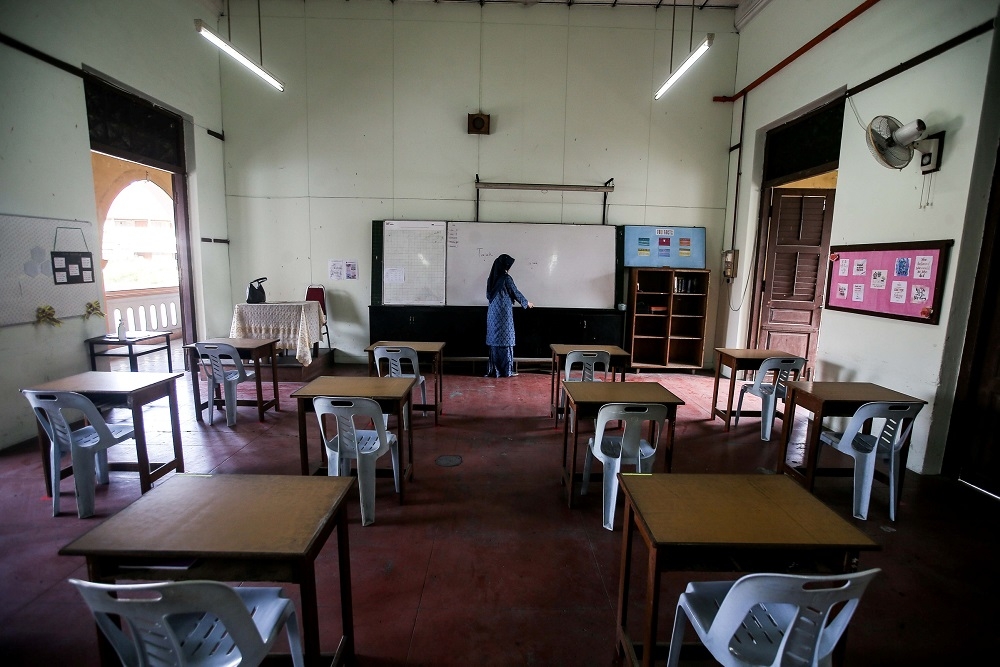
Data from the World Bank indicates that a staggering 42 per cent of 10-year-olds in Malaysia are “learning poor,” meaning they cannot read or comprehend a basic age appropriate text.
This figure is significantly higher than the average for other upper middle income countries. Furthermore, Malaysia’s performance in the PISA (Programme for International Student Assessment) has shown a worrying downward trend, with 2022 Mathematics scores plummeting to 404, placing the nation in the bottom third of 80 participating countries.
Locally, the ministry identified over 122,000 Year 1 students who have yet to master the “3M” (Reading, Writing, and Arithmetic), creating a massive backlog of remedial needs that often go unnoticed until it is far too late to intervene.
While the return to standardisation is a welcome step toward transparency and academic rigour, the most pressing concern lies in the actual readiness of the students who have spent their entire formative years in a “non exam” environment.
The current Standard 4 cohort has been raised in a classroom culture that prioritises continuous, low pressure evaluation rather than the high stakes atmosphere of a national hall.
Suddenly introducing a centralised exam administered by the Malaysian Examination Board (Lembaga Peperiksaan) this year poses a high risk of “exam shock.”
Without a dedicated transition period or a robust “bridging curriculum,” there is a genuine fear of inducing burnout in 10 year olds before their secondary education even begins.
This raises a critical question regarding timing: is the current school infrastructure truly ready to support the emotional well being and mental resilience of these young learners?
Another significant hurdle is the “subjectivity gap” inherited from the PBD era. Because previous assessments relied heavily on individual teacher judgment, a student labelled as “Band 4” in a high-performing urban school might possess vastly different competencies than a “Band 4” student in a rural or underfunded setting.
Forcing these students into a uniform central exam without first levelling the playing field could unfairly penalise those from disadvantaged backgrounds who have not had access to the same resources.
Readiness also extends to our educators; while the government promises “targeted interventions” based on these new exam results, teachers are already grappling with heavy administrative workloads.
For the Malaysia Learning Matrix to truly succeed, the data it generates must lead to smaller class sizes and specialised remedial support rather than simply adding more grading and reporting duties to an already stretched teaching force.
To ensure this decision becomes a success story for the nation, the government must resist the urge to use these exams as a tool for ranking schools or shaming underperformers.
Instead, the focus must remain strictly diagnostic, treating the 2026 Standard 4 assessments as a “baseline year” where results are used solely for internal school support rather than public academic standing.
A nationwide “literacy bootcamp” is needed to address the 3M gaps before the 2027 Form 3 assessments take place, ensuring that the “holistic” spirit of modern education including critical thinking and digital literacy is not abandoned in the rush to return to exams.
Ultimately, the success of the Malaysia Learning Matrix will not be measured by how many “As” are produced in the first year, but by how effectively it pulls that 42 per cent of “learning poor” children into the light of literacy and future opportunity. - malaymail
* Muhammad Ammirrul Atiqi Mohd Zainuri is a senior lecturer in the Faculty of Engineering and Built Environment, Universiti Kebangsaan Malaysia.
** This is the personal opinion of the writer or publication and does not necessarily represent the views of MMKtT.

No comments:
Post a Comment
Note: Only a member of this blog may post a comment.