


Prime Minister Anwar Ibrahim’s decision to restore the monthly Budi95 quota from 200 to 300 litres and lift Budi Diesel from 300 to 400 litres on Merdeka Eve was presented as temporary relief from the rising cost of living.
While the pressure facing households is real, reverting the fuel subsidy quota while oil prices remain elevated is an unsustainable and weak policy response.
It also does little to address the underlying cost-of-living problem while risking the reversal of an important fiscal reform undertaken by this government.
First, the decision contradicts the government’s own rationale for reducing the monthly Budi95 quota from 300 to 200 litres in April 2026, when global oil prices surged above US$100 per barrel.
The decision was supported by the government’s consumption data, which showed average monthly usage of 100 litres, while 90 percent of eligible users consumed less than 200 litres of petrol a month.
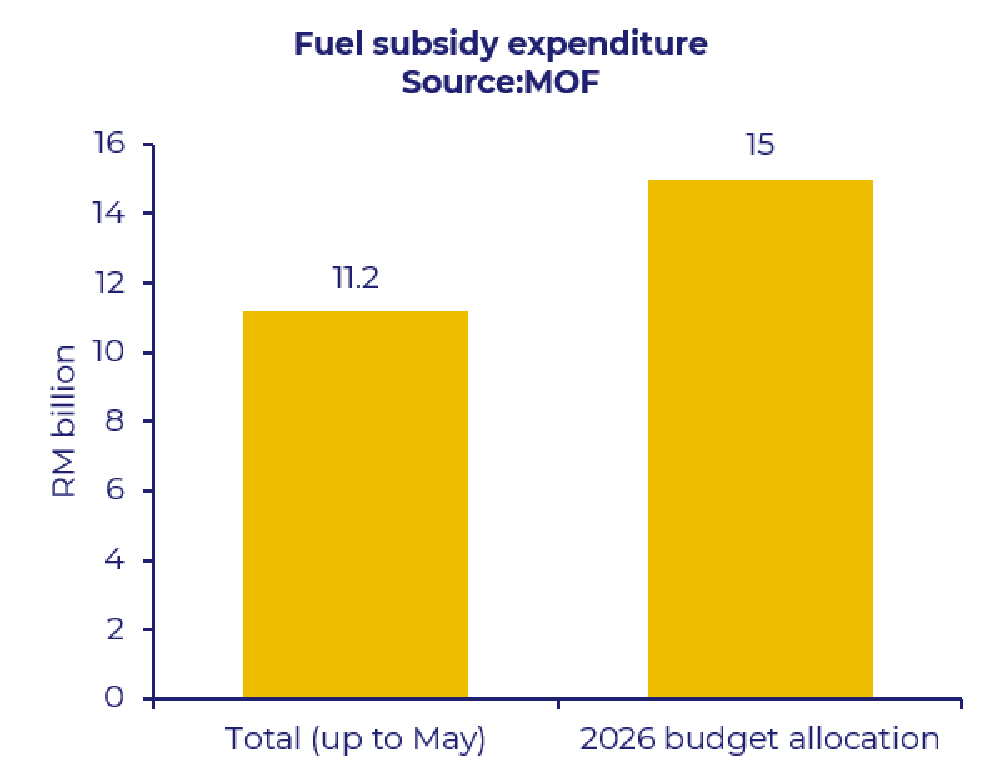
Even with the lower quota, the government had already spent RM11.2 billion as of May 2026, closing in on the RM15 billion allocated for fuel subsidies under Budget 2026.
Those pressures have not disappeared. Brent crude now hovers around US$90 per barrel, well above the Budget 2026 assumption of US$60–65 per barrel.
Increasing the fuel quota for RON95 and diesel exposes the budget to the same fiscal pressures that forced the government to reduce it in the first place.
While supply disruptions in the Strait of Hormuz have eased and the prime minister has cited stabilising supply conditions to justify extending the relief, renewed US-Iran hostilities yesterday have added fresh uncertainty.
Another oil-price shock could render the 300-litre quota fiscally unsustainable again and too politically sensitive for any administration to adjust.
Fuel subsidies reward consumption, not need
Second, fuel subsidies are a poor instrument for delivering cost-of-living relief because they reward consumption rather than need. Under the existing quota system, the more fuel a person consumes, the more subsidy they receive.
Broadly speaking, higher-income households are more likely to own multiple vehicles, drive larger cars, and travel longer distances.
Lower- and middle-income Malaysians who ride motorcycles, rely on public transport, or simply drive less receive less benefit.
Hence, the system directs more support towards heavier fuel users rather than households facing the greatest financial pressure.
A better approach is to target assistance directly at households that need it. International experience shows that energy subsidy reforms are more durable when paired with targeted cash transfers. Assistance can then follow financial need rather than petrol consumption.
Concerns that cash transfers may be spent on non-essential goods such as tobacco or alcohol are legitimate, but that is primarily a programme design issue. Transfers can be calibrated carefully or, if necessary, restricted through mechanisms such as fuel credits.
Real problem is stagnant incomes
Third, every ringgit spent on additional fuel subsidies carries an opportunity cost. Malaysia has a narrow tax revenue base, rising ageing-related expenditure commitments, and a growing debt-servicing burden.
Moreover, the Public Finance and Fiscal Responsibility Act requires public debt to be brought below 60 percent of GDP over the medium term by 2028.
More spending on petrol means less fiscal space for healthcare, education, and public infrastructure.
These trade-offs are already visible in the quality of public services.
Malaysians are already experiencing overcrowded public hospitals; doctors and nurses are overworked, public transport remains inadequate in many areas, and poor roads and congestion continue to impose real costs on households.
The prime minister’s Merdeka Eve announcement also included an additional RM1.5 billion in spending on health and education, but it fell short of the RM5.4 billion budget cut to the Health and Higher Education ministries earlier this year.
More fundamentally, Malaysia’s cost-of-living squeeze is becoming more of an income than a fuel-price problem. The global inflation shock since the pandemic has affected many economies, and Malaysia is not unique in facing higher prices.
However, the challenge is that wage growth and job quality have not improved fast enough for many households.
Hence, a durable response to the cost-of-living challenge should focus on closing the disconnect between wages and productivity, creating better-paying jobs, and strengthening the social safety net, particularly the basic Tier 0 floor of protection.
Short-term politics over difficult reform
Ordinary Malaysians should not be blamed for welcoming cheaper petrol. Few would turn down an immediate and tangible benefit.
The deeper problem is a persistent deficit of public trust. After years of high-level corruption scandals and weak confidence in public service, many Malaysians are sceptical that surrendering subsidy benefits would translate into better public service delivery.
For a government elected on a reform agenda, that trust deficit should be addressed through bolder institutional reform, not reinforced through another seemingly populist measure that may not survive another round of oil-price shocks.
As Malaysia enters its election season, cheaper or larger fuel quotas will undoubtedly be popular. It is no surprise there has been a deafening silence across the political divide as politicians make their own electoral calculations.
Some have even celebrated despite knowing that such a move comes at the expense of future generations.
Have we become so used to short-term rewards that we are no longer willing to defend difficult reforms? If so, the real cost of the extra 100 litres may be far greater than the subsidy bill itself. - Mkini
Sum Dek Joe is a trained economist and recently joined Bersama as its policy spokesperson.
The views expressed here are those of the author/contributor and do not necessarily represent the views of MMKtT.

No comments:
Post a Comment
Note: Only a member of this blog may post a comment.