`


THERE IS NO GOD EXCEPT ALLAH
read:
MALAYSIA Tanah Tumpah Darahku

LOVE MALAYSIA!!!


21 JUNE 2026

Friday, February 1, 2019

Let one person speak for the government, analyst says after ECRL clash


Finance Minister Lim Guan Eng (left) and Economic Affairs Minister Mohamed Azmin Ali recently issued differing statements on the ECRL mega project.
PETALING JAYA: An analyst has proposed that Putrajaya adopt a spokesperson system for the government, in the wake of contradicting statements from ministers over the fate of a China-backed mega project.
Speaking to FMT, Singapore Institute of International Affairs senior fellow Oh Ei Sun said the spokesperson should be a career bureaucrat, or at least someone who is well-versed in particular subject matters rather than individual ministries.
He added that flip-flops and clashing statements from Cabinet members on issues such as key projects would affect investor confidence.
He was referring to the contradictory statements by Finance Minister Lim Guan Eng and Economic Affairs Minister Mohamed Azmin Ali over the status of the East Coast Rail Link.
Azmin said the government had terminated China Communications Construction Group Ltd as the project’s contractor, while Lim said an official decision had yet to be made.
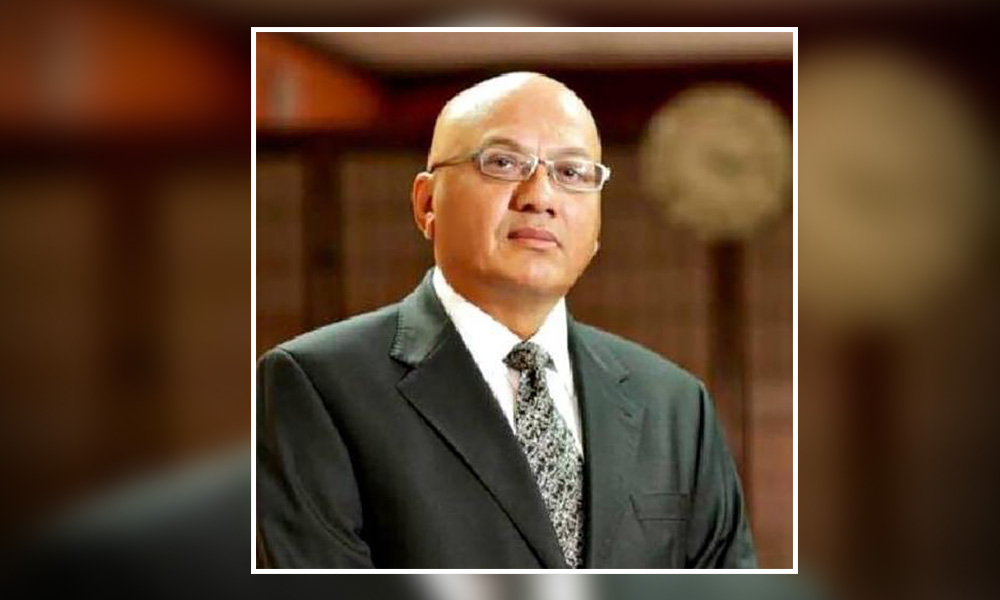
Oh Ei Sun.
Oh added that the Pakatan Harapan government had yet to come up with a consistent and well-structured plan to revive the flagging economy.
On the record fall of the ringgit against the baht as well as the overall performance of the Thai economy despite being under military rule, Oh said it would not be meaningful to compare the currencies of two similar economies as there would be “frequent and slight ups and downs”.
The ringgit had reached a record low of RM13.15 to 100 baht (RM1 to 7.60 baht).
“I am not so sure that we have an urgent need to strengthen the ringgit, for that would imply that we continue to rely heavily on imports,” Oh said.
“Instead, we should take advantage of a relatively weak ringgit to strengthen our exports and improve on our intangibles such as clean and efficient government.”
To this end, Oh said Malaysia’s “welcome message” to investors and the business community must be positive and consistent.
He noted that Thailand keeps a clear line between politics and the economy.
“Whether it is a civilian or military government, the pro-business and pro-investment policies continue.
“Even in the worst political crisis, the Thais will not jeopardise their economic production capability.”
This, he added, could be a lesson to Malaysia to steer clear of politics in the running of the government. - FMT

An artist strives to keep an old tradition alive

Amy Lin with her artwork. She combines traditional Chinese characters with colourful modern graphics, such as butterflies.
PETALING JAYA: When poets speak of the pain of love, they seldom mean the kind of suffering that Amy Lin goes through to give expression to her passion for Chinese calligraphy.
Lin lives with chronic rheumatoid arthritis and has to contend with the pain that runs through her fingers as she makes the brush strokes that constitute her literal labour of love.
It’s a love that has been nurtured since she was three years old. She started by learning to write her name in Chinese characters. Her parents, who believed in preserving old traditions, made sure she practised every day for hours.
“I myself had a deep interest in it,” she told FMT. “I started with just a pencil, but later began doing traditional calligraphy with the brush.”
Amy Lin.
By the time she was in kindergarten, she had become so good at writing Chinese characters that her teachers couldn’t believe their eyes. “One teacher asked my mother if there was anyone helping me with my homework,” she said.
When she turned 18, however, she went to college to study marketing, believing that she could never make a living as an artist. After graduation, she tried for years to concentrate on her career as a marketing expert and practically abandoned calligraphy for some time.
But the flame of love would not die. She eventually gave in to her yearning and started practising the art again as a hobby.
It was in 2014 that she was diagnosed with rheumatoid arthritis. This came after a year of intermittent fevers.
Amy Lin painting Chinese characters on red packets, or ang pao with a traditional brush. (Amy Lin pic)
Around the time of the diagnosis, she said, she noticed swellings on her joints and the pain was so excruciating that even putting on her clothes was a struggle.
She fell into depression and, for a time, didn’t even want to paint. But her family encouraged her to persevere and she soon realised that calligraphy was the one thing that could keep her happy.
“I couldn’t quit,” she said. “Life is short. I may as well keep on doing what I love while I still can.”
Some years later, the company she was working with decided to retrench her. The reason it gave was that it could no longer afford the insurance premiums to cover her treatment.
That was when she decided to set up business as a calligrapher. Her company’s name is Fun Yu Yu, which combines the English word “fun” and a Mandarin phrase that means being carefree and happy.
Her works are customised to the wishes of her clients, who buy them either to decorate their own homes or to give away as presents.
Although her true love is for traditional calligraphy, she finds herself these days painting more and more works that are in the modern style to cater to the tastes of her customers.
Traditional Chinese calligraphy on red paper, popular around this time of year.
She said the traditional style of drawing large Chinese characters with no accompanying graphics was becoming a thing of the past. She gets orders for them only once or twice a year.
She said clients found the old-fashioned scrolls inconvenient because of the amount of wall space they would take up.
“They are also more expensive, and I would have to go to a particular supplier to get the paper. My more modern works can be mounted in frames that take up less space and are easier to hang and carry around.”
But she has by no means abandoned tradition. Most of her current works combine traditional calligraphy with modern imagery, such as flowers or animals. She said she would receive more than 50 orders for such works every Chinese New Year and would charge anywhere between RM160 and RM700 for a piece.
She said traditional-style calligraphy on special red paper remained popular for Chinese New Year because of the association of red with good luck and prosperity. Legend has it that an old man once warded off a hideous monster by pasting pieces of red paper on doors and wearing red clothes.
Lin said she was struggling to sustain her business because the demand for her works is not constant.
“It’s not like the food and beverage business, where you get return customers,” she said. - FMT

The moderate Malay Muslim is a myth


This time last year, we were gripped by a culture of fear. Badmouthing the prime minister would attract the police. Publishing anything which annoyed Putrajaya would encourage the MCMC to block your website. Criticising the royals would invite mass protests and charges of sedition. We lived in a surreal world where corruption triumphed over common sense.
Fast forward to January 2019 and “Malaysia Baru” is a comparatively freer society. We can express ourselves without the fear of the police and the dakwah squad breathing down our necks. But one thing is clear - the moderate Malay Muslims are still in hiding.
Now, let me pop another bubble.
The Malays who demand syariah law, who want Malay women to be seen and not heard, who want women to be covered and assume a backseat role in society are not the rural folk.
The villagers are too busy trying to survive. Instead, the ones who demand a more Islamic society in a multicultural Malaysia are the tudung-clad Muslim women or Muslim men who are comfortable in Western attire, who converse in English, are Western educated, are well-travelled and professionals and articulate.
The voices of "moderate" Malay Muslims are needed to help oppose the growing demand for extremist practices, like the hudud bill or the death penalty for those who quit Islam. Again, the moderates have gone into hibernation.
They are probably afraid to be seen opposing other Muslims and risk being called heretics. We want their voices to lend support to oppose the beating and whipping of LGBTs and the violent deaths of transgenders, to criticise polygamy, child marriages and khalwat squads, and to denounce the forced conversions of the Orang Asli.
The "moderates" keep quiet, even if they disagree. Their silence is tantamount to approval of these extremist practices. In truth, there are no "moderate" Malays. They do not exist.
This is my unscientific breakdown of the Malay population:
About three percent of them are vocal. They make a lot of noise for their demands to be met.
Another three percent are enlightened. They attempt to spread awareness.
The rest are the "moderates" who are conspicuous by their silence. They should be renamed "Comfortable & Complacent" (CC) Malays.
These not-so-wealthy “CC Malays” outnumber the wealthy CC Malays but all of them are reticent about speaking out for fear of losing their perks, jobs and positions in society.
They have been conditioned since childhood, through a mixture of family upbringing, agama classes, peer pressure, Friday sermons and community groups, to believe that they cannot criticise their own brethren. A few have a tendency to bottle things up, and then run amok when they are unable to cope. Many disagree that everything is about the afterlife, but will not say this out loud.
Control of the mind
Children of the wealthy CC Malays enjoy the best education on offer. Where applicable, they attend primary international schools then gravitate to overseas colleges and universities. They snap up scholarships, even though others are more deserving. They are comfortable speaking English. The chance to broaden their intellect and experience is vast.
CC graduates have the first bite of the employment cherry, because of Mama or Papa's well-established connections, the old boys' network, family ties and more importantly, political and government cables.
Why should the CC Malays fight for reforms or a more just society? Why take the risk and lose their easily attainable perks? In a meritocratic society, their greatest fear is that they may not qualify for the benefits they currently enjoy. The bangsa and agama on their identity cards gave them an advantage over the other races. The CC Malays live in a bubble where everything is in their favour.
Conversely, the vocal Malay is like the worn water-pump that screeches. It gets immediate attention. The vocal Malays are the supporters of Umno-Baru and PAS and the bigots who threaten the peace. They want respect and their needs to be attended to, but they ignore the rights of the non-Malays.
The enlightened Malays, meanwhile, must be masochists. Remember, at one time, we did not think that Umno-Baru could be kicked out of office. Perhaps, the enlightened Malays will make others see sense one day.
The reaction of the ban on the depiction of dogs, pigs and crosses is a litmus test for distinguishing the various types of Malay. The CC Malays keep quiet. Vocal Malays claim that Islam says it is haram and so the ban must be upheld.
Enlightened Malays, forever inviting controversy, will say that these issues have nothing to do with religion. It is about control of the Malay mind to enable the politician to stay in power, or in Umno Baru's case, to regain power.
Malays who live overseas do not find photos of dogs, pigs and crosses offensive. Their minds are not bombarded with propaganda every day. They have a choice.
In Malaysia, politicians control the Malay mind and stupefy the Malays by removing their ability to think. They can then divide the nation and remain in power.
If you are Malay, do not allow yourself to be manipulated by people with a political agenda. If you are non-Malay, don't use the cop-out, "I do not wish to interfere in another religion."

MARIAM MOKHTAR is a defender of the truth, the admiral-general of the Green Bean Army and president of the Perak Liberation Organisation (PLO). BlogTwitter. - Mkini

Azmin appointed as Kelantan state action council chairperson


Economic Affairs Minister Mohamed Azmin Ali has been appointed as Kelantan state action council (MTNg) chairperson effective Jan 1.
A statement issued by the Prime Minister’s Office’s Implementation Coordination Unit said that MTNg was established in every state nationwide to act as the main body responsible for ensuring the decision made by the National Action Council (MTN) could be implemented at the state level.
“MTNg will act as the main coordinating platform for policy decisions related to planning, monitoring and tracking of the implementation of development policies and programmes as well as the ongoing initiatives of the federal government at the state level.
“To ensure that all development projects planned for the state of Kelantan to run smoothly, the federal government hopes for Kelantan government to give its full cooperation.
“This is important to ensure the federal government’s efforts to bring physical and human development across Kelantan will be able to provide an optimum impact to both state and its people," the statement said.
It added that the federal government’s commitment to boost development in Kelantan was clear as the state was one the states to be given priority in distribution of development allocation as set out in the Mid-Term Review of the Eleventh Malaysia Plan (2018-2020).
Bernama

Airlines increase flights during CNY period


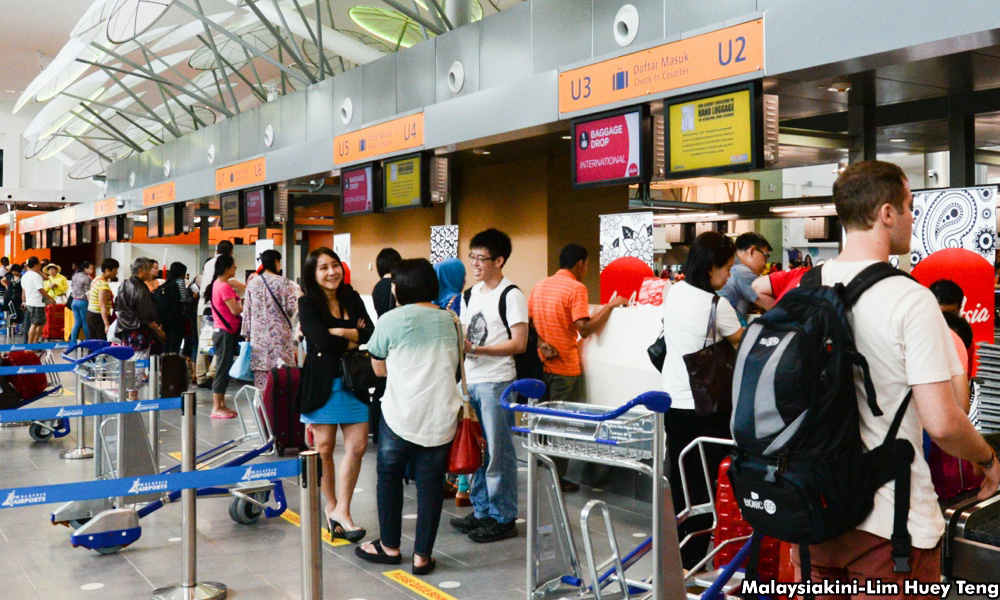
Three airlines have added a total of 376 low fare late night flights for the period between Jan 30 and Feb 12 in conjunction with the upcoming Chinese New Year, said Transport Minister Anthony Loke Siew Fook.
He said Malaysia Airlines, AirAsia and Malindo Air had also pledged to increase seats to 64,382 on 14 specific routes for the festive period to accommodate travel demand for popular routes including to and from Penang, Kuching, Kota Kinabalu, Sibu and Miri.
“Last year, the government requested the Malaysian Aviation Commission to conduct a study on high fares (charged by airlines) during peak travel periods in the country and to seek viable options to keep ticket prices at a reasonable level,” he told reporters after attending AirAsia’s send-off ceremony for additional Chinese New Year flights at the Kuala Lumpur International Airport 2 (KLIA2) last night.
Loke said the air fares for the extra night flights were 25 percent lower compared to those offered last year.
“For example, the airfare for the Kuala Lumpur-Sibu route on AirAsia last year was about RM1,000 but this year, the government has agreed for a low fare of RM149 for all seats.
“This is our initiative to reduce the cost of living,” he added.
- Bernama

Three questions for Malaysia’s new foreign policy


Last week, Malaysia’s ex-diplomat, Redzuan Kushairi, brought up a serious question about the current state of our foreign policy. According to him, the present Pakatan Harapan government has largely followed the ‘old’ foreign policies of the previous Mahathir 1.0 administration and as such, it is inadequate to adapt to the present global situation.
This is in light of the emergence of new powers such as China and Russia, a situation that exerts pressures on the smaller nations (including Malaysia) in terms of their engagements with the wider world.
To be exact, Redzuan (photo, above) provided three examples which the present Mahathir-led Harapan government is still banking its foreign policy on, namely the Non-Aligned Movement (NAM), the Group of 77 and Organisation of Islamic Cooperation (OIC). While these were the cornerstones of Malaysian foreign policy in the past, as he understood, they, however, are losing relevance in the disruptive great games between new and existing powers today.
What Malaysia should do now, instead, is to establish cooperation with individual countries such as Turkey, Tunisia and Indonesia on matters related to the Islamic world while at the same time, train more specialists on China and Indo-Pacific alliances to ensure our relevance in the international arena.
Coming from a diplomatic background, Redzuan’s revelations are both timely and necessary for Malaysia, which underwent a regime change last May. Just like how national politics needs to respond to a new political environment, the same it is for our foreign policy.
Being challenged by the disruptive global and regional environments of the day, a new foreign policy is required to service and advance our national interests abroad. But before moulding a new foreign policy, there is a need to consider three fundamental questions beforehand.
First and foremost, how does Malaysia posit China in the current world order? This is the most thought-provoking question thus far, considering both Prime Minister Dr Mahathir Mohamad and his named successor, Anwar Ibrahim, have consecutively brought up the conventional notion of developing versus developed nations. In Mahathir’s term, he cautioned the danger of a new version of colonialism for developing nations while for Anwar, it is Nehru’s Asian solidarity movement against the then Western imperialism of several decades ago.
Be it Mahathir or Anwar, both do not explain whether China is included within their arguments, a further indication that they have not settled the question of China in their long-standing notion of developing versus developed nations.
While still one of the developing nations, China is also a superpower-in-the-making today. Be it its economic prowess, military superiority, technological innovation or international influence, it is a misnomer to view the present China the same as the old China of the 1990s or even, during the Cold War period. Thus, this begs the earlier question: how does Malaysia place China in the current world situation?
Should we view it as a big developing nation as in the past or should we accept China as one of the great powers, just like the US? And if we take the latter’s stance, is it not the time for us to abandon the conventional “developing vs developed” dichotomy and start a whole new approach in our foreign policy pursuits?
Any adjustment of this scale will require not just perceptual change from our leaders but also, how Malaysia deals with a dominant China today.
Western world cannot be neglected
Second, when speaking about a disruptive global situation, there is no way that we can neglect the Western world itself. Hence, the second question is, how do we situate the Western powers in our new foreign policy? For a start, Malaysia has been enjoying long-standing ties with the UK, Australia, New Zealand and Canada ever since its independence in 1957.
Not only are these the earliest countries to recognise Malaysia as an independent state but some of them are also partners of the Five Powers Defence Arrangement (FPDA), to which Singapore and Malaysia belong.
While our bilateral trade with these countries is relatively lower than that of China’s, it does not mean these Western states are insignificant to us. For one, the enduring socio-cultural, business and military ties we have with these nations only highlight that there exist close bilateral ties among us.
As Trump’s “American First” policy, Brexit and China’s influence-spreading send shockwaves to major countries in the West, it is foreseeable that they are making their “return” to our part of the world. While the UK is eyeing to make a Southeast Asian comeback through economic and other areas of engagements, Canada, too, has to navigate itself away from its dependence on the American market into this largely untapped, emerging Asean market.
Australia, meanwhile, is eagerly cooperating with India and Japan as part of its Indo-Pacific collective effort to build their share of influence against the increasingly dominant China in Southeast Asia. All these developments are enveloping us today and it is for us to decide how we should situate these Western powers in our new foreign policy, without compromising our sovereignty, independence and self-determination.
And no doubt, fostering close relations with them may also, in turn, affect our policy vis-à-vis the US, Japan and India.
Third, in terms of our relations with the Islamic world, Redzuan made a good argument in that we should not pin too much hope on the OIC as what we did in the past. With the Yemen war ongoing, not only is there an actual risk of being dragged into a proxy war between Saudi Arabia and Iran, but it also puts into question the effectiveness of the Islamic organisation in managing the complicated situation in the Middle East.
Instead, as suggested by the ex-diplomat, it is more worthwhile to work with individual Islamic nations (such as Indonesia, Turkey and Tunisia) that share the same orientation as Malaysia in maintaining neutrality and enacting collective actions within the larger Muslim world.
What Putrajaya should ask at this point is, how do we work with these countries and engineer collective actions in the long-term? This will entail envisioning the forms of cooperation with like-minded Muslim nations, areas of collective actions as well as the possible establishment of mechanisms for this purpose.
More importantly, Malaysia can also explore ad hoc or visionary cooperation with other like-minded nations in the Islamic world and beyond in terms of preserving global peace, security and development goals.
Overall, these three fundamental questions are also reflections of the past versus the present geopolitical situation in the region and the world.
At the time that the 15-member Consultative Council on Foreign Policy is deliberating a new foreign policy framework for Malaysia, it is important to ensure that such a framework will eventually posit Malaysia on a path that allows it to manoeuvre its foreign policy in response to the disruptive regional and global politics today.
Answering these three fundamental questions will be a good start.

KARL CL LEE is a PhD candidate at the School of Arts and Social Sciences, Monash University (Malaysia campus). He was also visiting scholar at the School of Politics and Public Administration, Guangxi University for Nationalities (GXUN) under the 2017/2018 Chinese Government Scholarship (Bilateral Programme).
SK CHIA is researcher for Anbound Research Center (Malaysia), a subsidiary of Anbound, a leading independent think tank headquartered in Beijing. It is also a consultancy firm specialising in China-Asean cooperation. His e-mail is siangkimchia@anbound.com - Mkini

Yoursay: 'It’s time to focus on reforms, not Najib'


YOURSAY | ‘Focusing on the ex-PM in Cameron gave the impression that Harapan had nothing to show.’
The Wakandan: It is true that the 1MDB scandal had less impact in rural and semi-rural areas, which usually thrive on personal relationships and local realities.
This was proven in the last state election in Sarawak. While the then state BN acknowledged the corruption of 1MDB scandal, they nevertheless explained that it was a ‘Malaya affair’ and therefore did not concern them.
With much of the population in poverty, the higher concern is putting food on the table. BN has always exploited this to the core and, in fact, many believed that keeping them in perpetual poverty was deliberate in order to keep their hold on them.
Pakatan Harapan’s focusing on Prime Minister Najib Abdul Razak gave the impression that they had nothing to show. If you do not speak about your achievement or what you are doing, then that’s because you probably have nothing to show for in the first place. And how true was that?
Najib could boast about the previous government’s achievement because they had been in Putrajaya for decades, no matter how little that may be. While Harapan may not have those records being a new government, it could have shown what it is doing now.
Des Ng: It’s very sad to see that Harapan has become so complacent so fast - within nine months.
Instead of showing the rakyat what they can achieve and giving the rakyat a vision, Harapan continues to harp on the past regime's and Najib's misdeeds.
The kampung folks are not very good at reconciling why an alleged 'criminal' is allowed to walk and campaign freely amongst them. They are beginning to believe his innocence! Hence, they would back BN as the latter had been the 'provider' before.
Harapan had to wake up fast, or they will lose more by-elections and by the 15th general election, they will be finished.
Show the rakyat real reforms and they might be forgiven for their teething problems.
MahuSeeLui: Harapan's narrative should be that it is clean, honest, transparent and moving toward reforms.
Instead, it continues with many old practices. What to expect when it is headed by many old Umno stalwarts including Dr Mahathir Mohamad, and know nothing better.
Lodestar: This is a very unconvincing analysis. So political scientist Bridget Welsh thinks that Harapan should have campaigned on promising change, introducing new policies and cleaning up the system.
But BN supporters warmly welcomed Najib as campaigner-in-chief despite the dunghill of corruption charges that he is facing.
This doesn't sound like they are interested in change. Welsh seems to think that they are sophisticated voters, but the reality is that they lapped up BN's old rhetoric on race and religion.
Harapan lost simply because of the racial demographics of the electorate and their old style of thinking. Promising change would be like throwing flowers against parangs.
ChuenTick: Did Welsh not feel the sense of disillusionment and disappointment with Harapan among the voters that supported it during GE14?
But, yes, perhaps that is not a big deal for the Cameron Highlands by-election - those three findings she highlighted are more relevant to the situation on the ground there.
Yet, I believe that unless the Harapan government starts fulfilling its election promises, come GE15, we will have a new government.
Headhunter: What Welsh says about Najib is true. The government is making him relevant again, singling him out as their main enemy and giving him the publicity that he craves for. Very Umno indeed.
No wonder Najib and his sycophants think he will be the next prime minister again.
FairMind: Welsh is spot on! Harapan's strength was about promising change, about revamping the system and introducing new policies and values, but instead, it played to PAS and BN's strength - race and religion.
Bless Malaysia: Congratulation to the Securities Commission (SC) for taking some action. However, the punishment is certainly insufficient to deter future repeats of such irresponsible reporting, especially when the public trust is being violated.
The partner in charge should be barred from practising. The recent punishment of Deloitte Indonesia should be a fine example.
Annonnymous 080: I find this fine so unnecessary. This is given that SC in its own statement had said that "The SC said Deloitte's independent auditor's report for 1MDB Real Estate Sdn Bhd for 2015 and 2016 had stated that the firm was unable to obtain sufficient and appropriate audit evidence to determine whether the advances to 1MDB from, among others, the proceeds of the bond could be recovered."
So, why didn’t any SC officer read the independent audit report for 2015 and 2016? SC's higher management and staffers are so well paid and they should have taken the initiative to do their job. They should not expect others to alert them as the approval is in the hands of SC.
Anonymous_1527925538: What is RM2.2 million compared to the billions of ringgit the country lost because of the 1MDB scandal?
The SC should have also asked Deloitte to cough out all the audit fees they received from 1MDB.
Shovelnose: If SC wants to deter future white-collar criminals, they must grab the licensee or signing auditor by the collar and prosecute.
If found guilty of negligence by the court of law, not only should they be given a jail sentence but also have their professional licence withdrawn for good and barred from acting ever again as an auditor in any professional capacity in the country.
Slapping the wrist of a naughty child treatment is woefully insufficient. - Mkini