


ADUN SPEAKS | The recent controversy surrounding a student welfare poster at Universiti Pendidikan Sultan Idris (Upsi) has quickly mutated into a broader, more sinister national discourse.
Read the recent public statement by former politician Ronnie Liu carefully, and you will notice an astounding rhetorical leap.
What began as an administrative notice regarding the registration and support of new Muslim converts has suddenly been weaponised into a grand narrative of secret minor conversions, financial inducements, emotional manipulation, institutional complicity, and existential threats to minority survival.
If these were genuine allegations of institutional misconduct, they would demand immediate, rigorous investigation.
But as it stands, we are forced to ask the most fundamental questions: Where are the cases? Where are the official police reports? Where are the names, dates, and verified findings?
There is a vast, dangerous gulf between presenting verifiable evidence and constructing an alarmist narrative.
The fundamental flaw in such statements is not that they raise questions, but that they assume malicious answers without a single shred of proof.
It begins with a campus poster and leaps directly to a sweeping conclusion that public Islamic institutions are engaged in a predatory, systemic effort to target vulnerable non-Muslim students.
That conclusion is simply asserted, never demonstrated.
Why the suspicion?
This is where the real threat to our social fabric begins. Once every act of “dakwah” (proselytisation) or basic religious outreach is presumed suspicious, our entire ecosystem of mutual trust collapses.
Under this distorted lens, every welfare programme is labelled an illicit inducement, every autonomous convert is framed as a helpless victim, and every Islamic institution is treated as a suspect.
At that point, we are no longer engaging in a rational discussion about campus governance or constitutional rights. We are dealing in the currency of fear.
Regrettably, fear has become a highly profitable commodity in Malaysian politics. For years, certain political actors have operated on the premise that anxiety about Islam is far easier to sell to their base than mutual understanding.
It is easier to mobilise deep-seated prejudice than it is to cultivate trust. It is easier to weaponise worst-case hypotheticals than it is to engage with the actual reality on the ground.
This is why we see the same political playbook returning to the headlines time and again: a different spark, a different campus, but the same manufactured panic.
Are youths intellectually fragile?
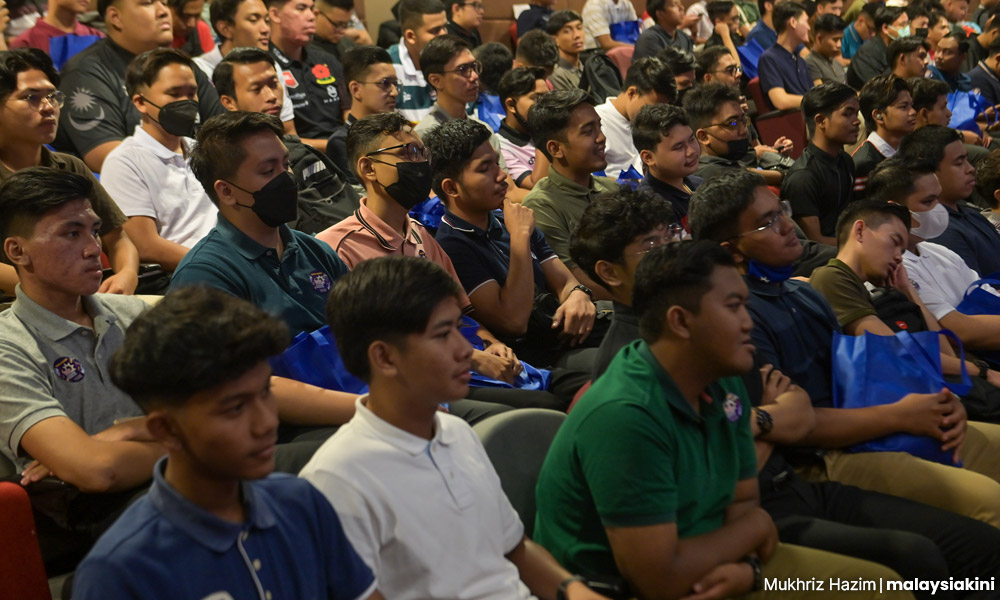
Let us be completely clear about the reality of higher education in Malaysia. Undergraduates entering public universities like Upsi via STPM, matriculation, or diploma pathways are legally adults under the Age of Majority Act 1971.
They are citizens deemed mature enough by our laws to vote in elections and chart their own academic and professional futures.
To suggest that these young adults are so intellectually fragile that they can be "coerced" or "bought" via hostel allocations or tuition aid is an insult to the intelligence of our university students, regardless of their ethnic background.
Furthermore, the financial support provided by welfare bodies is strictly a post-conversion safety net meant to support individuals who choose Islam voluntarily and often face sudden emotional or financial estrangement from their families.
Turning an act of basic humanitarian welfare into a "recruitment bribe" is a malicious inversion of reality.
The real question confronting us today is no longer about the technicalities of a campus poster, nor is it about whether genuine misconduct should be penalised - of course it should, if it exists.
The deeper question is this: When will political actors stop treating Islamophobia as a viable political tool?
Every time communal anxiety is traded for short-term political gain, the foundational trust between our communities grows a little weaker, and the space for rational, interfaith dialogue shrinks.
Minorities have a constitutional right to clarity and peace of mind, just as Muslims have a constitutional right to practice and share their faith without being reflexively painted as predators.
If we continue to allow opportunistic narratives to dictate national discourse, we will replace understanding with permanent polarisation.
And when that happens, every single Malaysian will end up paying the price. - Mkini
NUSHI MAHFOZ is Semenyih assemblyperson and Selangor PAS information chief.
The views expressed here are those of the author/contributor and do not necessarily represent the views of MMKtT.

No comments:
Post a Comment
Note: Only a member of this blog may post a comment.