


BRENT crude prices climbed back above US$100 a barrel on Sept 10 as worsening tensions in the Middle East fuelled fears of disruptions along two critical oil shipping routes – the Strait of Hormuz (SoH) and Bab-el-Mandeb.
Fresh concerns emerged over Saudi Arabia’s ability to reroute oil supplies after its 1,200km East-West pipeline was temporarily shut following drone attacks reportedly launched from Iraq.
The pipeline serves as an important alternative for Saudi oil exports, allowing crude to bypass the Strait of Hormuz.
According to Hong Leong Investment Bank (HLIB), It has a total capacity of seven mil barrels per day (bpd), with 5 mil bpd allocated for exports and the remaining two mil bpd supplying domestic refineries.
The disruption has heightened concerns over the availability of alternative export routes through the Red Sea and Bab-el-Mandeb, particularly as shipments from Yanbu have already weakened.
Yanbu’s exports dropped to a six-month low of 1.43 mil bpd, compared with an average of 3.9 mil bpd over the preceding three months.
At the same time, oil tanker traffic through the Strait of Hormuz has plunged dramatically. Traffic has remained below 10% of pre-war levels from July through September 2026, adding to concerns over potential disruptions to global oil supplies.
With the Strait of Hormuz serving as a crucial artery for international oil shipments, any prolonged disruption could further tighten supply expectations and keep crude prices elevated.
The combination of reduced flows through the SoH, weaker exports from Yanbu and disruption to Saudi Arabia’s alternative pipeline route has therefore added another layer of uncertainty to an already fragile oil market.
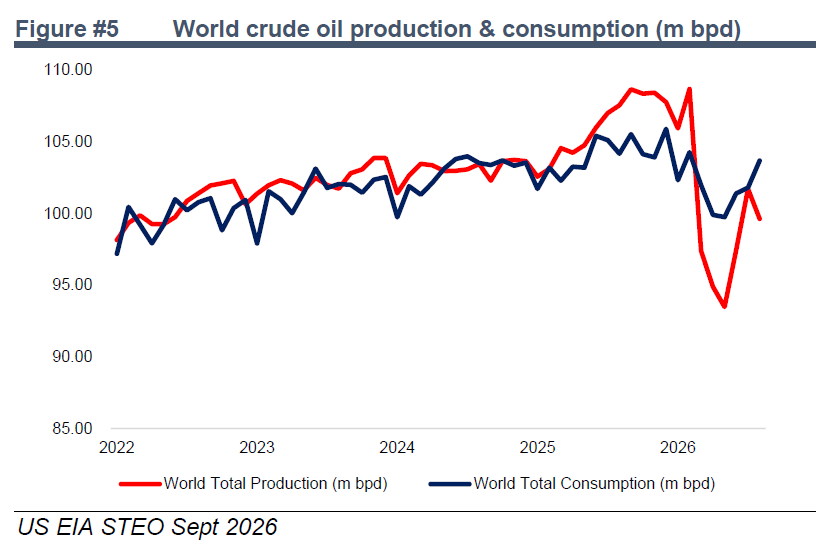
Global oil deficit widened sharply to 4.1 mil bpd in Aug-26 from just 0.1 mil bpd in Jul-26, and is expected to widen further to 4.8 mil bpd in Sep-26.
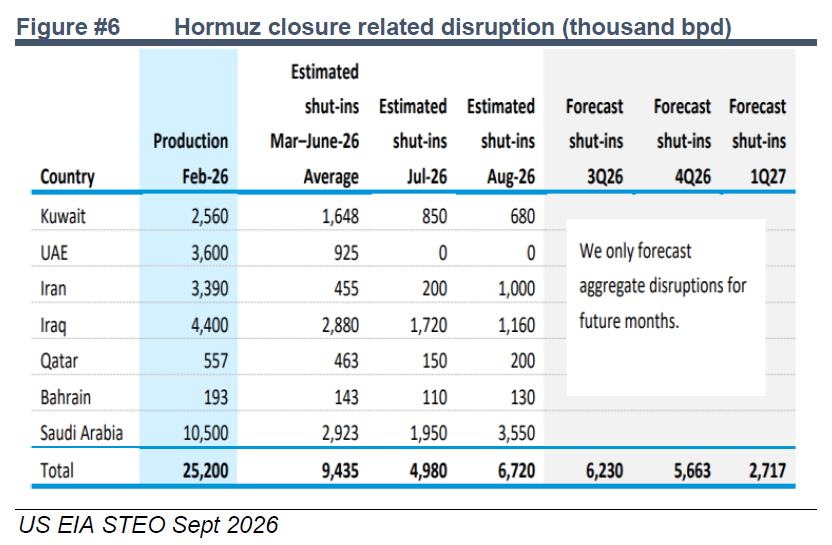
“The deterioration was driven mainly by Middle East supply disruptions, with regional production down 7.8% month-on-month (MoM), partly offset by higher output from Kazakhstan (+10% MoM) and the US (+0.4% MoM),” said HLIB.
Another alarming data is Middle East crude production shut-ins rose to 6.7 mil bpd in Aug-26 from 5 mil bpd in Jul-26, reflecting persistent constraints on regional exports and damaged energy infrastructure.
Brent has averaged USD87.6/bbl YTD, and we expect USD95–100/bbl towards end-2026, supported by persistent SoH disruptions, rising Bab el-Mandeb risks and constrained Middle East exports.
Alternative routes are also tightening, with Saudi’s East-West Pipeline disruption and subdued Red Sea traffic limiting crude rerouting.
The upcoming US midterm elections could add further volatility to Brent prices, in HLIB’s view.
Hence, they raised their 2026 Brent assumption to USD90/bbl from USD80/bbl, while maintaining USD75/bbl for 2027.
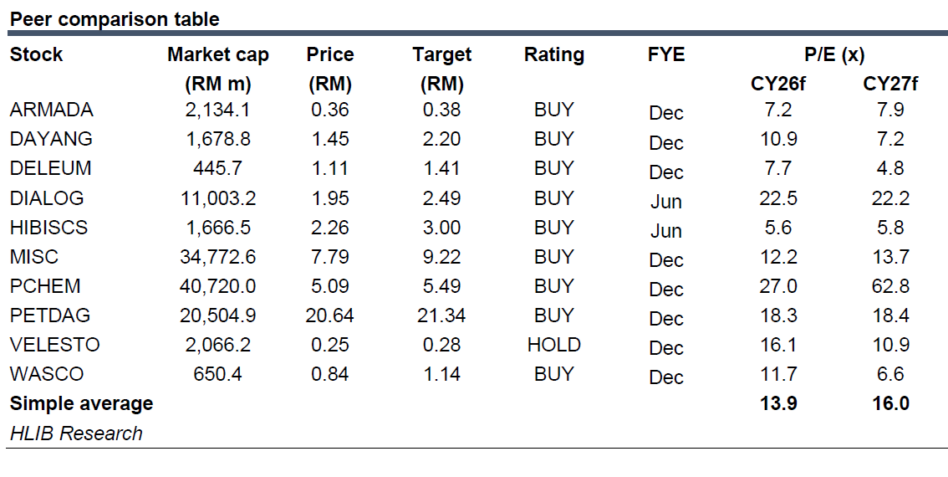
“While we retain BUY calls on most names, we remain selective and favour companies with earnings drivers that can sustain beyond near-term Brent Volatility,” said HLIB.
The research house advocates positioning for their 2027 thesis of a recovery in Petronas’ upstream capex alongside rising regional energy-security investments.— Focus Malaysia

No comments:
Post a Comment
Note: Only a member of this blog may post a comment.