`


THERE IS NO GOD EXCEPT ALLAH
read:
MALAYSIA Tanah Tumpah Darahku

LOVE MALAYSIA!!!


16 SEPTEMBER 2026

Wednesday, December 31, 2025

Top 4 political developments that will shape Malaysia in 2026


BY far the most consequential political development anticipated in 2026 is the series of state elections expected in Johor, Melaka and Sarawak.

In the last Johor and Malacca state elections, UMNO secured convincing victories under the leadership and shadow of Datuk Seri Najib Razak.

However, that political reality no longer exists—Najib is now incarcerated and following repeated and decisive defeats in court, it is increasingly clear that he is likely to spend the remainder of his life behind bars.

With their once-winning general removed from the battlefield, UMNO now faces an existential question: will the party be galvanised by Najib’s downfall and fight to reclaim his legacy, or will it be so demoralised that it collapses under the weight of his absence?

Sarawak: The election that matters most
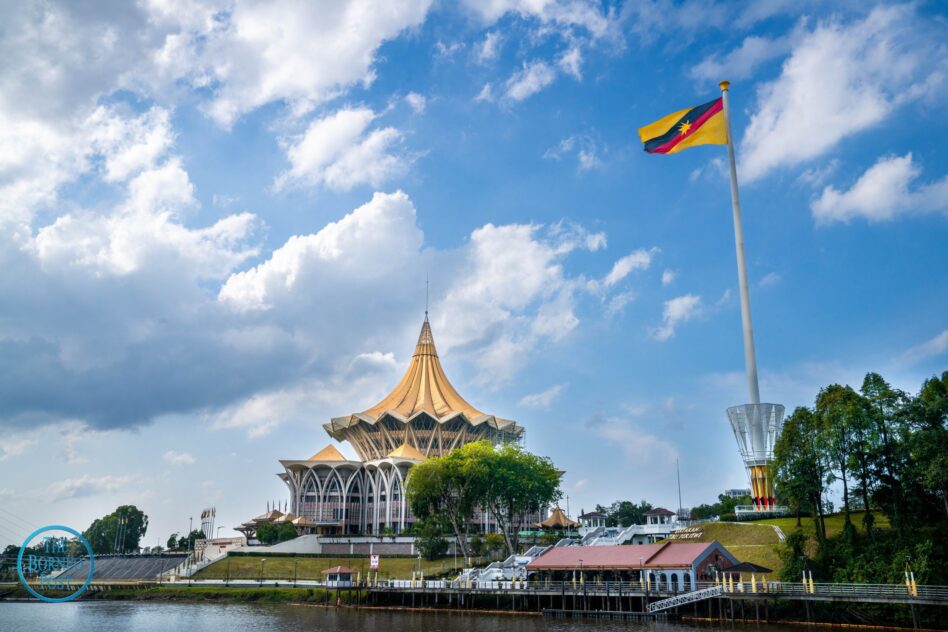
(Image: The Borneo Post/Chimon Upon)

The outcome of the Sarawak state election will speak volumes—not only about the future of the Pakatan Harapan (PH)-led government but also about the long-term cohesion of the Malaysian federation itself.

After suffering a heavy defeat in Sabah, Putrajaya simply cannot afford to lose Sarawak. Yet the uncomfortable truth is this: Putrajaya does not appear to have a realistic chance of winning there.

Sabah’s recent political revolt was driven by the “Sabah First” ideology—an idea originally inspired by Sarawak’s own “Sarawak First” doctrine. If the imitator was able to inflict such a decisive defeat on the federal government, it is difficult to imagine the original being any less brutal.

Should Putrajaya lose Sarawak by a margin equal to or worse than its loss in Sabah, that defeat is likely to generate political momentum that carries through to the next general election, projected for 2027, potentially precipitating the collapse of the PH-led government.

The probability of the Madani government fracturing

Almost every major component of the unity government has, at one point or another, threatened to walk away but will any of them actually do so?

Following its poor showing in the Sabah election, a visibly panicked DAP issued an ultimatum: recognise the UEC, or DAP would leave the unity government within six months.

However, public response to the ultimatum was tepid at best. After Datuk Seri Anwar Ibrahim announced a cabinet reshuffle—and after the government firmly rejected the idea of recognising the UEC—DAP has since grown noticeably quiet.

Whether DAP will honour its ultimatum or quietly pretend it never happened remains an open question—one that may only be answered by mid-2026.

DAP’s tensions with UMNO extend beyond policy. UMNO leaders have expressed anger over the way certain DAP politicians—most notably Puchong MP Yeo Bee Yin—appeared to celebrate Najib’s court verdict.

Najib’s subsequent conviction in the 1MDB case, which added another 15 years in prison and billions in fines, further inflamed UMNO’s grassroots, reigniting calls for the party to exit the unity government in protest.
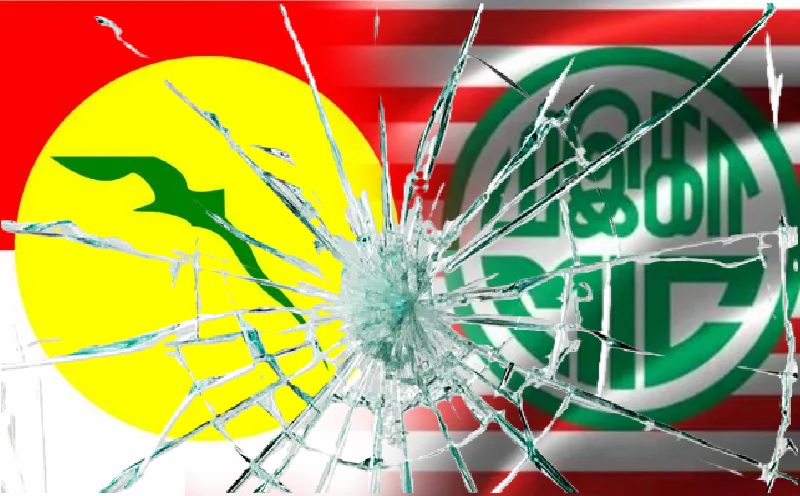
On a smaller but still relevant front, MIC—which has openly discussed leaving Barisan Nasional (BN) and the unity government for months—appears increasingly likely either to exit or be forced out in early 2026.

MCA, another minor coalition partner, may also finally be compelled to decide whether it wishes to remain within the unity framework.

Whether these threats are genuine or mere political posturing remains unclear. But if a sufficient number of parties do leave, the critical question becomes unavoidable: Can the unity government survive if everyone threatens to leave—and some actually do?

A change of guard in the Opposition

Perikatan Nasional (PN) has long struggled to sustain a coalition that runs against the natural order of politics. Why is it against the order of nature?

Because PN is led by its weaker partner.

Bersatu, which insists on leading PN, is weaker than PAS by nearly every meaningful metric: party machinery, grassroots reach, ideological clarity, leadership depth, membership size, and overall public support.

Yet Bersatu remains unwilling either to improve itself sufficiently to justify leadership or to humble itself and accept PAS as the coalition’s natural leader.

This unresolved contradiction has strained Bersatu-PAS relations for years. The latest manifestation of that strain surfaced in the Perlis Menteri Besar dispute, where Bersatu attempted to wrest the MB post from PAS, its own coalition partner.

Rather than strengthening itself by confronting its political opponents, Bersatu chose to cannibalise its ally. That act has almost certainly pushed the relationship to the brink of irreparable damage.

The coalition still holds—for now—because neither party has a viable alternative. But politics is fluid, and circumstances inevitably change. When they do, it is difficult to see how Bersatu and PAS can continue pretending that this betrayal never occurred.

Will Zahid still lead UMNO?
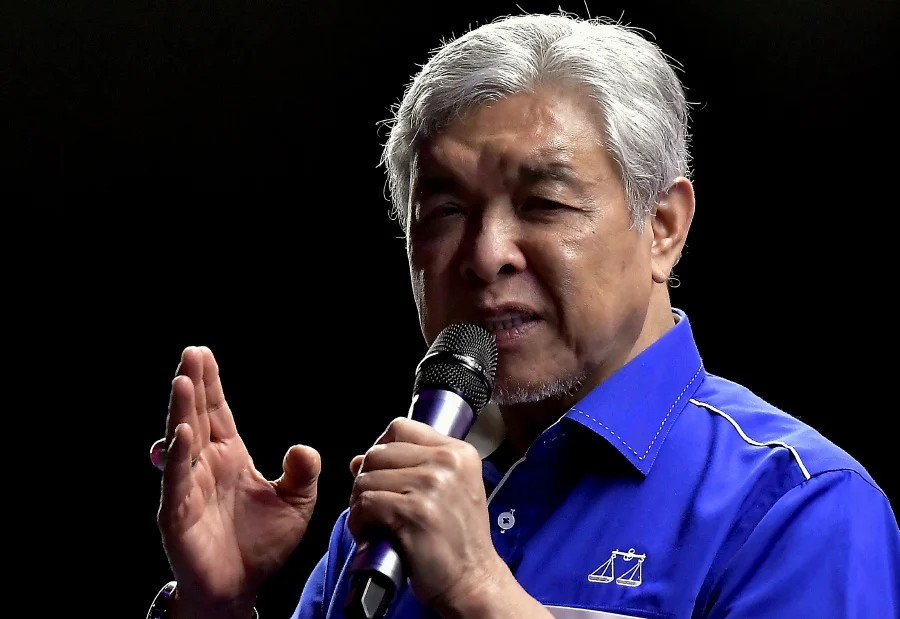
UMNO’s party election in March 2026 will answer one of the most pressing questions in Malaysian politics: will Datuk Seri Ahmad Zahid Hamidi remain UMNO president?

Zahid is deeply unpopular within the party. It was his decision to call the November 2022 general election that transformed what could have been a manageable outcome into a devastating defeat.

Prior to that election, UMNO had momentum, winning both Melaka and Johor while Najib’s imprisonment had stirred sympathy and mobilisation among the grassroots.

But Zahid squandered that momentum. Despite UMNO’s collapse, he emerged not weakened but elevated, securing the position of deputy prime minister while also receiving discharge not amounting to an acquittal (DNAA) decisions on 47 corruption-related charges.

This stands in stark contrast to Najib, the party’s more popular figure, who has faced relentless legal defeats.

Since UMNO’s last internal election in 2023, Zahid’s leadership has taken the party from bad to worse. He retains power largely because he enjoys the support of Anwar, and because he has systematically neutralised potential challengers such as Khairy Jamaluddin and Datuk Seri Hishammuddin Hussein.

Whether Zahid can continue clinging to the UMNO presidency—despite the party’s deteriorating condition—will be one of the most closely watched political dramas of 2026.

If 2026 has a defining theme, it is this: Survival, fragmentation, and reckoning.

State elections, coalition fractures, opposition realignments, and leadership battles will converge to determine not just who governs but whether Malaysia’s current political architecture can endure at all. 

Nehru Sathiamoorthy is a roving tutor who loves politics, philosophy and psychology.

The views expressed are solely of the author and do not necessarily reflect those of MMKtT. 

- Focus Malaysia.

Beware what you consume; milk drink with only 1% milk goes viral on the internet


ANYONE who grabbed a box of milk drink from the grocery shelf should reasonably expect a nutritious milk drink from their purchase. But nowadays, with all the additives and flavouring, can we be so sure anymore?

The only way to be certain is to have your own cow and to milk it by hand. And looking at the trend where food is concerned, this might actually be a good idea.

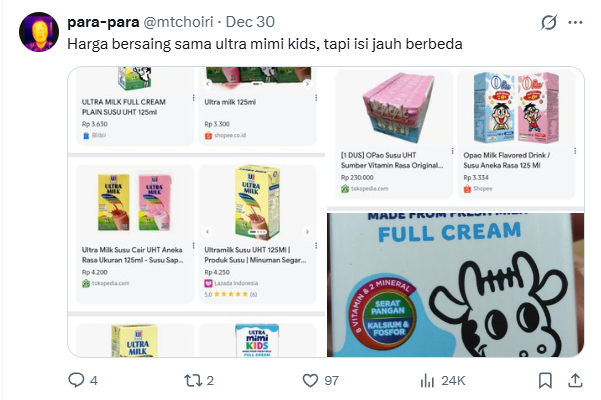
Take it from a recent and shocking post from netizen @Outstandjing who shared the contents of a milk drink.

Apparently the drink only contained 1% skimmed milk while water made up 86% of the content. Then there was a long list of chemical names such as trisodium nitrate, lactic acid, acidity regulator and many others that makes you unhealthy just by reading them.

The brand of the drink was Pao, with a happy child right in the middle of a blue background. Though we like to think the child wouldn’t be too happy to find out his milk drink is only 1% milk. 

Then when we think about it, can we pay for the milk with counterfeit money?

A netizen further compared the product to another milk drink which was selling at about the same price, although the content was far different.

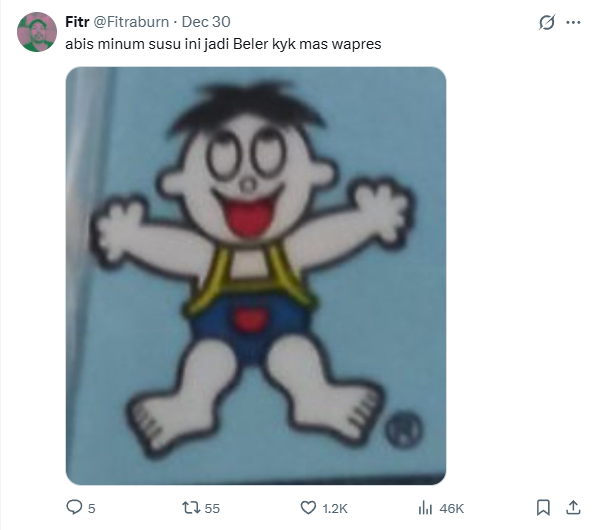
Another netizen by the name of @Fitraburn pointed out that those who drank the milk should become just like the illustration on the box.

However, the only redeeming quality for the drink was the description on the box which said, “minuman rasa susu,” or milk flavoured drink. That should explain the lack of nutrients.

Regardless, the post highlights just how much we would have missed as a consumer if we did not check the contents on the product. As we proceed into the future, label reading becomes increasingly vital. Either that or buy a cow and milk it with you own hands. — Focus Malaysia

“The art of Malaysian ministerial evasion: It’s not the title Dr Taufiq Johari, it’s about honesty!”


SINCE his appointment to the Cabinet earlier this month, Youth and Sports Minister Mohammed Taufiq Johari has faced sustained questions over whether he has over-stepped legal and ethical boundaries by presenting himself as a medical doctor, including the use of the “Dr” title.

On Monday (Dec 29), the 29-year-old who is currently the youngest minister in Prime Minister Datuk Seri Anwar Ibrahim’s Cabinet broke his silence on this issue by stating that the Malaysian Medical Council (MMC) has set the record straight. That reply raises more questions than it answers.

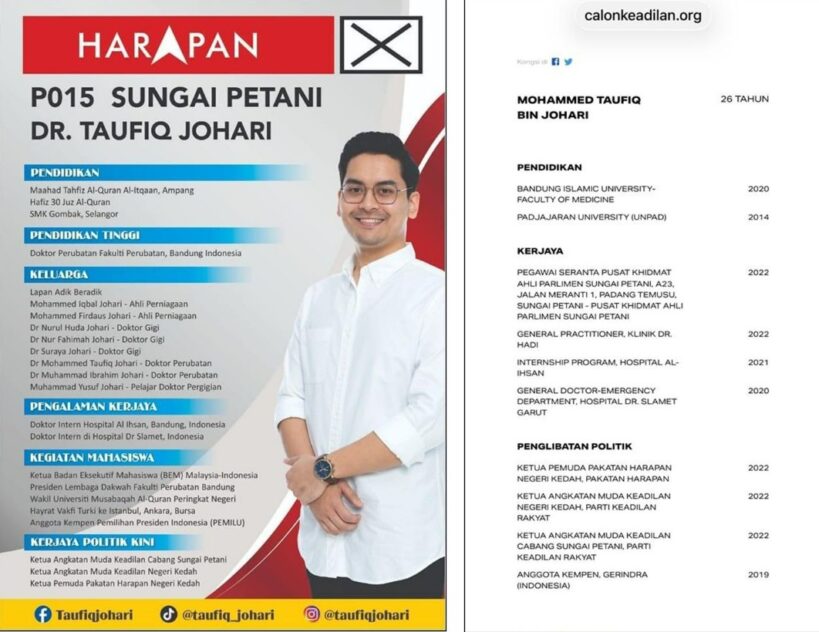
Prior to his Cabinet appointment, Taufiq presented himself as a “doctor”. It clearly says so in his biodata prior to the last general election, including having been a general practitioner (GP) at a clinic in Sungai Petani in 2022.

At that time, his father Tan Sri Johari Abdul was the Sungai Petani MP, a post held since 2008. Taufiq “inherited” the sea by, winning it in the 2022 general election while his dad went on to become the Dewan Rakyat speaker.

The thing is, Taufiq is not really a medical doctor as far as Malaysian laws are concerned. He completed his medical degree from the Bandung Islamic University which the MMC does not recognise. Put another way, he’s not allowed to practice medicine in Malaysia.

As for the “Dr” title, the MMC has clarified that it can be used even if one is not registered to practise medicine. That clarification, however, dodges the more uncomfortable question: Was there an attempt by Taufiq to deceive?

PR stunt turns awry?

In Malaysia, doctors are generally trustworthy and respected. They carry moral authority. When a politician presents himself as a medical doctor, most Malaysians understand it as someone who treats patients, completed housemanship and is registered to practise. Pretending otherwise is disingenuous.

It does not stop there. Images from Taufiq’s own social media posts compiled by former Barisan Nasional (BN) strategic communication deputy director-turned- Madani critic Datuk Eric See-To showed him in clinical settings, examining patients.

Perhaps it was just a case of a medically-trained person taking blood pressure (which doesn’t require one to have a practising licence) for photo-op purposes.

But again, context matters. Posting such images reinforces a public impression. It tells voters, “I’m a doctor who serves the community”. If that impression is false or at least materially misleading, it raises serious ethical problems.

But more importantly, did Taufiq practice as GP in Sungai Petani in 2022? His GE15 election biodata clearly says so. If that is the case, there’s been a clear breach of the law.

Of course, Taufiq can now claim that the “erroneous” biodata was uploaded without his knowledge on an official PKR website. Even if it’s true, that would be seen as an afterthought although it beats a sitting minister facing the music from medical authorities.

So far, Taufiq has chosen to only skirt around the issue. When queried by the media, he simply pointed to the MMC’s statement and refused to elaborate. That is evasion.

This issue is not just about titles. It is about whether a minister was honest with voters or whether he knowingly leaned on an image that carries social prestige to gain trust and support.

As the Youth and Sports Minister, this standard of accountability is even more stringent with young Malaysians looking to Taufiq as a role model or to set the benchmark for moral standards.

And with the negative global publicity surrounding the Football Association of Malaysia (FAM), the minister must be someone whose integrity is beyond question.

It is high time Taufiq set the record straight about this issue instead of being wishy-washy about it and risking it undermining his credibility – and that of the Madani administration.

Like how cancer spreads, it is better to remove a malignant tumour early than to risk one’s well-being and life over time. – Focus Malaysia

Muafakat Nasional not a political outfit, says Noh Omar


ALOR GAJAH: Muafakat Nasional (MN) deputy president Tan Sri Noh Omar has clarified that the body is a non-governmental organisation and not a political entity.

Noh, who is also a Bersatu Supreme Council member, said there has been confusion regarding the status of MN.

"MN was established as a volunteer service centre to help the people regardless of political background or race. It started in Melaka and will be expanded to the federal level and other states," he said after launching the MN service centre for the Durian Tunggal state constituency.

MN was previously the name of the now-defunct political alliance between Umno and Pas formed after Pakatan Harapan came to power in 2018.

Recently, some leaders, including Pas election director Datuk Seri Muhammad Sanusi Md Nor, floated the idea of reviving the pact.

In 2022, former Umno strongman Tan Sri Annuar Musa announced the formation of an NGO using the same name.

Noh said that while the majority of MN members are Malays, the NGO also involves non-Malays regardless of their political ideology.

Separately, Noh said he believed Bersatu president Tan Sri Muhyiddin Yassin's decision to resign as Perikatan Nasional (PN) chairman was a move to prioritise the coalition amid temsions between Bersatu and Pas.

"Because he prioritises PN, he resigned as the PN chairman. To me, he is a man of great character and I am confident there will be continuity in PN.

"In our struggle, leaders come and go, but the party's struggle must continue," he said.

Yesterday, Muhyiddin announced his resignation as PN chairman after five years leading the coalition. - NST