Prime Minister Datuk Seri Anwar Ibrahim said the threat to civilisation does not stem from a loss of access to knowledge — of which there is now a glut — but from society’s waning love and patience for reading, reflecting, and thinking critically and deeply. — Bernama pic
KUALA LUMPUR, Oct 29 — The decline of reading culture and the rise of shallow thinking in the digital age are pressing challenges that could threaten the future of civilisation, says Prime Minister Datuk Seri Anwar Ibrahim.
In a Facebook post yesterday, the prime minister shared his thoughts after taking time to read the latest work by James Marriott, titled The New Dark Ages: The End of Reading and the Dawn of a Post-Literate Society.
He said the threat to civilisation does not stem from a loss of access to knowledge — of which there is now a glut — but from society’s waning love and patience for reading, reflecting, and thinking critically and deeply.
“We may be increasingly wealthy in information, yet impoverished in wisdom. The question, therefore, is not merely whether humanity still reads, but whether humanity still wants to think,” he said.
Reflecting on history, Anwar recalled society’s deep reverence for intellectual and literary traditions upon the death of great French writer Victor Hugo in 1885, which saw around two million people gather in Paris to pay their last respects.
He said a similar scene unfolded following the death of renowned Russian literary giant Fyodor Dostoevsky in 1881, when tens of thousands joined his funeral procession in Saint Petersburg, demonstrating how deeply society at the time valued literature, culture, intellectual traditions, and thought.
“Neither of them was a king nor a victorious warlord, but they were thinkers and scholars whose ideas resonated deeply in the hearts and minds of society,” he added. — Bernama
A fallen tree in Putrajaya, October 28, 2026. — Social media pic
KUALA LUMPUR, Oct 29 — Five fallen tree incidents were reported at several locations in Selangor from yesterday afternoon to last night, affecting six vehicles that were struck by trees or branches, with no casualties reported.
Selangor Fire and Rescue Department assistant director of operations Ashrul Riezal Asbar said the first incident occurred at Jalan MR 1/6, Rawang, at 4.40pm, when a tree belonging to the Selayang Municipal Council fell onto three vehicles.
“The vehicles involved were a Hyundai Santa Fe, Proton Iriz and Perodua Axia. A team from the Batu Arang Fire and Rescue Station arrived at 4.54 pm, with four personnel and a Fire Rescue Tender (FRT) deployed,” he said in a statement yesterday.
He said the second incident occurred at 5.05pm at the Education Quarters in Persiaran Indera Wawasan, Pusat Bandar Puchong, when a tree fell onto a Toyota Vios.
A team from the Puchong Fire and Rescue Station arrived at 5.14pm. The operation was brought under control at 5.16 pm and concluded a minute later, with seven personnel involved, he said.
Meanwhile, a fallen tree incident was reported by a member of the public on the Threads platform at 5.10pm along the Kerinchi Link Expressway, from Bangsar towards Bukit Damansara.
A post by Threads user @rmasyraf showed a fallen tree on the road and rescue personnel at the scene.
However, further details of the incident, including the number of vehicles affected, could not be obtained as the Kuala Lumpur Fire and Rescue Department had not received any report.
Ashrul Riezal said two more incidents were reported in the evening. At 6.44pm, a tree branch fell onto a Honda CR-V at Jalan DM 3/7, Taman Desa Rawang, while at 6.49pm, a tree fell onto a Proton Saga at Akasia Apartment, Jalan Wawasan 2/3, Puchong.
“For the incident in Taman Desa Rawang, a team from the Rawang Fire and Rescue Station arrived at 6.55pm, with eight personnel, an FRT and an Emergency Medical Rescue Services (EMRS) vehicle deployed.
“For the incident at Akasia Apartment, a team from the Puchong Fire and Rescue Station arrived at 6.55pm, with seven personnel and an FRT deployed. Both reports stated that there were no casualties, but the times when the operations were brought under control and concluded were not specified,” he said.
Overall, the four incidents reported to the fire and rescue department involved six vehicles, while the fifth incident along the Kerinchi Link Expressway was known through a public post on Threads. The total number of vehicles affected in all five incidents could not be confirmed. — Bernama
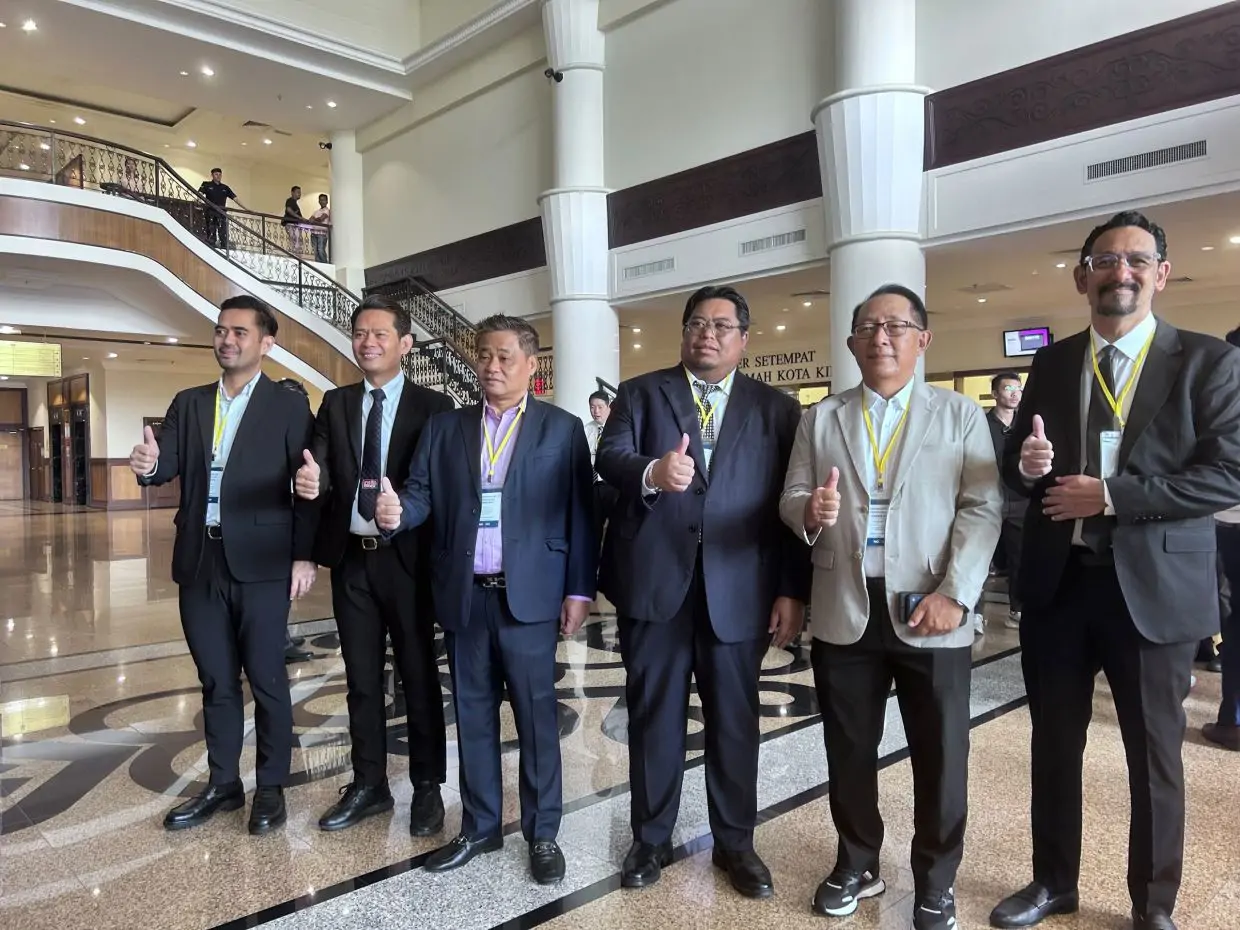
KOTA KINABALU: Sabah leaders from both sides of the divide and members of the public gathered outside the court complex here on Thursday (Oct 29) for the Court of Appeal hearing on Sabah’s 40% revenue share entitlement.
Kuamut assemblyman Datuk Masiung Banah said he was there to support the fight for state rights, while Nabawan elected representative Datuk Abdul Ghani Mohamed Yassin said he was there for solidarity.
Tanjung Keramat assemblyman Shah Alfie Yahya said he wanted to better understand the 40% share being sought, while Lamag's Mohd Ismail Ayob said it was important to fulfil the aspirations of the people.
Datuk Hazem Mubarak Musa, the Sungai Manila assemblyman, said Sabahans' common goal is to see their rights under the Malaysia Agreement 1963 (MA63) fulfilled.
A three-member appellate panel is expected to convene at around 10am to hear Putrajaya's arguments against the High Court decision on Oct 17 last year specifically on the issue of the lost revenue.
The court has allowed up to 250 people to gather at its conference hall to follow the hearing live through a closed-circuit audiovisual transmission from the courtroom. - Star
PARLIAMENT | The Malaysia Competition Commission (MyCC) is investigating 510 firms suspected of bid-rigging involving public and private sector tenders worth more than RM3 billion.
Domestic Trade and Cost of Living Minister Armizan Ali said the commission has also “proposed actions” against 18 firms suspected of bid-rigging in food supply and cleaning services tenders worth over RM108.3 million.
Armizan (above) said the tenders involved 12 public sector entities, comprising six ministries, three public universities, two state Islamic religious departments and a federal statutory body.
He also said evidence gathered by MyCC included the centralised coordination and preparation of tender documents, the exchange of information, including proposed bid prices, and the sharing of financial and human resources among the enterprises, Bernama reported.
The enterprises have been given the opportunity to submit representations before MyCC makes its final decisions, taking into account their responses and the evidence gathered during the investigation.
“MyCC has taken enforcement action against 58 companies for bid rigging, with penalties totalling RM98.49 million,” Armizan said when winding up the debate on the Supply Bill 2027 at the policy stage for his ministry in the Dewan Rakyat yesterday.
On Tuesday, the Education Ministry said it would look into allegations of a cartel or collusion in Phase Two of the cooked food supply service tenders for the 2027-2029 period.
The ministry was also prepared to cooperate with the MACC and other relevant authorities if further investigations were needed.
E-commerce law
On the proposed e-commerce bill, Armizan said it would be tabled at the next Dewan Rakyat sitting to strengthen accountability among online platforms and sellers.
He said the proposed legislation would focus on four areas: consumer protection; the responsibilities of platform operators, online sellers and consumers; efficient dispute resolution mechanisms; and alignment with international model laws.
The bill would also seek to protect consumers from unfair trade practices and strengthen enforcement against cross-border e-commerce platforms selling goods and services directly to consumers in Malaysia.
“It will establish clear accountability to ensure a fair and equitable online business environment, particularly for local traders and consumers.
“This includes ensuring that foreign sellers and operating platforms meet appropriate standards of responsibility, particularly in consumer protection and transaction transparency,” the minister added. - Mkini
Locally developed navigation apps should be subjected to the same cybersecurity scrutiny as their foreign counterparts to ensure they can protect user data, tech experts say, amid the government's push of the local TuJu app over Waze.
At the same time, they challenged the government's rationale for banning Waze for civil servants because apps such as Google Maps, whose parent company Google bought Waze in 2013, also collect similar information from their users.
Experts cautioned that Malaysian-developed applications should not automatically be considered safer than foreign competitors, stressing that all should be assessed against the same cybersecurity standards.
Prime Minister Anwar Ibrahim recently touted TuJu as an alternative to Waze due to national security concerns over the latter’s Israeli roots, but TuJu soon faced complaints over technical glitches and navigation shortcomings following a surge in users, which Anwar acknowledged after overwhelming public feedback.
Malaysian Highway Authority (LLM) Hasni Mohammad later clarified in an interview with Malaysiakini that TuJu was never intended to rival Waze, but was developed primarily to improve services along tolled highways by providing traffic updates, information on rest stops and emergency contacts.
Despite its more limited intended role, questions remain over the readiness and security of local navigation apps.
Equal cybersecurity checks
Cybersecurity consultant Aaron Ikram Mokhtar said the government should evaluate all navigation applications using consistent criteria, including the types of data collected, where they are stored, whether they are shared with third parties and how they are protected against unauthorised access.
The Tuju highway navigation app
“TuJu still collects location data and relies on external mapping services, and there is no clear public evidence that either app has been independently audited.
“Country of origin should be one consideration, not the deciding factor. Applying the same standard to Waze, Google Maps, TuJu, and Pintaz would make the policy more credible and less selective,” he said, noting that local applications should be scrutinised as heavily to ensure their safety.
He added that local developers could introduce bug bounty programmes, which reward security researchers for identifying vulnerabilities so they can be fixed before malicious actors exploit them.
Such measures would be particularly important because weaknesses in one application could expose users to wider risks if they reused the same login credentials across multiple platforms, including social media and online banking services.
Building confidence by being transparent
Akati Sekurity chief executive officer Krishna Rajagopal said local developers could build public confidence by being more transparent about how their applications operated and handled users' information.
He said users who had relied on Waze for years might be reluctant to switch to unfamiliar services, particularly if the government simply instructed them to stop using one application without adequately explaining the reasons or demonstrating that alternatives were reliable.
However, clearer disclosures about data collection, security measures and accountability could encourage users to consider locally developed applications on their own merits.
“By right, the same six requirements that the National Cyber Security Agency (Nacsa) has outlined should be answered by LLM or TuJu or any other (local) alternative.
“I think that's very important. A lot of people perhaps have a bit of uneasiness about the fact that in Malaysia, government authorities are not included in the Personal Data Protection Act.
“So if there is an incident with a local alternative, who's liable?” he asked.
Cybersecurity risks
The six factors outlined by Nacsa for assessing navigation apps’ cybersecurity risks are as follows:
the types of data accessed,
app permissions,
where data is processed,
data retention policies,
third-party sharing arrangements, and
the security controls implemented by developers.
The agency also highlighted that Waze collects information beyond users’ locations, including journeys and routes, GPS and device sensor data, timestamps and IP addresses. Depending on users’ device and account settings, the app may also collect location and travel information when it is not actively being used.
Nacsa warned that such data, when collected repeatedly and analysed in aggregate, could reveal patterns in users’ movements and activities.
Waze, which is headquartered in Tel Aviv, has denied allegations that its app collects sensitive government information or allows third parties to exploit users’ personal data.
A spokesperson told Malaysiakini that the app operates under strict privacy policies to protect user data and complies with global data protection standards.
Justification?
Concerns over the readiness of local alternatives aside, the experts further questioned the government’s decision to ban Waze, particularly whether its links to Israel alone are sufficient to justify the move.
Aaron said it was important to distinguish between a potential security risk and a demonstrated threat, particularly when a restriction affects a service used by the public.
“A potential risk means an app collects data that could be misused; a demonstrated threat means there is evidence of actual misuse, a breach, or unlawful access.
“Nacsa says there is no evidence Waze has analysed aggregated location data to profile users. Therefore, the ban can be defended as precautionary, but it should not be presented as proof of an existing security incident,” Aaron said.
He instead opined that the government should publish a summary of its security assessment of Waze, including how it collects, stores and shares users’ data, to explain why the ban is necessary.
“(Because) without that, the public cannot judge whether the ban is proportionate or based mainly on political concerns,” Aaron added.
Digital media expert and Monash University lecturer Benjamin Loh also concurred with the idea, saying the government should identify the actual national security concerns instead of treating Waze's reference to Israeli law as sufficient justification.
“Just because Waze indicates that they are somehow following Israeli laws… it's unclear whether that means that they are going to undercut or supersede Malaysian laws and start to carry that data as well,” Loh said.
Why Waze but not Google Maps?
The experts also questioned why the restriction appeared to single out Waze when other widely used foreign navigation applications, particularly Google Maps, collect similar categories of user information. Google Maps, which bought Waze in 2013, is based in the United States.
Aaron said Waze and Google Maps were technically comparable in that both could collect users' location information, routes and device data, with background location access depending on their settings and permissions.
The more apparent distinction, he said, concerned their respective legal jurisdictions rather than a fundamental difference in the types of data they could collect.
Loh, however, described the reasoning for exempting Google Maps on the basis of its US jurisdiction as “silly”, arguing that foreign technology companies generally operate across borders while remaining subject to the laws of the countries in which they provide services.
He said the collection of user data was common among major technology companies, including those based in the US, making it difficult to justify treating Waze differently based on its country of origin alone.
“Any app, technically speaking, is going to cater towards the law in its own respective country. But due to the international nature of how apps work anyway, most apps essentially will still cater towards the local laws in any specific country as well,” he said.
Loh said that although data protection regulations have strengthened safeguards against the misuse and distribution of personal information, major technology companies continued to collect substantial amounts of user data.
He added the government should therefore explain what made Waze a distinct security risk compared with other navigation applications, rather than apply restrictions selectively.
Pesuruhjaya Tinggi India Somnath Ghosh berkata hubungan India-Perlis mempunyai sejarah panjang yang boleh dimanfaatkan.
Somnath Ghosh mengadakan kunjungan hormat ke atas Raja Perlis Tuanku Syed Sirajuddin Jamalullail dan Raja Perempuan Perlis Tuanku Tengku Fauziah Tengku Abdul Rashid di Balai Menghadap Biru, Istana Arau. (Gambar Istana Arau)
PETALING JAYA: India mahu meneroka peluang kerjasama baharu dalam sektor pendidikan dan ekonomi di Perlis bagi memperkukuh hubungan dua hala.
Perkara itu antara dibincangkan dalam kunjungan hormat Pesuruhjaya Tinggi India ke Malaysia Somnath Ghosh yang menghadap Raja Perlis Tuanku Syed Sirajuddin Jamalullail dan Raja Perempuan Perlis Tuanku Tengku Fauziah Tengku Abdul Rashid di Istana Arau, semalam.
Mengiringi baginda ialah Raja Muda Perlis Tuanku Syed Faizuddin Putra Jamalullail dan Raja Puan Muda Perlis Tuanku Lailatul Shahreen Akashah Khalil.
Turut berangkat, Waris Yang Kedua Negeri Perlis, Syed Sirajuddin Areeb Putra Jamalullail serta puteri kedua baginda Sharifah Farah Adriana Jamalullail.
Menurut kenyataan Istana Arau, kedua-dua pihak membincangkan pelbagai peluang kerjasama baharu demi manfaat bersama, termasuk potensi kolaborasi dalam sektor pendidikan dan ekonomi.
Ghosh berkata kunjungan itu juga bertujuan mengukuhkan hubungan India dengan Perlis yang sudah lama terjalin.
Katanya, hubungan itu dapat dijejak sejak lawatan negara rasmi Yang di-Pertuan Agong Ketiga, Almarhum Tuanku Syed Putra Jamalullail, ke India pada 1961.
Menurutnya, lawatan bersejarah itu membantu meletakkan asas hubungan diplomatik moden antara Persekutuan Tanah Melayu, yang kemudiannya menjadi Malaysia, dengan India.
India, katanya, turut menghargai peranan institusi diraja Perlis dalam memupuk keharmonian dan kemajuan.
Ghosh merakamkan penghargaan kepada Raja Perlis dan Raja Perempuan Perlis kerana menerima kunjungan hormatnya serta yakin hubungan India-Perlis akan terus berkembang.
Sepanjang hari pertamanya di Perlis, Ghosh turut menghadiri taklimat mengenai potensi pelaburan negeri oleh Bahagian Perancang Ekonomi Negeri Perlis, selain menyertai beberapa program bersama Tuanku Syed Faizuddin. - FMT
Lim Lip Eng says an average of more than one police officer or personnel member was arrested daily over the past five years and eight months.
Kepong MP Lim Lip Eng said the public will lose their trust in the police if they are involved in crime.
PETALING JAYA: Kepong MP Lim Lip Eng has called on Inspector-General of Police Khalid Ismail and Attorney-General Dusuki Mokhtar to disclose how many of the 2,097 police officers and personnel arrested from 2021 to August this year have been charged, convicted or dismissed from the force.
In a written parliamentary reply to Lim on Tuesday, home minister Saifuddin Nasution Ismail revealed that 1,551 of the police officers and personnel arrested from 2021 to August this year were nabbed for drug-related offences. Sixty-four were arrested in relation to robberies, and 482 were arrested by the Malaysian Anti-Corruption Commission.
In a statement today, Lim said the 2,097 arrests amounted to an average of more than one police officer or personnel member being arrested daily over the five years and eight months, describing the figure as a “severe blow” to the integrity of the police force.
“The police are supposed to arrest criminals, not become criminals themselves. How can the public continue to trust the police if they are involved in crime?” said Lim, a lawyer by training.
“And these are just three categories of offences… They do not include the various other crimes not specified in the minister’s reply. What is the actual number of police officers and personnel arrested for all offences?”
Lim also questioned the delay in investigating a case involving 12 police officers suspected of robbing a group of Chinese nationals of cryptocurrency worth about RM200,000 in Country Heights, Kajang, on Feb 5.
The 12 police personnel, including four officers from the Bukit Aman commercial crime investigation department, were detained for suspected involvement in a gang robbery.
Khalid previously said the policemen had been assigned to desk duties to ensure that the investigation could proceed properly.
In his written parliamentary reply to Lim, Saifuddin said the case remained under investigation, more than eight months after the incident.
Lim contrasted this with the case of Malaysian Border Control and Protection Agency chief Shuhaily Zain, who was charged in court 23 days after an incident at KLIA.
“The inspector-general of police and the attorney-general should explain the difference in the investigation timelines,” he added.
Shuhaily was charged in the Sepang magistrates’ court on Oct 21 with assaulting two policemen last month. - FMT