


Project Stability and Accountability for Malaysia (Projek Sama) urges BN chairperson Ahmad Zahid Hamidi to commission a study on the political benefits and costs of local elections to BN.
This would be more productive, instead of merely asking Umno Youth chief Dr Akmal Saleh and MCA Youth chief Ling Tian Soon to “kiss and make up” over their disagreement on the latter’s advocacy of local government elections.
BN should also consider another of MCA’s progressive proposals: a law on equitable constituency development fund (CDF).
Ling, his predecessor Nicole Wong, and MCA Federal Territories chairperson Wee Jeck Seng are forward thinking leaders in BN who can see how the abolition of local elections - a move that helped strengthen Alliance/BN’s dominance until 2008 - has now turned into a curse for BN’s competitiveness.
This is especially true in the six states dominated by PAS and Pakatan Harapan, namely Terengganu, Kelantan, Kedah, Perlis, Penang, and Selangor.

The winner-takes-all nature of local councillor appointments allows state governments to exclude opposition parties, and even allies, from representation in local councils.
This perpetuates the dominance of the state ruling parties by disincentivising young political talents from joining the unrepresented parties, or by denying those talents an important training ground for rising to the state and federal arenas.
30pct of votes but nothing to show for
The best example is Terengganu, where BN won about 31.68 percent of the votes in the 2022 parliamentary election and 28.7 percent in the 2023 state election, the highest among the six states.
Yet it holds not a single parliamentary or state seat because of the first-past-the-post (FPTP) electoral system.
And because local councillors are appointed, the 30 percent of voters who chose BN did not get even one of the state’s 120 councillor seats.
The implication is disastrous for BN’s standing as a national party, reducing it to a regional party of southern Peninsular Malaysia.
If a young Malay talent in Terengganu wants to enter politics, they would first consider PAS rather than Umno, because the latter has no training ground for them to hone their skills in politics and governance.
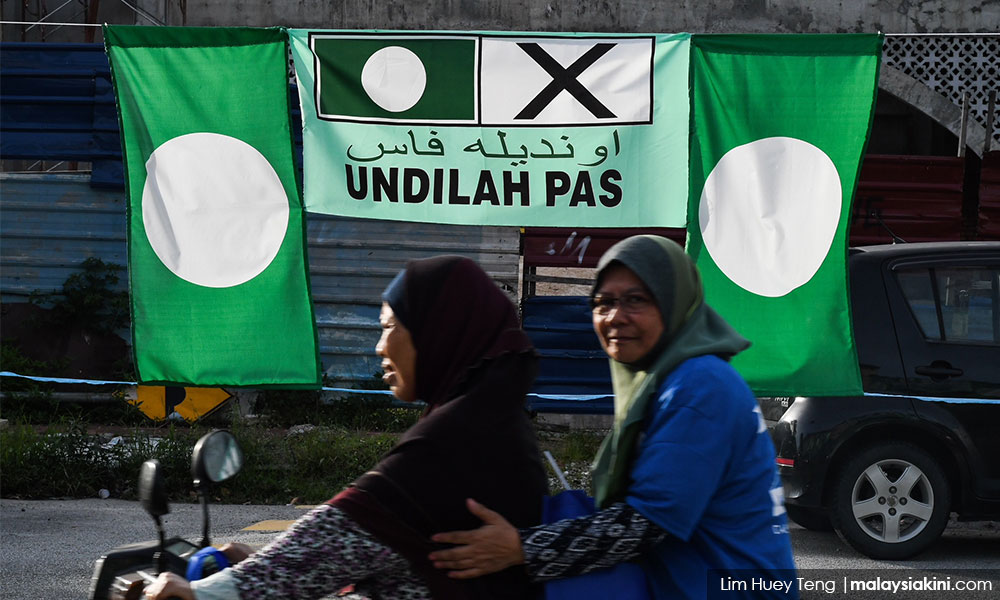
If they did join Umno, they would have to move to the southern states, such as Johor.
This dire prospect applies not only to Terengganu, but also to Kelantan, Kedah, Perlis, Penang, and Selangor.
This threat of BN/Umno’s de-nationalisation will not be resolved by the BN-Perikatan Nasional pact.
Even if PN, or effectively PAS, gives BN/Umno one or two parliamentary and state seats and several councillor seats, they will be merely ornamental.
The threat persists because PAS will rationally want to maintain its political monopoly and will not allow Umno to emerge as a potential rival in future.
Is this the future that Umno is willing to sign up to?

Smaller and smaller slice of electoral pie
Since 2018, keeping a monopolistic, anti-competitive political system has run against BN/Umno’s best interest, and entering an alliance with either PN or Harapan does not reverse this.
Under FPTP and the conventional rules of coalition politics in Malaysia, BN/Umno would not be allowed to contest in constituencies held by its partners.
In the 2023 state elections, Umno could only contest in constituencies won by PN, in addition to those it had won in 2018, with the exception of Dusun Tua, which DAP passed to Umno.
Having won only 9.18 percent and 5.56 percent of the votes in Selangor and Penang respectively, Umno was given only two and three councillor seats.

Can BN/Umno expect much greater generosity from PAS, the party’s ultimate competitor for the Malay nationalist support base?
Better democratic representation is good for BN
This is why BN/Umno should conduct its own study on the political benefits and costs to BN/Umno of having local elections.
It should, in fact, study the net benefit of holding pilot local elections in Kelantan and Terengganu, where Malays constitute 95 percent or more of the electorate and need not at all worry about losing power.
BN/Umno must not base its position on local elections on the study commissioned by the federal territories minister on the feasibility of local elections in Kuala Lumpur.
The study was narrowly confined to the capital city and to the legal context of the Federal Capital Act 1960. More fundamentally, it did not consider inter-party competition, and hence BN/Umno’s best interests.

BN/Umno must be bold enough to confront today’s political realities and ask whether the winner-takes-all, anti-competitive, and monopolistic political structure entrenched after 1969 still favours a BN/Umno that no longer enjoys dominance and cannot realistically expect to rebuild it after 2018.
In this context, BN/Umno should consider moving away from a pure FPTP electoral system, centralised federalism, and executive dominance over Parliament.
BN/Umno’s ultimate self-interest lies in its electoral competitiveness vis-à-vis its rivals, including both Harapan and PN, rather than counting on the short-term benefit of an alliance with either of the two rival blocs.
BN/Umno should show itself as a party that is open to reforms and willing to consider proposals that promote democracy even at the local level and promote a level playing field for all parties by championing a law on equitable CDF.
Otherwise, it will be viewed as a party that is still stuck in the past and tone-deaf to the rakyat’s aspiration for positive political reform. - Mkini
PROJEK SAMA is an initiative to advocate for institutional reforms for the sake of political stability and accountability.
The views expressed here are those of the author/contributor and do not necessarily represent the views of MMKtT

No comments:
Post a Comment
Note: Only a member of this blog may post a comment.