



THE difficulty some Indian families face when renting houses in Malaysia is a serious social issue. It deserves discussion because access to housing should depend on a tenant’s financial ability, rental record and conduct – not ethnicity, religion or cultural background.
There are several possible reasons but it is important to distinguish between documented ethnical discrimination, landlords’ perceptions and genuine financial or tenancy requirements.
#1 Ethnic and racial discrimination
Some landlords may prefer Malay or Chinese tenants and reject Indian applicants because of racial stereotypes. This can happen even when an Indian family has a stable income and can afford the rent.
#2 Stereotyping and prejudice
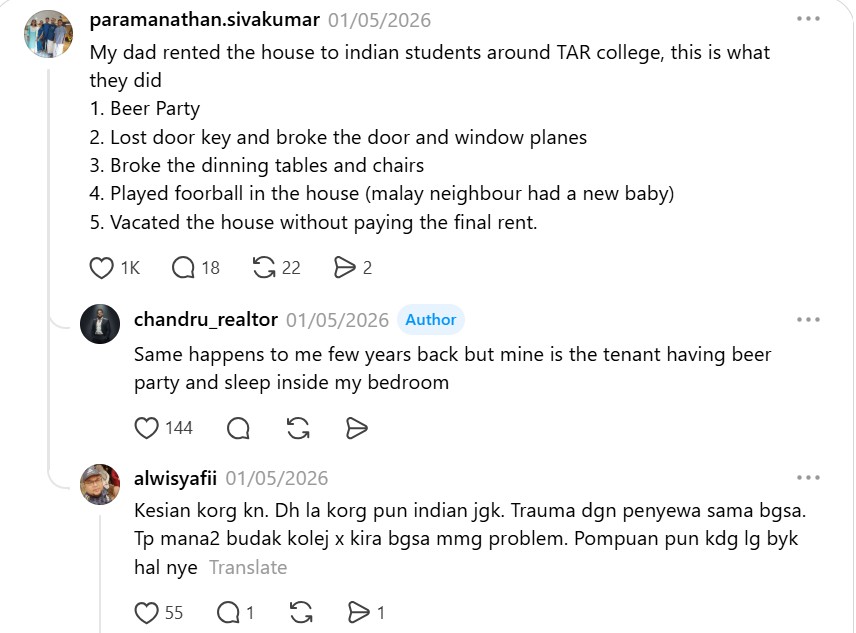
Certain landlords may associate Indian tenants with negative stereotypes and prejudices concerning noise, alcohol consumption, large gatherings or property maintenance. These assumptions are unfair when applied to an entire community.
#3 Religious and cultural differences
Some landlords may have preferences concerning food preparation, cooking smells, religious practices, visitors or household arrangements. These preferences can become discriminatory when used to exclude tenants based on their ethnicity or religion.
#4 Socio-economic perceptions
Moreover, some Indian households, particularly those facing lower incomes or insecure employment, may encounter difficulties meeting rental deposits, advance payments and documentation requirements. However, financial difficulties are not exclusive to Indians.
#5 Informal rental practices
Some property owners and agents make decisions based on personal preferences rather than transparent screening criteria. An applicant may be rejected without being given a clear reason.
What does the research say?
This is not merely an anecdotal complaint. Research has documented the problem.
i. Academic study (2025)
A study entitled “Housing Racism Against Indians in Malaysia’s Klang Valley” by Gabriel Pereira and Ting-Fai Yu published in the journal Asian Anthropology in 2025 has examined how racial stereotypes affect Indian Malaysians seeking rental accommodation.
The researchers identify racial prejudice and stereotypes portraying Indians negatively as factors influencing landlords’ decisions. Get Access
ii. YouGov survey (2019)
The Malaysian survey found that 46% of Indian Malaysians experienced ethnic discrimination when renting followed by their Chinese compatriots (20%) and the Malays (18%)
This suggests that Indian Malaysians reported substantially higher levels of rental discrimination.
iii. Architects of Diversity (2026)
A study of 35,367 online room-rental listings in the Klang Valley collected in February 2026 found that:
- 8% explicitly excluded at least one ethnic group.
- 7% of all listings explicitly excluded Indian tenants.
- Only 68.3% were open to Indian tenants.
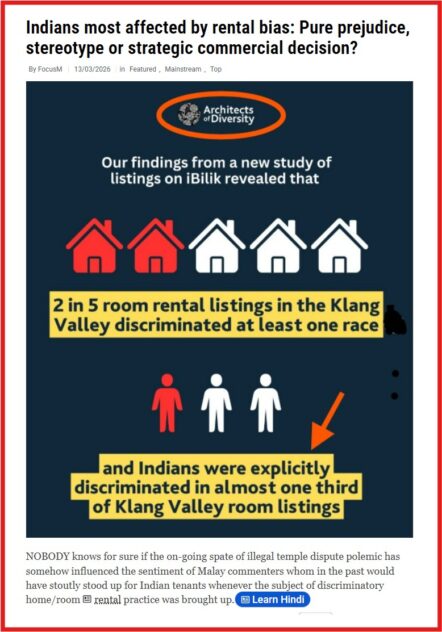
However, these figures were derived from room rentals advertised on iBilik as opposed to the entire Malaysian housing market or exclusively family-house rentals.
Why is this particularly concerning for Indian families?
There are several consequences beyond simply finding a place to live. They are:
Limited housing choices: Families may have to search longer or accept properties outside their preferred neighbourhood.
Higher financial burden: They may have fewer affordable options if certain listings exclude them.
Educational disruption: Children may have to travel farther to school or change schools when families cannot secure suitable accommodation.
Social segregation: Ethnic preferences in housing can reinforce residential separation between communities.
Psychological impact: Repeated rejection can create frustration, humiliation and a feeling of being treated as second-class citizens.
What can Malaysia do?
I would suggest five measures:
- Introduce clear residential tenancy legislation that prohibits unjustified racial discrimination.
- Require property agents to follow professional, non-discriminatory tenant-selection practices.
- Establish an accessible housing discrimination complaint mechanism.
- Encourage rental platforms to remove race-based filtering.
- Promote objective tenant screening based on income, employment, rental history and ability to pay.
Article 8 of the Federal Constitution establishes equality before the law. However, its application to discrimination by private landlords requires careful legal consideration; it should not automatically be interpreted as a comprehensive prohibition of every private rental decision.
My conclusion
Malaysia is a multi-racial country. A Malaysian Indian family should not have to prove its worth as a citizen before being allowed to rent a house.
A landlord has legitimate rights to protect property and assess a prospective tenant’s financial capacity. However, rejecting an otherwise qualified applicant simply because the applicant is Indian is racial discrimination.
A person’s ethnicity does not determine whether that person is a good tenant. One principle should guide the Malaysian rental market:
A house should be rented based on the tenant’s ability to pay, responsibility and integrity – not the colour of the tenant’s skin.
Deveniskandar Bin K. Shanmuganathan a.k.a. Deven Raja Lawak is a 54-year-old Malaysian comedy entertainer, actor, model and aspiring singer based in Subang Jaya,
The views expressed are solely of the author and do not necessarily reflect those of MMKtT
- Focus Malaysia.

No comments:
Post a Comment
Note: Only a member of this blog may post a comment.