


Projek Sama warns that the political crisis in Negeri Sembilan stems from a poor fit between our outdated electoral system and our divided political landscape, and that there may be replays elsewhere if both stay the same.
When no party can win a majority alone, coalition governments are necessary - a normal feature of mature parliamentary democracies. In countries with proportional representation, parties can form post-election coalitions without first demanding that voters support their allies.
Under the First-Past-The-Post (FPTP) electoral system, our parties opt to form permanent coalitions or electoral pacts, asking their supporters to vote for their allies.
When these allies walk away after the election, voters feel betrayed. This is what happened in Negeri Sembilan, when voters were asked to vote for Umno on Pakatan Harapan’s behalf and now Umno walks away.
This happened during the Sheraton Move when people voted for Bersatu as part of Harapan and then Bersatu pulled out from the coalition.
In both Negeri Sembilan and the Sheraton Move, this damages public trust and demands urgent changes in mindset, practice, and the political system itself.
The Sheraton Move has delivered part of the solution - anti-hopping laws at both federal and state levels, which have since curbed mass defections by individual lawmakers to topple a government.
Had Umno-BN contested under a common permanent-coalition banner with Harapan in 2023, Negeri Sembilan’s anti-hopping law might have triggered 14 by-elections.
The Negeri Sembilan political crisis calls for a solution for the more complicated source of grievance: en masse withdrawal by a party from an electoral and governing pact.
The core challenge is how to spare voters from having to support a party (B) they distrust, without preventing their preferred party (A) from forming a government with B after the election.
Backed into a corner
Under FPTP, many voters are backed into a corner: they must either vote for an unwanted ally or stay home. Both options reduce their political power. Solving this is in the interest of every political party and the health of our democracy.
The institutional fix is to add Closed List Proportional Representation (CLPR) seats on top of existing FPTP seats. This would give voters two votes: one for a local candidate, one for any party statewide.
In Negeri Sembilan, for example, if 12 CLPR seats were added to the existing 36 FPTP seats, a simulation based on 2023 vote shares (Harapan - 39 percent, BN - 38 percent, Perikatan Nasional - 22 percent) would yield the following allocation: Harapan (5), BN (5), PN (2).
Such a narrow margin between seats would naturally boost voter turnout as voters could support their preferred party (A) through the CLPR ballot, regardless of who is on their FPTP ballot.
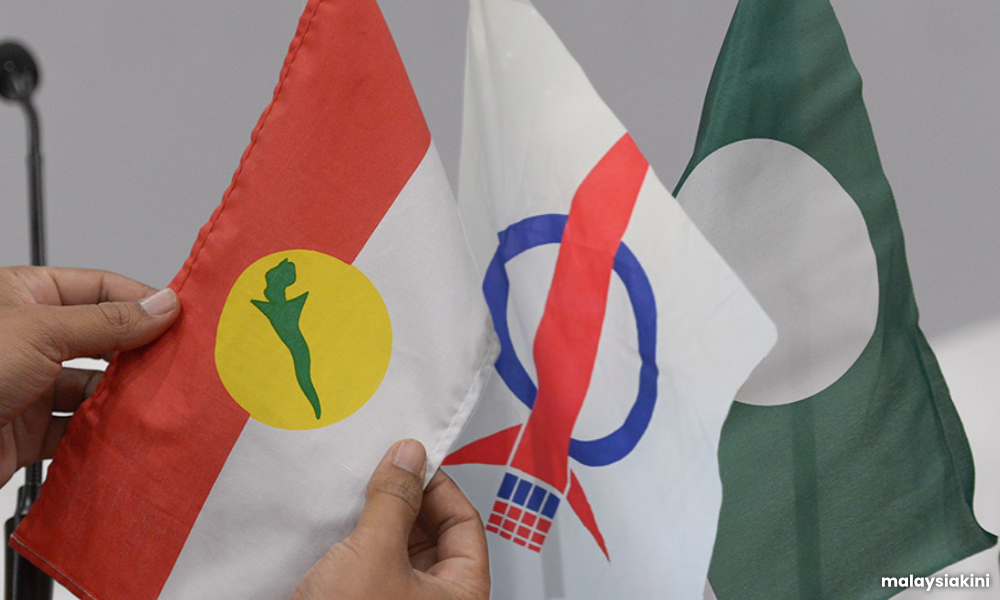
This will force parties to work hard to earn the trust of their allies' supporters instead of simply relying on the alliance to pull them through. Consequently, any party considering a post-election “breakup” will have to think twice, as they will no longer be able to easily harvest the votes of their former partners.
Amending Articles 116 and 117 of the Federal Constitution to allow this is an undeniably difficult task, but it is a conversation that must start now.
Concerns that such a system might further polarise local politics deserve a serious, evidence-based public debate, not knee-jerk dismissal.
Until such reform is in place, Projek Sama urges the following:
For parties: Avoid entering permanent coalitions or completely ruling out absolute power-sharing with specific political parties unless promises can be upheld. Changing their rigid stand after the election would backfire on public trust. Political parties or coalitions should opt for limited electoral pacts with compatible parties where some multi-cornered fights might be allowed, preserving the voter’s right to choose.
For voters: Simply sitting out does not reduce frustration, as it only reduces political power. The best option for voters is to back their party of choice (A) whenever they are on the ballot, but only if party B - an ally of Party A - is contesting, to rigorously scrutinise B’s credibility.
As for Negeri Sembilan, the state government must command the confidence of the majority of state assemblypersons.
This can be achieved through a single-coalition majority, the formation of a coalition government to reach a majority, or even a minority government supported by members of the opposition via a confidence and supply agreement (CSA).

Changes in government should happen through a formal vote of confidence or no-confidence. Crucially, any obstruction of these democratic processes cannot last more than six months; at that point, the state assembly automatically dissolves to pave the way for a fresh election.
Following the withdrawal of BN’s 14 assemblypersons from the Harapan-led government, the democratic options are clear: either a reconfigured government that reflects the new balance of power, or an early election.
While both paths are constitutionally permissible, political actors should be mindful that voters will ultimately judge the legitimacy of their choices.
While Article 10 of the Negeri Sembilan state constitution empowers the four undangs to remove the Yang di-Pertuan Besar, this requires two conditions to be met: (a) specific grounds - severe disability, defects rendering him unfit for the high office of the Yang di-Pertuan Besar under syariah law, or deliberate disregard of the state constitution; and (b) a full and complete inquiry.
As these conditions are not manifestly fulfilled, Tuanku Muhriz Tuanku Munawir remains the legitimate head of state.
With Malaysia already facing a global economic crisis arising from the United States’ and Israel’s war on Iran, all parties and institutions must act responsibly.
Malaysians deserve stability - not the absence of change, but the maintenance of predictability and public trust amidst necessary changes.
To achieve stability, we must continuously scrutinise our institutional frameworks and behavioural patterns to eliminate wrong incentives. - Mkini
PROJEK SAMA is an initiative to advocate for institutional reforms for the sake of political stability and accountability at a time when our nation steers through the uncharted waters of a hung Parliament and coalition government.
The views expressed here are those of the author/contributor and do not necessarily represent the views of MMKtT.

No comments:
Post a Comment
Note: Only a member of this blog may post a comment.