


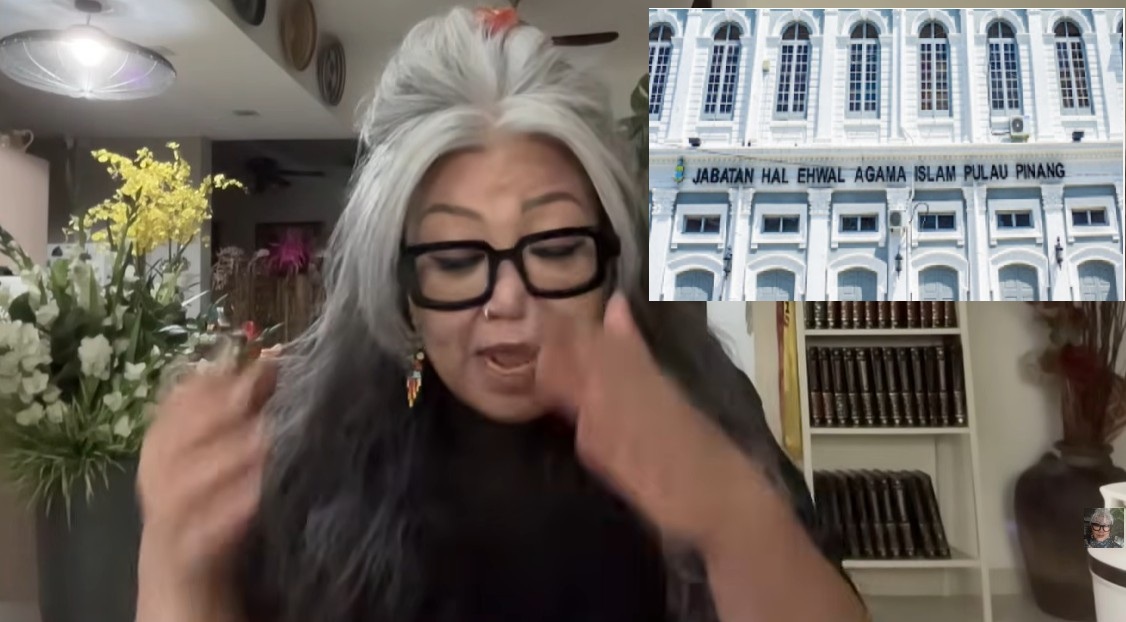
A GENUINE attempt at fostering communal relations or a misguided effort that has upset the Muslim community?
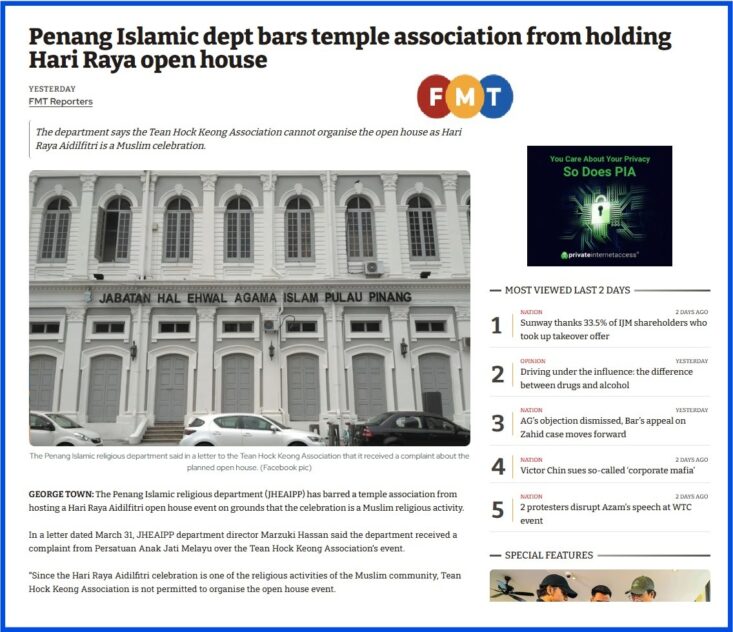
Such is how human rights activist and lawyer Siti Kasim weights on the Penang Islamic Department’s (JHEAIPP) decision to bar temple-linked group Tean Hock Keong Association from staging a Hari Raya open house.

According to Free Malaysia Today (FMT), the contention is that Hari Raya Aidilfitri is a Muslim religious celebration, henceforth a non-Muslim religious body should not organise it.
“Legally, this is NOT a straightforward issue. On strict legal footing, the position taken by JHEAIPP is not entirely baseless but it’s also not absolute,” observed Siti Kasim in her latest YouTube rant.
“Islamic authorities in Malaysia do have jurisdiction over Islamic religious matters, especially to prevent confusion or abuse of Islamic practices.
“However, an open house is not a religious ritual – it’s a cultural/social expression widely practised across communities in Malaysia.”
Thus, scrapping the open house idea itself creates a grey area unless “the event involved religious rites (ie takbir, prayer, zakat elements) which provides stronger justification to restrict”.
“If it was purely social goodwill (food, interfaith gathering), then there’s much weaker justification. So legally, this looks overbroad unless there was clear religious content involved,” opined the Orang Asli advocate.
“Moreover, the social reality is such that Malaysia’s open house culture is multi-racial in nature with Malaysia having long practiced Chinese groups hosting Hari Raya open houses; Malay leaders attending Chinese New Year celebrations; and temples, churches or NGOs hosting multi-faith events.”
Editor’s Note: The Tean Hock Keong Association has explained in a letter to JHEAIPP dated April 5 that the open house was intended to “foster unity, strengthen ties of friendship and reinforce harmony in the local community”.
Furthermore, its secretary Ng Choong Seong justified that the event was carefully planned after advice from the Penang national unity and integration department and discussions with local mosque land surau leaders as well as community representatives who had agreed to it.
Moreover, all food would have been halal and sourced from catering businesses run by residents as a way of supporting the community.
Double standards
On the basis that the open house tradition itself “is civic as opposed to being theological”, Siti Kasim expressed concern that the decision risks (i) re-framing Hari Raya as exclusive rather than shared festivity; and (ii) undermining decades of inter-communal goodwill practices.
“Our government agencies and politicians routinely promote rumah terbuka perpaduan and cross-cultural celebrations yet in this case, a non-Muslim group is told it can’t host such an event,” observed Siti Kasim.
“That itself creates a double standard perception even if unintended. And perception matters politically: It FEEDS narratives of religious gatekeeping and erodes trust in neutral governance.”
“Although there is legitimate concern over religious dilution or confusion, a blanket prohibition is a blunt tool. In this regard, a guideline-based approach would be smarter – allow open houses and prohibit religious rituals being replicated incorrectly.”
So what is Siti Kasim’s verdict in this matter?
This decision feels legally arguable but weakly justified (if no rituals involved), socially tone-deaf and politically counter-productive.
It risks turning a shared national culture into a guarded religious boundary which is not how Malaysia has historically functioned.
Malaysia’s strength has always been this paradox: Deep religious identities + shared public culture. Decisions like this – if not carefully calibrated will start to separate those two – and that’s where long-term friction begins. – Focus Malaysia

No comments:
Post a Comment
Note: Only a member of this blog may post a comment.