


Prime Minister Anwar Ibrahim has reopened Malaysia’s debate over the goods and services tax (GST).
While he has ruled out a return to GST and its broad-based principle, he remains open to incorporating selected GST features, such as input mechanisms, into the existing sales and service tax (SST).
While the intention is to protect lower-income households and give businesses the benefits of an input-tax credit system, it may risk inheriting the worst of both systems.
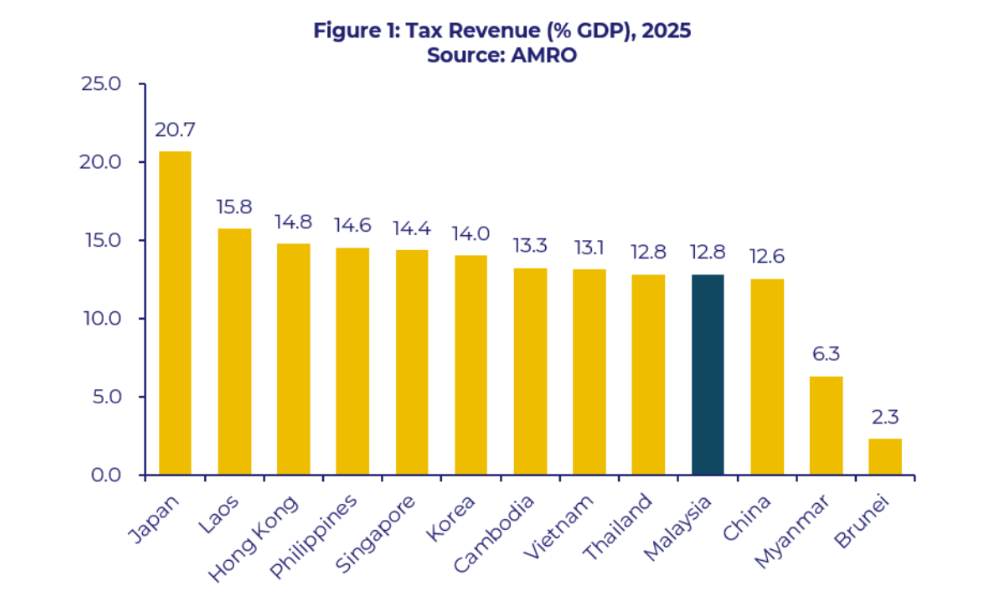
Malaysia can no longer avoid its tax revenue problem. Our tax revenue remains low by regional standards (Figure 1), while spending pressures from healthcare, education, ageing and infrastructure continue to rise.
At the same time, the Fiscal Responsibility Act commits the government to reducing the fiscal deficit to 3 percent of GDP and public debt to below 60 percent of GDP (2025: 65.3 percent of GDP) by the end of 2028.
Achieving these objectives will prove difficult without a more durable revenue base.
From an economic perspective, a properly designed GST is generally superior to SST as a broad-based consumption tax.
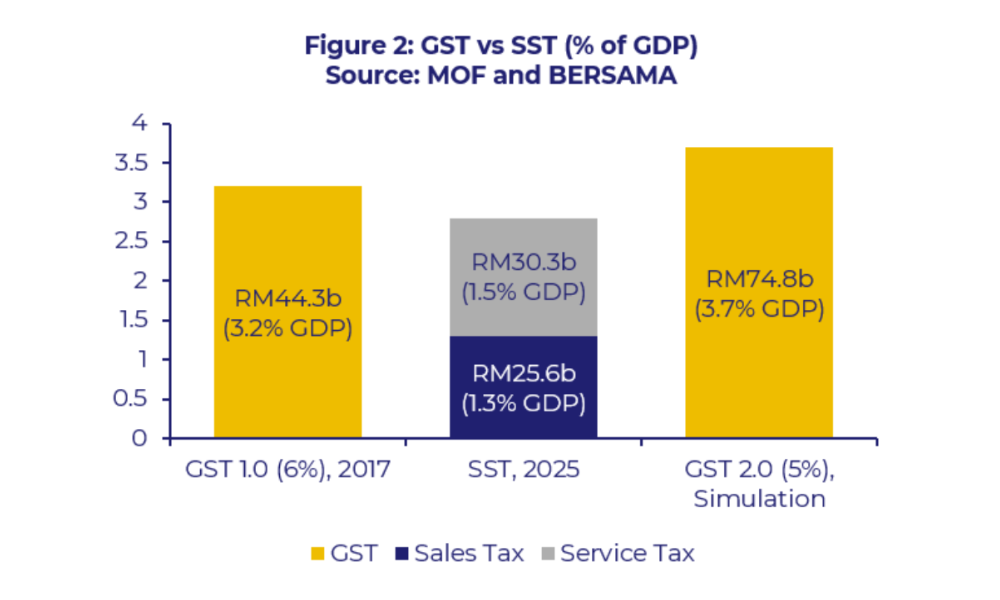
Even a relatively moderate 5 percent GST could generate an estimated additional 1 percent of GDP (RM19 billion) in revenue compared with the current SST (Figure 2).
Moreover, GST allows businesses to claim credits for taxes paid on their inputs, ensuring that tax is levied on value added rather than cascading repeatedly throughout the supply chain.
The same mechanism creates an element of self-enforcement: businesses require valid invoices to claim input-tax credits, thereby generating an audit trail that becomes even more effective alongside the implementation of e-invoicing.
SST, by contrast, has a narrower base, risks cascading and relies heavily on exemptions and sector-specific rules that complicate compliance.
While GST does raise legitimate concerns about regressivity, the challenge can be met with targeted transfers or other forms of financial assistance.
Singapore’s GST Voucher scheme, for instance, offset an average of 84 percent of GST payable by the bottom 20 percent of households.
The economic case for GST is clear, but the elephant in the room is actually political.
GST became a political landmine and was abolished in 2018 under the first Pakatan Harapan government, of which many current political actors, including some in my own party, were part of.
Few have since been willing to seriously advocate for its return. Many understand its economic merits privately but are reluctant to defend it publicly.
The same pattern appears in other difficult reforms, from fuel subsidies to pensions. Yet refusing to make a decision does not eliminate that cost. It merely shifts that cost into higher debt or deteriorating public services as fiscal constraints tighten.
This is precisely why incorporating selected GST features into SST is the wrong compromise.

GST works because it is a coherent value-added tax operating across a broad base. Introducing input-tax credits while retaining SST exemptions and sector-specific treatments would only make the system more difficult to enforce.
Businesses would have to determine which inputs qualify for credits and which transactions remain exempt, while tax authorities would face complicated classification disputes and compliance checks.
Additional exemptions would also create room for lobbying, while potentially breaking the credit chain and recreating the cascading problem GST was designed to eliminate.
If the government believes the value-added mechanism is superior, it should move towards a proper GST rather than constructing a complex hybrid system for which there is little international precedent.
Use better tax refund system
Any GST 2.0 must, however, confront the challenges that damaged confidence in GST 1.0. One major weakness was the tax refund system. By 2018, RM19.4 billion in GST refunds remained outstanding, hurting business cash flow.
Prompt refunds are fundamental to the proper functioning of GST. Without them, an input-tax credit system becomes a tax on working capital. The concern remains relevant today, as businesses continue to raise delays involving tax refunds related to corporate income tax.
A future GST must therefore come with clear statutory refund timelines, transparent tracking mechanisms and the prompt repayment of legitimate claims.
The second condition is a credible social bargain with households. Indeed, a broad-based consumption tax can disproportionately affect poorer households.
However, the solution should be targeted redistribution, not an inefficient hybrid tax that hollows out the tax base through exemptions.
Malaysia should institutionalise social assistance with clear eligibility criteria and predictable benefits, potentially including dedicated GST rebates to protect vulnerable households.
Concurrently, the government must rebuild the public’s confidence that additional tax revenue will be spent responsibly by reducing leakages, strengthening procurement and transparently reporting its expenditures.
There is also merit in considering whether part of GST revenue should be shared with state governments through a transparent formula, alongside greater fiscal devolution to strengthen local public services and reduce regional disparities.
These institutional preconditions are demanding, but Malaysia is better prepared than it was a decade ago.
Tax authorities already have prior experience, businesses have operated under GST before, much of the institutional knowledge remains, and e-invoicing provides a stronger digital backbone for compliance and enforcement.
The government therefore does not need to reinvent the system.
Lack of political will
What Malaysia is running short of is not technical capacity, but political courage. Such tax reforms are inherently unpopular and are often easier to undertake earlier in an administration term, when political capital is stronger.

However, to begin exploring such reform only as the term approaches its final years risks turning reform into yet another feasibility exercise rather than an actual decision.
Malaysia’s political class has become very good at diagnosing challenges, but better at finding reasons not to solve them. Reform cannot mean doing only what is politically painless.
The economic case is clear, and much of the infrastructure already exists. A hybrid GST-SST system designed to avoid a difficult political decision is not meaningful reform; it is simply another way of kicking the can down a road that is rapidly running out. - Mkini
SUM DEK JOE is a trained economist and Bersama policy spokesperson.
LAU KEN ERN is an undergraduate student at the University of Cambridge pursuing a bachelor’s degree in Philosophy.
The views expressed here are those of the author/contributor and do not necessarily represent the views of MMKtT.

No comments:
Post a Comment
Note: Only a member of this blog may post a comment.