


KUALA LUMPUR, Dec 18 — Malaysian universities continue to draw thousands of foreign students each year, with Chinese nationals leading the pack.
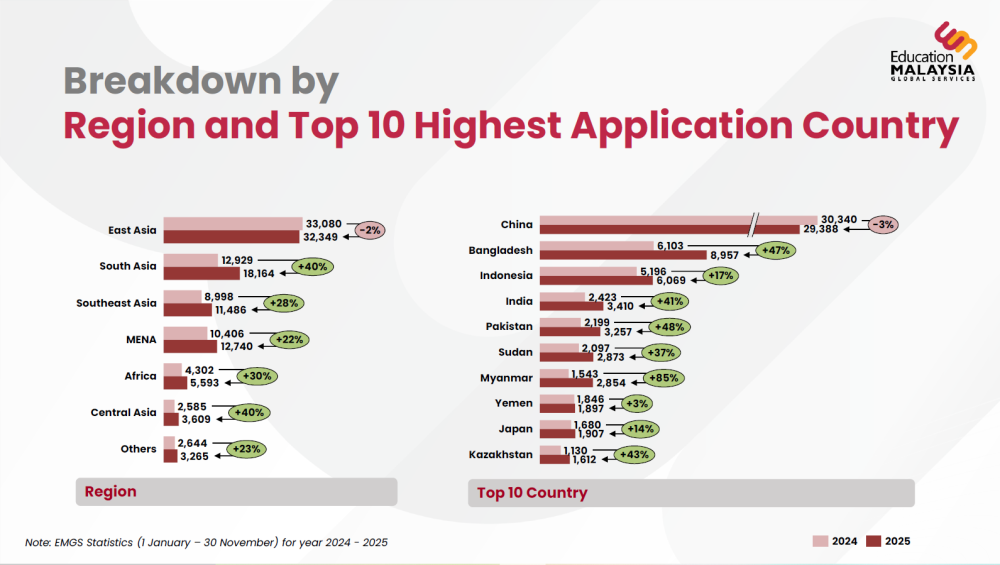
Data from Education Malaysia Global Services (EMGS) obtained by Malay Mail shows 29,388 students from China enrolled in public and private universities from January to November 30 this year, far ahead of Bangladesh (8,957) and India (3,410).
EMGS chief Novie Tajuddin said the slight dip from China – a 3 per cent decline from last year – is due to many top universities in Malaysia hitting their quota for international students, a move designed to maintain quality and balance campus resources.
“As a result, they are unable to admit additional foreign students until enough current international students complete their studies and graduate.
“This restriction forms part of the enrolment governance framework to ensure balanced capacity, quality assurance, and proper resource allocation within the institutions,” he told Malay Mail.
The interest from Chinese nationals has been noticeably rising in recent years.
In 2020, Malaysian universities received 8,876 applications from China, which nearly doubled the following year to 19,202 and continued to rise in 2023 with 26,627 applications.
Bangladesh nationals have also shown significant growth in student numbers, with a 47 per cent increase in enrolments, reaching 8,957 this year from 6,103 last year.
Additionally, enrolments from India have increased by 41 per cent to 3,410 from 2,423 last year.
Overall, EMGS data indicates a 6 per cent rise in total enrolments this year, climbing from 81,992 to 87,206.
What drives the demand?
The demand for studying in Malaysia is driven by various factors; one notable factor is the affordability of education here compared to destinations like the UK, the US, Canada, and Australia.
“Malaysia hosts reputable foreign branch campuses, allowing students to obtain UK-, Australia-, Ireland-, Japan-, and China-accredited qualifications at significantly lower costs while studying locally,” Novie said.
Another factor is EMGS’s promotional efforts in China and the Indian subcontinent.
Novie highlighted the establishment of the Study in Malaysia Corner in China at Guangxi University, enhancing visibility and support for prospective students.
“EMGS also recently participated in the Malaysia Pavilion at the China-Asean Expo, further promoting Malaysia as a preferred education destination to a wider regional audience,” he said.
In Bangladesh and India, EMGS continuously conducts the Study in Malaysia Education Fair.
“Students from both countries have shown increasing interest in studying in Malaysia due to greater social media exposure and on-ground promotional activities.
“Additionally, on 15 December 2025, EMGS will organise the Malaysia-India Higher Education Forum 2025 together with the Association of Indian Universities, along with the first and largest Mega Study in Malaysia Education Fair in Chennai, India,” Novie said.
Economic contributions of international students
According to a study by EMGS, each international student spends approximately RM9,600 per month in Malaysia, encompassing expenses for tuition fees, accommodation, food, and more.
“With a current international student population of approximately 150,000, this translates to a total monthly economic contribution of RM1.44 billion and an annual impact of RM17.28 billion on the Malaysian economy,” Novie added. - malaymail

No comments:
Post a Comment
Note: Only a member of this blog may post a comment.