


Prime Minister Anwar Ibrahim skilfully presided over the Asean summit last year despite a tense geopolitical backdrop.
Despite trade tensions and the conflict in Gaza, Anwar rightly used Malaysia, as Asean chair then, to showcase our country’s capability to lead the bloc.
Anwar even convinced US President Donald Trump to attend the summit in Kuala Lumpur, where he was deftly handled by Putrajaya. While Asean welcomes the US’ re-engagement, the bloc is keen to maintain its centrality to regional policymaking.
Putrajaya, in line with Asean doctrine, continues to pursue a non-aligned foreign policy in the midst of great power competition, tightening economic ties with China in the past decade while relying on Western nations, primarily the US, for security.
A free-trading nation like Malaysia is ultimately dependent on a stable Indo-Pacific where the rule of international law is respected, thereby safeguarding investment flows, export demand, and technology transfers.
This status quo, however, is not guaranteed to hold. The force of US-China competition may yet break the hedging strategy upon which nations like Malaysia have historically depended.
In this sense, it was Anwar’s meeting with Japanese Prime Minister Sanae Takaichi at October’s Japan-Malaysia summit meeting, rather than his seeming rapport with Trump, that says most about Malaysia’s future course through choppy geopolitical waters.
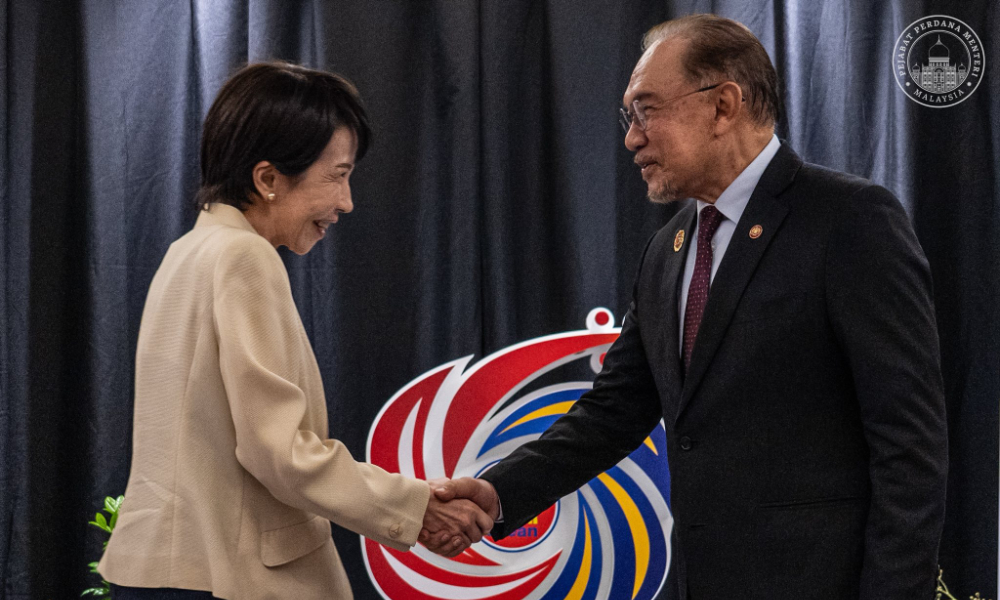
There is much that unites Malaysia and Japan’s visions of regional security. The Asean Outlook on the Indo-Pacific (Aoip), which Malaysia upholds and advances, subscribes to the emphasis of Japan’s Free and Open Indo-Pacific (Foip) policy on rules, non-coercion, and freedom of navigation.
In their meeting, Takaichi emphasised to her counterpart that Japan sees Malaysia as an important, comprehensive, and strategic partner for the realisation of Foip.
Security talks
While economic cooperation has dominated bilateral ties since independence, with Japan being the third largest foreign investor in Malaysia, the security side of the relationship is developing quickly.
This reflects the regional environment, which is certainly deteriorating. Japan’s widely respected Defence Minister Shinjiro Koizumi has emphasised that Japan faces the most severe and complex security environment since the post-war era.
On Dec 6, this was confirmed in the minds of regional policymakers. A Japanese F-15 fighter was threatened by a Chinese J-15 jet fighter, which locked its fire control radar onto the F-15 for 30 minutes.
The international community was quick to condemn this act of aggression, siding with Japan as a defender of the rules-based order.
This incident will only strengthen Koizumi’s intent to deepen ties with like-minded countries, those that share fundamental democratic values and Japan’s commitment to the rules-based international order, as well as reinforcing the archipelago nation’s own defence capabilities.
Defence procurement
Japan’s provision to Malaysia of unmanned aerial vehicles (UAVs) and rescue boats through its Official Security Assistance (OSA) initiative is evidence of this strategy in action.
An agreement has also been reached for Japan to provide a diving support vessel and related equipment, for which Anwar has expressed his appreciation.
While Putrajaya is concerned over, for example, China’s incursions into the exclusive economic zones of Asean nations, it clearly lags Japan in terms of equipping itself for potential instability in the Indo-Pacific.

This reflects Malaysia’s geographic distance from China, as well as Putrajaya’s concerns over potential retribution.
To support this expansion, Malaysia’s defence spending will rise to two percent of gross domestic product by the end of this fiscal year, two years ahead of schedule, and next year’s budget is expected to be the largest on record.
Japan will also, as Koizumi has expressed, use the transfer of defence equipment overseas to like-minded nations, of which Malaysia is one, to shape the security environment in line with Foip’s goals. He is also keen to remove existing constraints on equipment transfer rules.
Putrajaya understands the logic of these steps, although its economic closeness with China makes expanding its own defence capabilities difficult.
However, there are frameworks in place. For example, the Japan-Malaysia Comprehensive Strategic Partnership signed in December 2023 would help advance a shared regional agenda.
Events, as ever in geopolitics, may accelerate reforms. Potential US retrenchment and further incursions by China in Southeast and East Asia represent a direct threat to Malaysia’s national interest, not least the development of its promising semiconductor sector.
In this context, the shared values that underpin Japan-Malaysia ties will increasingly be put to the test.
These are two nations, though differing in size and influence, that can lead the Indo-Pacific away from conflict, preserving the rules-based international order that has yielded prosperity and security in equal measure. - Mkini
R PANEIR SELVAM is the principal consultant of Arunachala Research & Consultancy Sdn Bhd (Arrescon), a think tank specialising in strategic national and geopolitical matters.
The views expressed here are those of the author/contributor and do not necessarily represent the views of MMKtT.

No comments:
Post a Comment
Note: Only a member of this blog may post a comment.