


Negeri Sembilan’s 2026 results offer important insights into how Malaysian voting is changing and staying the same.
The surface analysis of BN-Perikatan Nasional winning through a Malay “unity” alliance obscures important changes and consistencies on the ground. While identity politics remains paramount in shaping voting, conditions are evolving, with Negeri Sembilan’s polls having their own unique voting trends.
This analysis digs into voting trends. Part 1 looks at ethnic voting, with Part 2 focusing on generation and class findings. The latter lenses are critical for understanding voting more holistically.
A more complex picture
A closer look at the polling station and “saluran” (stream) electoral results in last month’s polls, coupled with post-election ground analysis, shows a more complex and multi-faceted picture.
The analysis below differentiates voting in BN and PN contested seats to better understand trends, with the findings detailing the share of the vote in the seats contested, while for Pakatan Harapan (which contested in all seats) and the case for BN in Johor (which also contested all seats), the value listed is for the overall results.
Unlike in Johor where BN’s victory is outright, the findings show that Negeri Sembilan was not a clear-cut outright for any of the coalitions: with the gains came losses, and with the losses came gains.
PAS/PN maintained its strengthened electoral position of 2022, arguably winning the most from the “Malay unity” electoral arrangement. Wawasan Negara – barely one month old officially then – won the most from the strategic alliance, with little on the ground support of its own. The Negeri Sembilan results were starkly different from the total defeat for PAS/PN in Johor.
BN’s victories – winning the state government leadership – came with tradeoffs. Negeri Sembilan’s results differ from those of Johor, where BN won the lion’s share of the Malay vote and a significant share of the non-Malay vote, capturing a middle ground in Malaysia’s multi-ethnic terrain. In fact, Umno/BN did not perform as well as in Johor overall.
In Negeri Sembilan, voting trends returned to ethnic polarisation, with a major difference being a fragmentation of the Indian vote. BN lost the multi-ethnic middle ground due to its electoral arrangement with PAS/PN.
Seat-wise, the biggest decline in support was evident for Anwar Ibrahim’s Harapan, losing control of the state government. The findings show that Harapan’s losses in Negeri are not as severe as those of Johor.
In fact, Harapan experienced a rebound of sorts in Negeri Sembilan; it maintained its traditional patterns of ethnic support from those who voted, except for the Indian community.
Let’s look at the findings in greater detail. Below I draw from an analysis of ethnic voting. Just a gentle reminder that the findings are statistical estimates using ecological inference of voting behaviour and should be read as statistical markers of voting trends.
1. Malay vote - BN’s Malay return, but still divided Malay vote with Harapan gains
The analysis of ethnic voting shows that a strong majority of Malays supported the BN-PN electoral arrangement, an estimated 80 percent. BN won slightly more Malay support in seats they contested compared to PN, given its stronger historic support in the state. In Negeri Sembilan, as in Johor, Umno/BN became the leading champion of the Malays, returning to their old traditional electoral patterns.
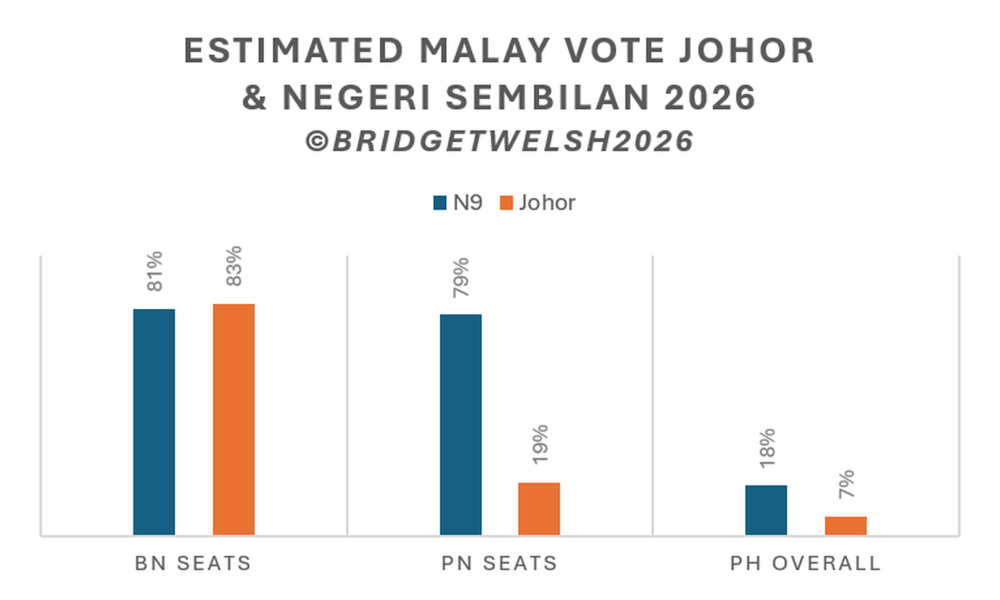
Importantly, BN carried PN in at least four of the seven seats PN won. It is only in Paroi, Ampangan and Bagan Pinang – the latter where the security force vote was decisive – that PAS on its own made a significant contribution to the outcome.
In the seats of Klawang, Sikamat, Serting and Gemas, traditional Umno/BN support was decisive for the PN victory. In contrast, it is only in Labu and Lenggeng where PAS core support boosted BN’s performance, but in both of these seats, BN would likely have won the seats without PAS’ core support.
Harapan won higher Malay support in Negeri Sembilan compared to Johor, an estimated 18 percent compared to an estimated seven percent. Harapan’s share of the Malay vote in the 2022 general election was 19 percent, effectively similar. This is in part the product of Harapan’s incumbency and areas where PKR has developed its own traditional supporters.
Also, some Malays stayed with Harapan in the state election, not comfortable with the BN-PN electoral arrangement. With Harapan winning nearly one-fifth of the Malay vote, the results show continued division among Malay voters.
While this share is not enough for Anwar’s coalition to hold its current number of seats, it shows that Anwar’s coalition remains a player electorally in the state and nationally for a general election, especially in multi-ethnic areas such as Selangor and Perak.
Importantly, Harapan was not “wiped” out among Malays as it was in Johor. The results show that Harapan maintained a core of Malay supporters in Negeri Sembilan.
Finally, Negeri Sembilan’s findings show the rise of the even more right-wing Berjasa party, tied to the hardline Isma group. This party is becoming a political force, adopting the exclusionary hate rhetoric adopted by PAS.
One of the side effects of the normalisation of hate speech has been to increase the electoral viability of even more right-wing parties. The Negeri Sembilan Nilai results, where Berjasa won 21 percent of the overall vote and 39 percent of the Malay vote, are illustrative. It also shows that there are other contenders for the still-divided Malay vote.
2. Chinese polarisation, Indian fragmentation and Orang Asli swing – loss of middle ground
The analysis of non-Malay vote shows a more complex picture.
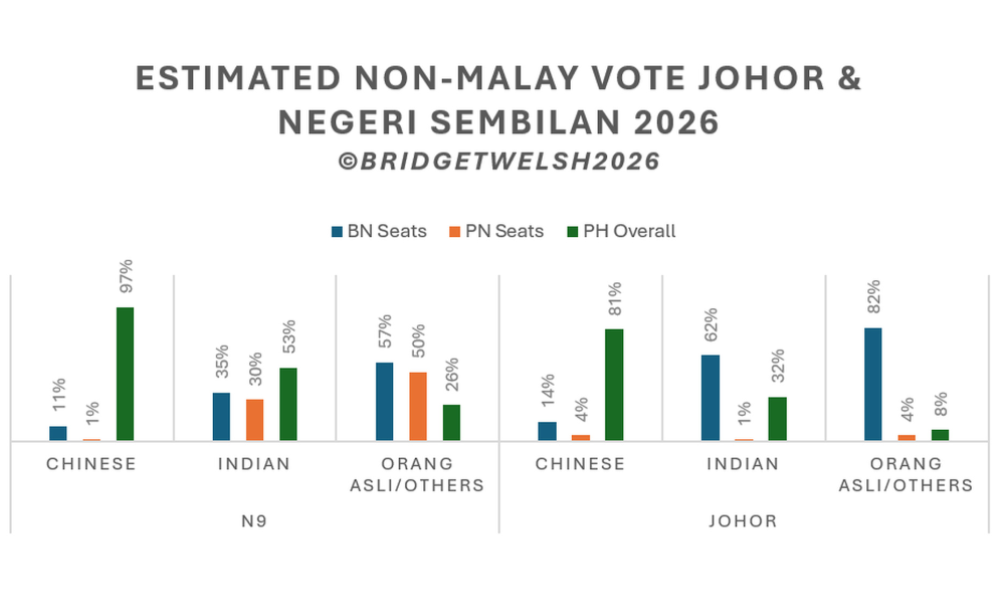
Chinese support remained solidly and overwhelmingly in the Harapan camp, especially for DAP. The support of Chinese voters for Harapan extended to an estimated 97 percent for the state overall (up from an estimated 95 percent in 2023 (where Harapan worked with BN) and estimated 93 percent in 2022), although there is some variation among seats, such as Chennah. (For those interested in learning about some of the key races, check out Kerusi Panas Season 4, Episode 4 out later this week).
The Chinese ethnic polarisation of Negeri Sembilan is stark. PAS won a pathetic estimated one percent - the cost of racial hatred directed toward the Chinese community. BN in their seats did somewhat better, an estimated 11 percent, but not as high as in Johor at 14 percent.
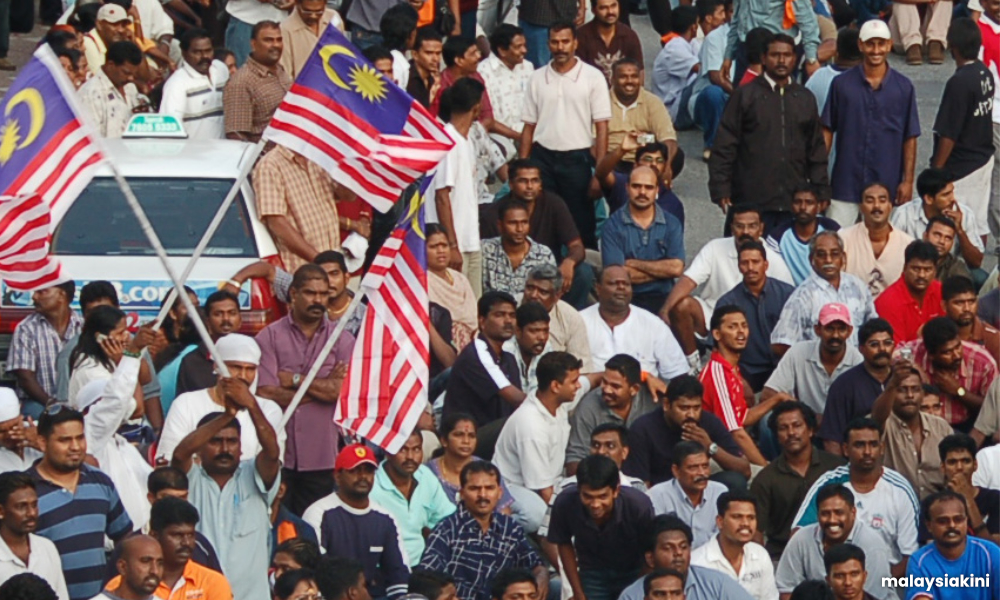
Indian vote became more fragmented in Negeri Sembilan. Please note that for smaller groups such as Indians and Orang Asli, the statistical estimates are less robust. The data shows three things:
First, Harapan lost Indian support overall – which was evident from the ground analysis as well. Harapan support among Indians reached an estimated 53 percent, down from an estimated 79 percent in 2023 and estimated 72 percent in the 2022 general election.
The Harapan support from Indians in Negeri Sembilan was higher than that of Johor, at an estimated 32 percent, speaking to the rebound noted above and rejection of the BN-PN electoral arrangement.
Second, the Negeri Sembilan Indian vote was more fragmented. More of the overall vote went to alternative parties/contenders, as was the case in Jeram Padang, for example, where Bersatu won 13 percent of the overall vote, disproportionately among Indians.
Indian voters are clearly looking for better representation and increasingly voting along racial lines due to greater trust/understanding of Indian candidates. This trend is also a product of the greater salience of identity politics. It is not just Malays who are voting along ethnic lines.
Third, Indian voting extended to both BN and PN, at an estimated 35 percent and 30 percent respectively. This reflects a gain from GE15, up from 21 percent and 19 percent respectively – reinforcing the electoral fragmentation of the community.
For BN, the estimated 35 percent from Indians is considerably lower than that in Johor, estimated at 62 percent. This decline parallels the lower support from Chinese, as BN lost the multi-ethnic middle ground. MCA and MIC were weaker in winning support in Negeri Sembilan, but the loss is also the product of working with PAS/PN.
Orang Asli vote also witnessed a similar difference – higher in Johor than in Negeri Sembilan. By electorally choosing PAS, BN’s electoral trends are also increasingly reflecting PAS’ trends as well.
3. Ethnic turnout increase
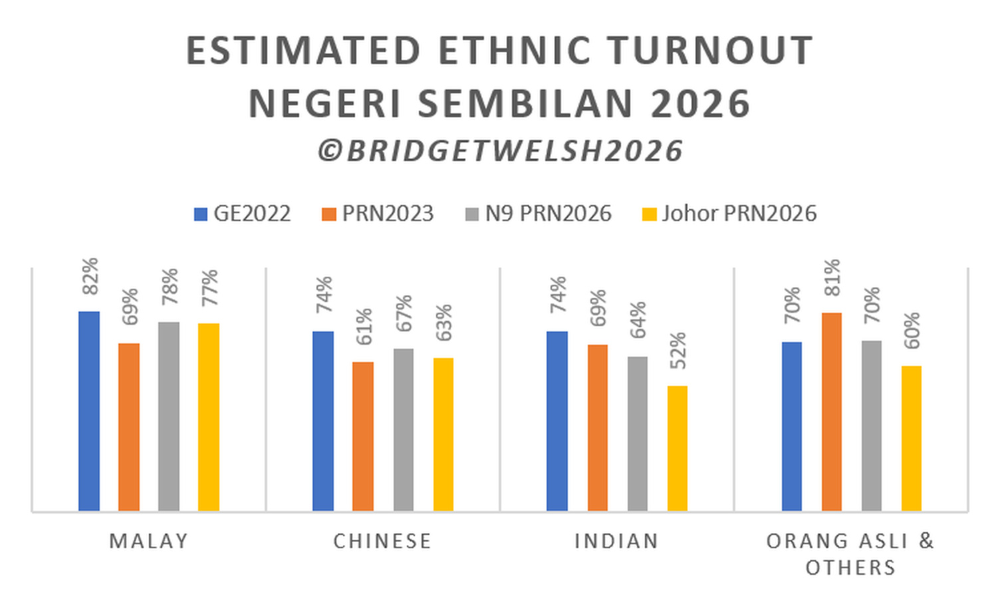
Finally, an ethnic lens on turnout shows that the Negeri Sembilan polls brought more voters to the polls compared to the 2023 state elections, and importantly, compared to the 2026 Johor polls.
The election especially brought more non-Malays out – Chinese estimated turnout was up three percent, Indians 12 percent and Orang Asli/Others 10 percent.
The main reasons were greater mobilisation by parties across the political terrain. For many non-Malays, concerns about the BN-PN electoral arrangement and a backlash against BN gains in Johor were also evident.
Of the communities, Indian turnout was the lowest in Negeri Sembilan’s 2026 state polls, showing dissatisfaction with all on offer. Chinese turnout was still an estimated 11 percent lower than in a general election, reflecting dissatisfaction with Harapan as a whole and continued Chinese voter disengagement.
A changing electoral terrain
The ethnic voting patterns point to three broad implications. Foremost, that despite the gains of the BN-PN alliance, the Malay vote remains divided, with the Harapan still retaining one-fifth and new parties also carving into Malay support.
Second, ethnic polarisation among Chinese and fragmentation among Indians have deepened compared to the Johor polls. Electorally, the effect is that BN’s aim to win more of the multi-ethnic ground in Negeri Sembilan floundered or rather was impacted by PAS' toxic racist hate speech campaign rhetoric and growing non-Malay concerns about an exclusionary Malay alliance.
Third, despite its significant losses, Harapan’s results are not as bleak as the overall results suggest from an ethnic lens.
The problems for Harapan, and strengths for other coalitions, lie elsewhere; the subject of Part 2 (forthcoming), which adopts a non-ethnic lens to understand voting trends. - FMT
BRIDGET WELSH is an honorary research associate of the University of Nottingham’s Asia Research Institute and a senior associate fellow at The Habibie Centre. Her writings can be found at bridgetwelsh.com.
The views expressed here are those of the author/contributor and do not necessarily represent the views of MMKtT.

No comments:
Post a Comment
Note: Only a member of this blog may post a comment.