


This month Prime Minister Anwar Ibrahim and his Madani government mark the mid-term point of a five-year tenure.
It is a time of political inflection – mood changes in the electorate, increased political mobilisation through walks and rallies, and more intensive elite engagement with voters.
The country enters another election season, starting with Sabah, in a campaign that is effectively underway. It comes at a time when demands and critical attention centred on the government remain strong.
Emotions are high among those politically engaged – anger and disappointment meld with admiration and acceptance.
For the majority, there is less enthusiasm for all things politics as they struggle to make a living during this period of economic uncertainty.
At this critical juncture, the key political challenge for Anwar and his government has moved from survival to continuation; the leadership is looking for a contract extension, a second term in office and a public mandate for Madani at the polls.
This piece looks at some of the hurdles ahead in reaching this goal.
Addressing divisions and marginalisation
Let’s start by recognising that securing a second term will not be easy to achieve. In fact, it is a tall order for a multitude of reasons, not least of which are that Malaysia remains deeply politically polarised and fragmented.
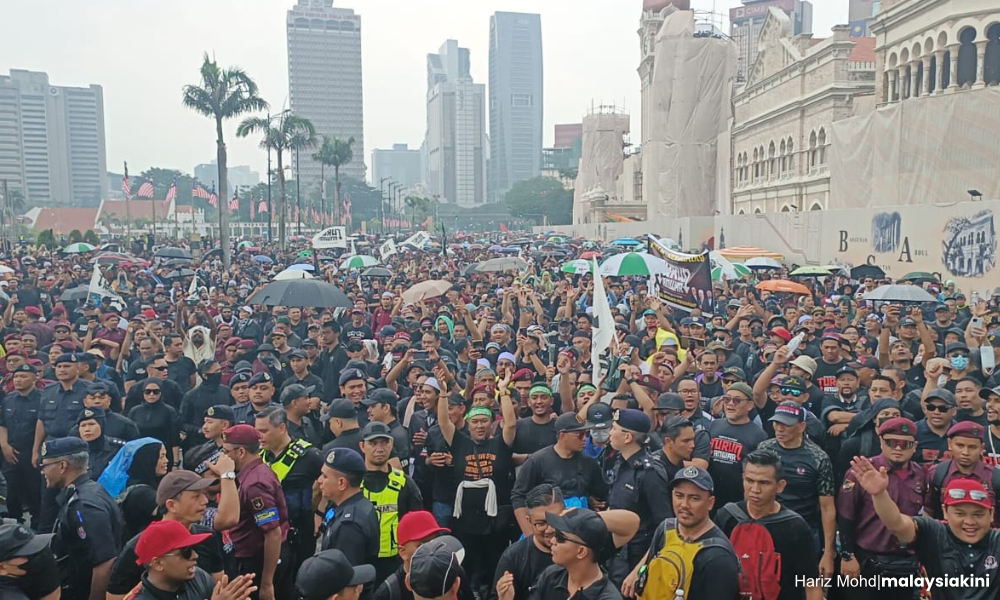
The last two years have entrenched polarisation between those in power and their political foes out of power. The tone of last weekend’s “Turun Anwar” rally and hateful comments in Parliament by opposition politicians showcase this antipathy.
The political divisions in society remain, even if they only come to the surface over various ethnically loaded spats as politicians turn back to mobilising division for political gain.
The pattern has been to address the divisions by quieting discussion, by trying not to directly engage the issues, rather than address underlying points of contention and to promote dialogue.
All of Malaysia’s various communities still resonate with perceptions of displacement and grievances. From the lack of majority Malay support for the Madani government to minority communities feeling ignored and further marginalised, the reality is that there are serious gaps in inclusion and policies to promote broader belonging.
These sentiments extend to a widening divide between Borneo and Peninsular Malaysians, as there has been disquiet and resentment as Borneo, especially Sarawak, has started to prosper (after decades of federal neglect).
To compound the divisions, an approach has been to reinforce another divide, between an arbitrary category of middle and upper earners who pay the majority of taxes to those who rely on government support, a class divide with worrying perceived ethnic overtones.
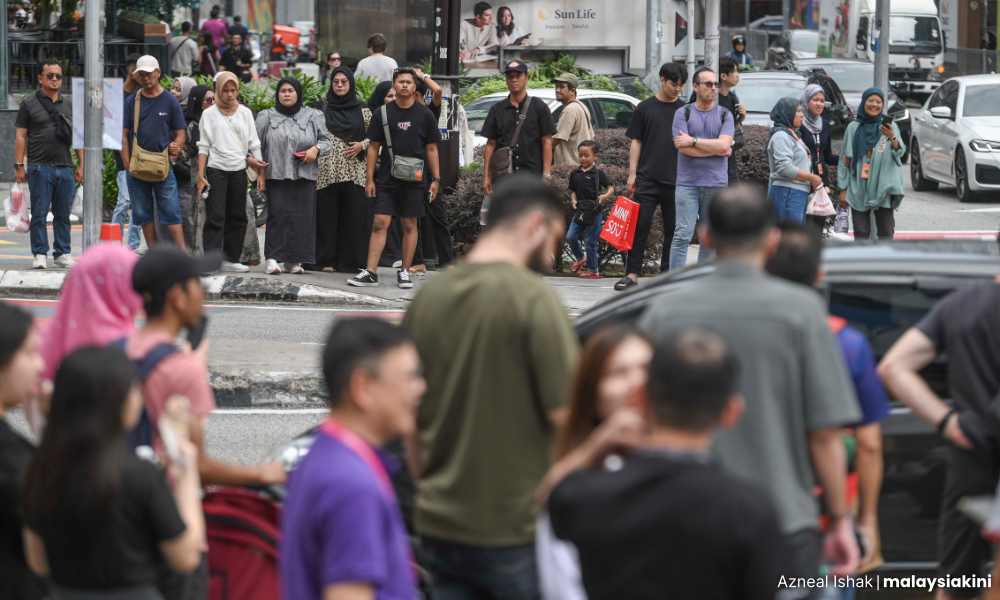
What made the government’s recent “goodie” announcement important is its inclusiveness. Recall, it was Najib Abdul Razak’s inclusive Bantuan Rakyat 1Malaysia (BR1M) social welfare assistance that garnered support across communities, a residual sentiment that still remains.
Muhyiddin Yassin’s pandemic-induced social assistance did the same, although it faded faster in memory as it was clear elites were comparatively gaining more at a time of crisis.
Nevertheless, future inclusive distributive measures have similar potential. Yet cash handouts couched only to garner short-term support with limited financial support do not go far enough and will fade quickly from memory. Two and a half years until the next general election is a long time.
As the Madani government looks ahead to establishing a concrete legacy that can be remembered, the legacy needs depth, more fundamental policy reforms that change how policies are implemented and to whom and importantly, help to narrow gaps rather than widen them.
Managing coalition pressures
To achieve this, the strains in the government coalition and divisions within political parties need to be better managed. So far, the governing coalition has largely kept its differences within its ranks.
The successful management of different coalitions within the Madani government has been a hallmark of Anwar’s achievements in office. Trust building among Madani government elites with shared interests has grown. Malaysia has needed a period of political stability after the political turmoil of the pandemic, and Anwar has provided it.
Yet, in this time of inflection, political conditions are changing. Distrust of betrayal lurks in the background. The open splits within Anwar’s political party, PKR, remain on display in statements or podcasts, where the battle continues with barbs and attempts to shift political positioning.
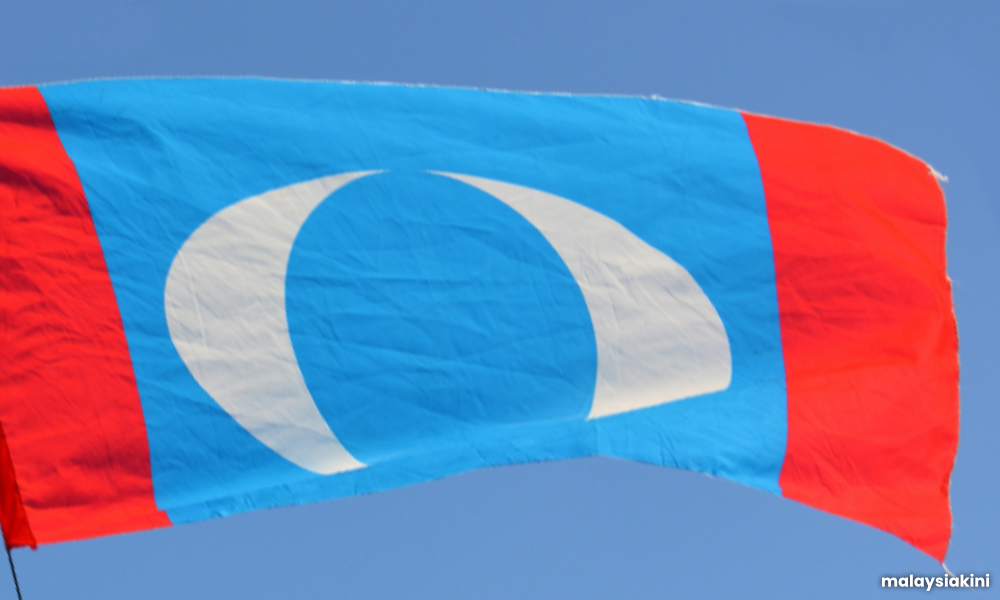
Despite repeated assurances by Umno leaders that they will stay with the Madani government, and are already allied with them in Sabah, there are residual concerns that Umno – or any of the parties, for that matter – will ally with whichever serves them best.
The reality is that the coming state polls – Sabah, Sarawak and Malacca - will bring divisions to the fore, over final contentious seat negotiations and in campaigning. It remains to be seen whether former political competitors can move away from the theatrical battles of the past and divisive narratives.
It also remains to be seen whether the stakes will rise to make the coming state polls less about the reputations and interests of individual leaders than about better governance for the ordinary people voting. All too often, there is a deep cynicism that politics is serving elites, not the rakyat, a sentiment that has become stronger.
For the Madani government, the test ahead will be new coalition compromises, new, more inclusive narratives of engagement and different forms of sharing, ones that allow diverse views and encourage constructive rather than destructive patterns of political engagement.
Not easy. Political gain in Malaysia has long been driven by taking the opponent down, either through open attack, a wound to the back or stoking division through pitting Malaysians against each other.
How will parties campaign in a “friendly” and “constructive” manner, and the federal coalition manage when parties at the state level go against each other? Minimally, it will be messy. Maximally, it will require good management, one that is not seen to focus on the interests of manager/leader(s) but the broader company/country.
If there has been a major shift in the last few months politically, it has been an erosion of political support for the Madani government among what in political science is known as the “political community”, those closely connected to civil society, business and religious leaders and such shaping “ordinary” views of politics.

This echoes erosion that has come earlier from Indian Malaysians and among predominantly Chinese voters who are disengaging, opting not to vote in lower turnout numbers.
The recent shift has come from the poor handling of the judicial independence crisis – which remains salient – and persistent view of an abandonment of political reforms – now characterised as reformati.
What this has meant is that many within the political base for Anwar’s coalition have become more disheartened, distanced. While some continue to call for meaningful institutional reform, many have given up. The question is whether they will give up at the polls as well.
For the Madani government – especially for Pakatan Harapan – to lose its political legitimacy among its pro-reform base is something difficult to recover from electorally. Lessons from Umno are illustrative here. This party is still struggling to win back its base and is increasingly dependent on cooperation with Harapan to secure electoral victories.
The Madani approach so far has been to take this base for granted, to assume that they will have “no choice” and come back.
Yet, here too, two and a half years is a long time in politics, with voters more fluid in how they vote than in the past and political loyalties comparatively less loyal than in the past (with support for PAS being the biggest exception).
A delivery of meaningful political reform to the base – not just talk of reform – will be decisive in setting who among the Madani parties will lead, as it will impact the political strength of Anwar’s coalition, Harapan, the most.
A new middle ground
As new initiatives on financial support try to reach out across Malaysians, the electoral viability of a second term for the current government will be shaped by engagement with those in the “middle ground”.
Yet this term means something quite different than it did before the 2018 and 2022 polls. Then it was voters who were willing to take a risk to embrace change, to move away from party loyalties, largely for reforms. The value-based choice to opt for a new government was made by voting for what they deemed as a “better Malaysia” in what was argued as a country in need of “saving”.
Since then, some voters have experienced voting regret for leaving one party/coalition for another, including some who abandoned Umno/BN.

Some are just opting for the most familiar option, as it is not clear what the other option will bring. Many voters are not sure how parties differ from each other, with perhaps the only registered differences involving traditional issues of the use/agendas of race and religion.
Yet, today, there are multiple forces that are driving political fluidity – younger voters and the less risk-adverse change makers across generations.
Youth have diverse political loyalties but have less loyalty to a particular party. Liking the new is evident. Risk takers are willing to support political turnover, while there are many who value stability for the sake of stability, ironically, many who voted for change in the last polls.
This middle ground is comprised of less ideologically and value-driven voting compared to the past, shaped by how they see the last five years in Malaysia’s politics through a more pragmatic lens.
Here is where the economy and how voters see their livelihood interests have come back to the fore. Many continue to hold on to the nostalgia of a patronage-driven domestic economy managed by Umno and a time when capital was more readily available.
This option is not as available to the Madani government due to contemporary fiscal limits, ironically impacted by the damaging Najib 1MDB scandal. Many businesses – especially small businesses – are really struggling under current conditions.
For the Madani government, the new middle ground is risky. Youth engagement and support are uneven at best, and risk-taking is weighed against those in power.
Businesspersons are taking a hard look to try to navigate what can bring them more security. The path of national politics is being pushed less by fluid relationships among elites but among voters looking (sometimes fruitlessly) for better options.
Electorally, there is a move away from supporting political parties, as the candidate factor is garnering more attention, especially in contests where political delivery is highly personalised, such as Sabah. This dynamic, like that of the stress on coalitions, brings greater electoral uncertainty.
Hard battle ahead
This time of inflection for the government is the beginning of what could be an even harder struggle than that for political survival, where the management largely involves elites.
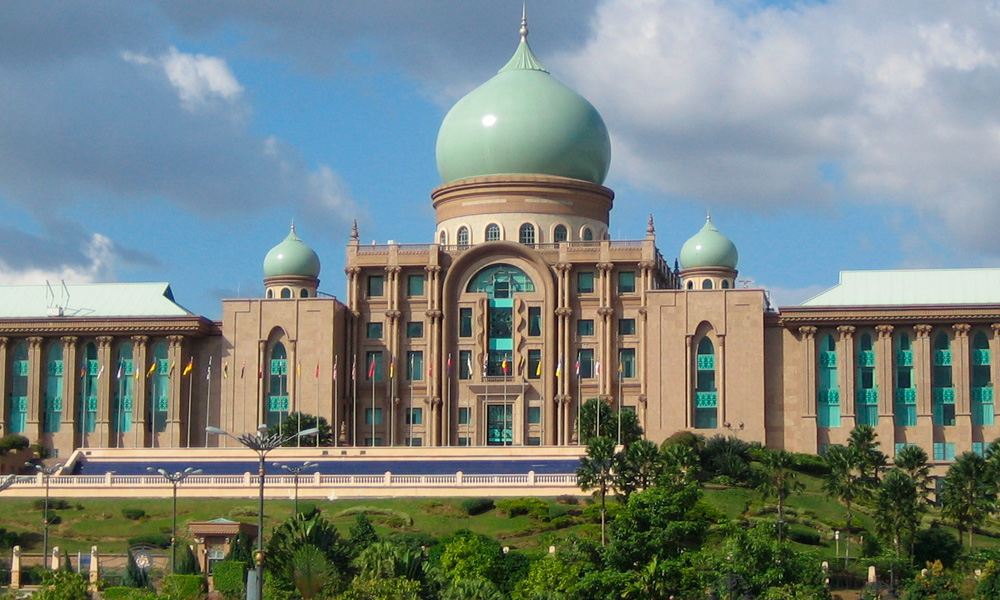
Now the struggle is to win over voters, who remain demanding at a time when there are more difficulties in engaging them.
The reality is that changing political practices and perceptions is not only in the purview of elites. Many voters are also more comfortable with older political narratives.
It is a difficult task, but not an impossible one. The Madani government will need to do (much) more if it is to attain its goal of a contract extension – it will need to work to change the social and political contract with Malaysians, listen and respond to the traditionally Harapan political base - including the substantive criticisms on the judiciary and minimalist-to-date reforms.
Fortunately for the Madani government, there is still time in their term. Yet, as the past shows, a failure to act, and act soon and substantively, will make it harder to do so in the future. - Mkini
BRIDGET WELSH is an honorary research associate of the University of Nottingham’s Asia Research Institute, a senior research associate at Hu Fu Centre for East Asia Democratic Studies, and a senior associate fellow at The Habibie Centre. Her writings can be found at bridgetwelsh.com.
The views expressed here are those of the author/contributor and do not necessarily represent the views of MMKtT.

No comments:
Post a Comment
Note: Only a member of this blog may post a comment.