


This is the third and final piece in Devastation Creep, a series on ecological collapse and the often ignored governance failures behind it.
The first piece set out the civic failures - no science, no press, no public voice - that have let this run unchecked for decades.
The second explores the governance system itself: who makes these decisions, who profits, and why nobody answers for the outcomes.
The first part in this final piece looks at the manifestation of these failures at a national level through the Lynas project and its 14-year operation in Gebeng, Kuantan.
On the east coast of Pahang, upstream of a river that drains into the South China Sea, sits a pile of waste that will stay radioactive for 14 billion years, in the largest rare earth processing facility outside China.
Thorium-232, the by-product accumulating at the Lynas refinery in Gebeng, has a half-life roughly three times the age of the Earth.
By 2036, the site and its adjacent peatland are projected to hold more than 14 million tonnes of waste - 2.6 million tonnes radioactive and 11.7 tonnes of scheduled hazardous waste, according to the environmental impact assessment (EIA) submitted in April 2026.
The EIA, to justify expanding the plant says, in effect, that everything is fine. This would not be permitted in Australia, so why here?
The EIA also says two things that cannot both be true. It classifies the facility’s treated wastewater as harmless, non-radioactive effluent that complies with Standard B of the Environmental Quality (Industrial Effluent) Regulations 2009.
Yet, its own data show that fish in the stormwater retention pond, where wastewater is diluted with rainwater, are carrying levels of radiation well above international safety limits.
Contradiction behind regulatory trick?
This contradiction is hidden behind a regulatory trick: local rules test pollutant concentration at the discharge point rather than total pollutant mass.
This lets Lynas use clean rainwater in its retention pond to dilute process effluent until surface samples pass inspection.
However, diluting radioactive isotopes does not make them disappear. They settle into the benthic mud, and because the pond is unlined, radiation leaches directly into the peatland's shallow groundwater while surface wastewater flows into public rivers.
Declaring a site safe based on diluted liquid samples is regulatory theatre. A responsible regulator would read that and throw the assessment out. And ours did.
The Environment Department (DOE) rejected this expansion EIA, but gave no public reason why.
/file/1245/1fb4e9714dd583f457fad8428696e6b9.jpeg)
Will the DOE step forward and disclose its grounds? But notice what that rejection changes: nothing. Lynas is simply expected to resubmit, yet as of Oct 8, the DOE portal shows no updated submission.
Meanwhile, the existing plant - the one producing the very waste this whole assessment was meant to scrutinise - keeps running as it has for 14 years.
It operates under a licence renewed by the Atomic Energy Department for another 10 years on March 2, one month before this EIA was submitted. Daily production continues unabated through the structural crack between two regulators.
Not about one company
This is not about one Australian company behaving badly. Lynas is simply playing the standard corporate playbook: invest and operate where environmental regulations are lax, and enforcement is weak - minimising cost, maximising output, and externalising costs by taking whatever a host government will let it take.
The question is what our government lets it take and why.
Behind the technical language, the Lynas facility is a case study of how approval systems in Malaysia actually work and can be easily ignored if you have the money and connections.
The approval systems are not a filter that stops harm, but simply paperwork that obfuscates complications, enabling the government to say yes to whoever holds the most money or leverage, while looking like a real process happened.
As Lynas operates its processing facility in Kalgoorlie, Australia, identical radioactive waste from the same cracking and leaching industrial process faces two starkly different regulatory regimes.
In Australia, this waste (iron phosphate or WLP residue in Malaysia) is classified as low-level waste (LLW). The Environment Protection Authority (EPA) enforces strict regulatory mandates requiring closed-loop reverse osmosis water recycling, lined evaporation ponds, and long-term isolation of the waste at the remote Mount Weld mine pit.
In Malaysia, by contrast, a regulatory loophole is exploited to reclassify the exact same waste stream as very low-level waste (VLLW), even though the residue accumulates massive volumes of long-lived radionuclides at an activity concentration of 6Bq/g, six times the regulatory threshold for clearance.
This VLLW label lowers the legal safety bar, permitting wastewater discharge and above-ground landfill directly on flood-prone peatland close to populated coastal communities.
Why do we accept a standard for our own people that Australia refuses to tolerate for theirs?
The answer is not technical. It is political: leaders so desperate for foreign direct investment that they cater to companies whose business model relies on slack regulatory environments to externalise their environmental costs.
They have priced our communities' health below what a wealthier nation demands for its own.
We have done this before
In 1982, a rare earth plant opened in Bukit Merah, Perak: a joint venture built on Japanese capital and technology, processing a different ore for rare earths, but revolving around the same essential problem - waste laced with thorium and heavy metals.
It was dumped in fields, along roadsides, and into water, and stored in drums that were not designed to hold it.
Residents fell ill. They organised, they sued, and they eventually won. Mitsubishi Chemical, the plant's major shareholder, shut it down in the 1990s and spent over US$100 million entombing the waste in a hilltop repository.
The cleanup was not declared complete until around 2011.
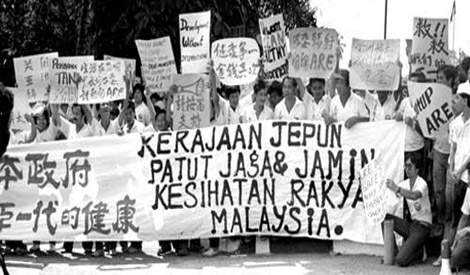
No state authority has ever formally declared the Bukit Merah dumping site safe. As recently as 2019, residents living within a hundred metres of the buried waste said nobody had told them whether the ground beneath them was clean.
The regulator responsible for making that call, the Atomic Energy Department, is the same body that licenses Lynas today. Is it too much to ask them to finally provide a clear answer?
Thus, we cannot claim ignorance. What is missing is any sign that it changed how we decide or if we learnt anything. The evidence suggested that no lessons were learnt, which should not come as a surprise.
The incompetence and disregard
Lynas' permanent waste facility sits on reclaimed peat swamp, soft and waterlogged ground with the water table barely a metre below the surface, in a region that receives more than 2,500mm of rain a year and has recorded single-year totals above 4,000mm.
Mining standards for waste like this call for anchoring the structure down to bedrock, which here lies 33 to 42m down.
The design instead scrapes off the top metre or two of peat, swaps in compacted soil lined with plastic and clay, and calls it stable. It is the engineering equivalent of building a vault on a sponge.
According to an Appointed Individual reviewing the EIA’s health impact assessment, no baseline health study has ever been conducted on the facility’s workers or neighbouring residents.
No blood work, no long-term monitoring, in the 14 years of operation. Lynas has argued that such testing cannot meaningfully be done. This is untrue and wholly unacceptable, and the government should demand a study be conducted by an independent body.
A facility handling long-lived radioactive material telling the public that its health impact is simply unmeasurable is not reassurance. It shows they're not that concerned.
/file/publisher-c1a3f893382d2b2f8a9aa22a654d9c97/2023/08/4234442e6526124a0f510c379488a417.jpg)
The plant's plan for decommissioning in 2041 amounts to capping the waste with soil and walking away, with no accounting for material that outlives the liner systems by hundreds of millions of years.
The technology meant to isolate the radioactive thorium, thorium extraction, is described in the EIA as an early-stage research project still at pilot scale.
And the environmental radiation data stops at March 2024, which happens to exclude the pilot trials the expansion is supposed to be judged on.
Any one of these complications should stop an approval process and detailed studies commissioned. Taken together, they clearly are not a case of oversight.
The complacency
One of the most detailed technical critiques of the Lynas expansion, a thirty-point rebuttal cataloguing every gap above and more, was not produced by the DOE, or a university, or a national newspaper.
It was written by a volunteer, in her own time, for a civil society coalition, using nothing more than the EIA the government had itself put on public display for a month.
The state's job, done for free by civil society actors using publicly available documents, because the state was not willing to exercise its authority.
This is systemic ignorance and complacency - at worst, negligence driven by political pressure.
No independent scientific body has evaluated the plant’s environmental impact since the government’s own executive review committee in 2018.
That committee explicitly warned of unresolved long-term risks, highlighting unmonitored groundwater contamination and the total lack of a viable waste management strategy.
Yet in the eight years since, Lynas has piled up over a million additional tonnes of radioactive waste, relying on routine regulatory paperwork while operating completely unscrutinised by any independent scientific panel.
Nor was this gap allowed to open without warning. As far back as 2014, an International Atomic Energy Agency (IAEA) follow-up mission explicitly recommended routine public disclosure of all environmental monitoring data around the facility.
Twelve years later, that directive remains unfulfilled. The government holds the complete, unedited historical record of groundwater and surface discharge testing around Gebeng.
To this day, it has not been published, and no reason has been given. Why?
/file/attachments/885/76b66ce9cf46e36fbb6d269b429227c2_247740.jpg)
If the Madani government is truly committed to transparency, it must immediately compel Lynas to make every raw historical dataset public.
What citizens have received instead, more than a decade on, is merely a handful of summarised figures embedded in an EIA commissioned by the very company seeking expansion.
Regulators cannot claim surprise when foreign experts raised the alarm over a decade ago. In 2013, a radiological protection specialist at Germany's Öko-Institut explicitly condemned the facility's waste management model in a report commissioned by a local NGO.
Beyond highlighting severe groundwater leaching risks from tropical downpours and toxic heavy-metal contamination, the foreign expert cautioned that "in no case" should the residue enter public infrastructure, warning it would "pose high radioactive doses to the public via direct radiation”.
Yet commercialising these hazardous residues as construction fill, road sub-base, and soil additives is precisely the recycling loophole Lynas has repeatedly advanced in its EIA filings.
The press has largely failed to apply real pressure, reporting on the facility in sanitised, neutral tones rather than conducting rigorous investigative exposes.
For over a decade, local communities have voiced fierce opposition, yet public outrage has failed to halt a single licence renewal.
Meanwhile, the company’s own website tells the public there has been no rise in background radiation and no health or environmental impact since operations began in 2012.
Yet claiming no measurable rise in baseline radiation is vastly different from producing zero radioactive discharge, as evidenced by contaminated fish in the plant's unlined pond.
When no authority independently monitors and measures, a company is left to grade its own data.
Deprived of the truth and unsupported by a passive press, the public is simply worn down until people gradually stop asking questions and stop fighting.
This is the classic story of a foreign company getting away with things it could never do back home. - Mkini
CHANDRAN NAIR is the founder and CEO of Global Institute for Tomorrow and the author of “Dismantling Global White Privilege: Equity for a Post-Western World”.
The views expressed here are those of the author/contributor and do not necessarily represent the views of MMKtT.

No comments:
Post a Comment
Note: Only a member of this blog may post a comment.