`


THERE IS NO GOD EXCEPT ALLAH
read:
MALAYSIA Tanah Tumpah Darahku

LOVE MALAYSIA!!!


Friday, August 31, 2018

Hannah striving to change mindset of civil servants for an inclusive Malaysia


KUALA LUMPUR: Changing the mindset of Malaysians to rebuild a new inclusive Malaysia is difficult, and that is why Hannah Yeoh wants to start with the civil service. 

"Changing government is the easy part, changing mindset is the hardest," said the Women, Family and Community deputy minister during a Merdeka Day celebration held by Malaysians for Malaysia on Thursday (Aug 31).
Yeoh said the new mould for Malaysia should be not divisive or tear people down, and she aimed to achieve this by first changing the mindset of the civil service. 

"I'm trying to better them, challenge them to think out of the box and do things differently," she said, adding that it would take time.  

The Segambut MP said Malaysia had enough space for everyone to agree to disagree. 

"My wish is that we co-exist without labelling one another," she added.

"When I tell Malays I can speak Malay, they are surprised that a Chinese person can speak Malay. But when I tell the Chinese I cannot speak Mandarin, they are surprised that a Chinese cannot speak Mandarin," Yeoh related. 

She said in the new Malaysia, people should stop labelling each other and stop judging people from the language they used and the clothes they wore. 

"Let Malaysians be Malaysians. There is a space for everyone here, let them enjoy," she said. 

Yeoh urged Malaysians to speak loud and proud about a new inclusive Malaysia, whether it be through a movie, article or show. 

She said there were enough good people in the government who would continue to be a voice for all Malaysians. 

The Merdeka celebration was attended by notable activists like transgender advocate Nisha Ayub, lawyer Siti Kassim, Datin Paduka Marina Mahathir and Ivy Josiah. 

Also present was Prime Minister Tun Dr Mahathir Mohamad and Petaling Jaya MP Maria Chin Abdullah. - Star

Prices of cigarettes to go up after sales tax fixed at 10%


PETALING JAYA: Sales and Service Tax (SST) for cigarettes has been gazetted at 10% as of Aug 29, and this will cause the prices of cigarette to increase.
British American Tobacco (M) Bhd (BAT) managing director Erik Stoel said the company is concerned about the impact that the 10% SST will have on the cigarette industry, given the high incidence of illegal cigarettes.
He urged the Government to re-consider an SST increase on tobacco products "in light of these high levels of illegal cigarette trade and the persistent pressure on disposable income for the average Malaysian consumer".
"For the tobacco industry, a SST of 10% is higher than the previous 6% GST (goods and service tax). "Furthermore, this implies a double taxation as the SST will be levied inclusive of the high levels of excise, which we currently contribute to the Government," he said in a statement on Friday.

He said that this will unfortunately leave the company no other choice but to consider increase of prices for consumers.
"We are concerned that this could further fuel the growth of illegal trade in Malaysia.
"The legal cigarette industry is under tremendous pressure and has never recovered from the unprecedented excise tax hike of close to 40% way back in November 2015, which increased cigarette prices to the existing high prices compared to illegal cigarettes," he said.
As a consequence, Stoel said that sales volumes of legal cigarettes have declined significantly and has made Malaysia a "very attractive hunting ground for smugglers and all sorts of criminal elements that should not be associated with a respectable 'new Malaysia'".
"This price increase will result in higher disparity between legal and illegal cigarette prices, in absence of any effective government solutions to curb illegal cigarette trade in Malaysia," he said.- Star

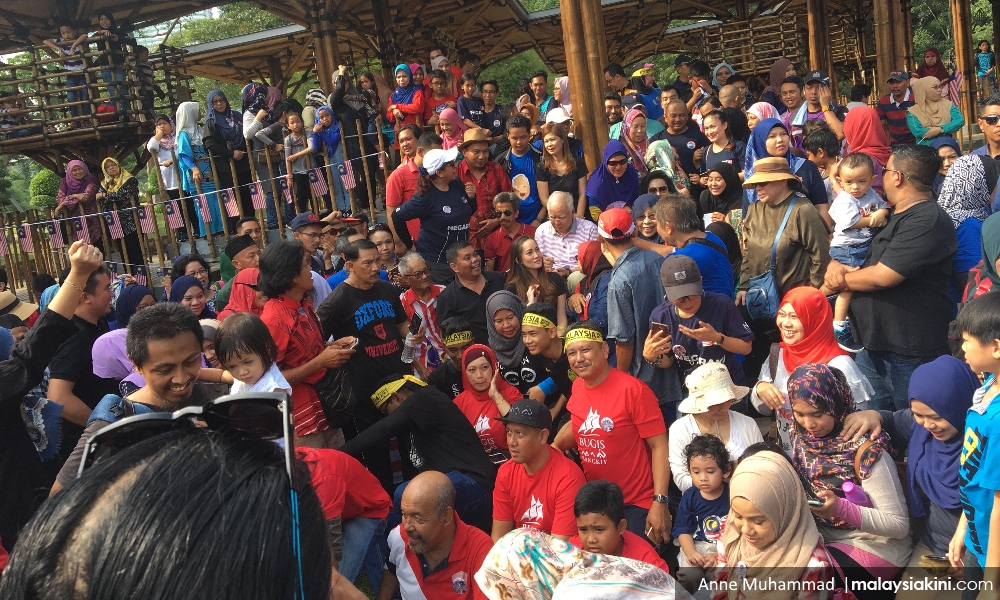
‘CANNOT TALK OR YOU WILL CALLED IN AGAIN’: ROSMAH, DRESSED IN FASHIONABLE DOBERMAN SPOTS, CUTS SHORT NAJIB’S SPEECH AT POORLY-ATTENDED MERDEKA PICNIC

Datuk Seri Najib Razak did not have time for a long speech after being cut short his wife during a picnic in conjunction with the Merdeka Day which was attended by the couple this morning.
The former prime minister had opened his speech by pledging to continue monitoring the government of Pakatan Harapan especially in terms of the promises it made ahead of the 14th general election.
“Thank you for being with us because we love this country.
“We will do our best for the country, any promise that have not been fulfilled, we know lah…” Najib said at the Merdeka picnic program held at the Botanical Gardens in Kuala Lumpur.
His wife Rosmah spontaneously interrupted his speech at that point in jest: “Cannot talk, or you will be called in again (by the authorities). “
Her words were greeted with laughter by the crowd of about 120 people.
Najib then ended his speech by shouting ‘Merdeka (independence)’ three times.
For more than two hours, Najib and his wife mingled and chatted with the crowd while enjoying the ‘nasi lemak’ provided by the organizer, Datuk Lokman Noor Adam.
Most of those who came for the picnic were dressed in blue, and some were wearing clothes with his face and the BN flag in the background.
A family even donned clothes made in the pattern of the national flag Jalur Gemilang.
Lokman when asked about the lacklustre number of attendees explained the program was initially scheduled to take place at the Tun Abdul Razak Memorial Hall which can accommodate only 120 people.
“The total attendance was shortlisted to only 120 people, and we had to reject many who wanted to join.
“But the location was moved at the last minute,” he said.
-THE ABOVE IS A GOOGLE TRANSLATION OF THE ORIGINAL STORY IN MALAY FROM MALAYSIAKINI APPENDED BELOW

Rosmah pesan Najib: Kalau terus bersuara nanti kena panggil lagi

Datuk Seri Najib Razak tidak sempat berucap panjang selepas dipotong isterinya ketika program kecil-kecilan sempena Hari Merdeka yang dihadiri pasangan itu, pagi tadi.
Bekas perdana menteri itu membuka ucapannya dengan berjanji untuk terus memantau kerajaan Pakatan Harapan (HARAPAN) terutama dalam soal janji manifesto PRU ke-14.
“Terima kasih kerana dapat bersama-sama kita kerana kita cintakan negara ini.
“Kita akan melakukan yang terbaik untuk negara. Mana-mana janji yang tak ditunaikan, kita tahulah…” kata Najib dalam program perkelahan Hari Merdeka di Taman Botani, Kuala Lumpur.
Ketika itu, Rosmah dengan spontan menyampuk ucapannya dengan berseloroh: Tak boleh cakap nanti kena panggil (pihak berkuasa) lagi.”
Kata-kata itu disambut ketawa kira-kira 120 orang yang hadir.
Najib kemudian menamatkan ucapannya dengan melaungkan “merdeka” sebanyak tiga kali.
Selama lebih dua jam, Najib dan isteri meluangkan masa beramah mesra dan berswafoto bersama hadirin sambil menikmati juadah nasi lemak yang disediakan penganjur, Datuk Lokman Noor Adam.
Kebanyakannya berbaju biru, malah ada juga yang memakai baju berlatarbelakangkan wajahnya dan mengibar bendera BN.
Lokman ketika ditanya berhubung jumlah hadirin yang sederhana menjelaskan, program pada mulanya dijadual berlangsung di Dewan Memorial Tun Abdul Razak yang hanya boleh memuatkan 120 orang.
“Jumlah kehadiran sudah disenarai pendek kepada 120 orang sahaja, dan kita terpaksa tolak banyak lagi yang mahu sertai.
“Tetapi lokasi terpaksa dipindah di saat akhir ke sini,” katanya lagi.- MKINI
MKINI

Guan Eng: Irwan ignored IRB's call to transfer funds for tax refunds


Former treasurer-general Mohd Irwan Serigar did not heed the Inland Revenue Board's (IRB) request to transfer the necessary monies to the Tax Refund Fund (TBBC), Finance Minister Lim Guan Eng said today.
In a statement today, Lim revealed that the IRB had made the written request to Irwan in 2016, but the request was ignored.
He explained that the Finance Ministry's Cash Management Committee, which Irwan chaired, had met monthly but did not execute the necessary transfers to the TBBC.
"What the previous administration did, can be considered falsification of the accounts and misappropriation of tax refunds for other purposes or covering up for the (budget) deficit to show a surplus.
"The real question is, who is responsible (for this)? Was it Irwan, the former finance minister Najib Abdul Razak or both?" asked Lim.
Previously, the Finance Ministry had revealed that the IRB owed RM16 billion in tax refunds, spanning back six years and involving 1.65 million cases.
IRB plans to prioritise individual taxpayers for refunds first and that 90 percent of refunds owed had been paid on July 31.
However, the Finance Ministry said other refunds will have to wait because the government doesn't have the funds for the TBBC at the moment and may consider offering tax credits to offset future tax payments.
Meanwhile, the customs department also revealed that it was unable to issue RM19.25 billion in GST refunds.
The police are probing both matters and have recorded statements from Lim.
Najib had accused the new administration of failing to pay the refunds because it is currently facing a cash crunch by removing GST between June 1 and Aug 31.
However, Lim today said the TBBC had only RM1.486 billion as of May 31 which led him to believe that the money meant for refunds was recorded as revenue by the previous administration.
"This means that the federal government's revenue, as recorded by the previous government, was inaccurate and overdeclared," he said. - Mkini

‘THEIR ELOQUENCE IS UNMATCHED, THEIR INTELLECT SECOND TO NONE’ – THE 2 MEN NAJIB NOW FEARS MORE THAN FEAR ITSELF: SENIOR LAWYER SULAIMAN ABDULLAH APPOINTED GOVT’S LEAD PROSECUTOR IN SRC CASE & RETIRED JUDGE GOPAL SRI RAM IN 1MDB CASE

KUALA LUMPUR — A senior private lawyer and a former judge-turned-lawyer were appointed to separately lead the prosecution of ex-prime minister Datuk Seri Najib Razak and cases tied to the 1MDB scandal, Attorney-General Tommy Thomas announced today.
Thomas said the appointment of lawyer Datuk Sulaiman Abdullah to lead prosecutors in Najib’s trial next year was necessary as the AG felt he would not be able to handle the case and his other responsibilities simultaneously.
“Datuk Sulaiman is one of the nation’s leading barristers, having substantial experience in criminal law, including white collar crime.
“His eloquence is unmatched, and his intellect second to none. Datuk Sulaiman has impeccable integrity, and is a principled lawyer,” he said in a statement today.
.
Thomas pointed out that Najib’s trial — involving seven criminal charges of criminal breach of trust, power abuse and money-laundering offences over RM42 million linked to former 1MDB subsidiary SRC International Sdn Bhd — would take up seven weeks from February 12 to March 29.
“A trial of this importance and complexity requires the full-time attention of lead counsel, not just during the duration of the trial, but also in the months leading to the trial, followed by the preparation of detailed written submissions after the trial.
“Unfortunately, the demands of equally urgent and pressing matters of state do not permit me the time required to focus on this prosecution,” he said earlier in the statement, when explaining why he had decided to exercise his discretion under Section 379 of the Criminal Procedure Code to appoint Sulaiman.
As for the 1MDB matter, Thomas said the Malaysian Anti-Corruption Commission and police have yet to submit the investigation papers (except for one) to the Attorney-General’s Chambers (AGC).
Noting that the AGC will have to study and prepare charges and prosecute the alleged accused in trials after receiving the 1MDB investigation papers, Thomas said he has appointed retired Federal Court judge Datuk Seri Gopal Sri Ram to lead the process.
“In order to spearhead this entire process, I am pleased to announce the appointment of Datuk Seri Gopal Sri Ram as Senior Deputy Public Prosecutor pursuant to Section 376 (3) of the CPC,” he said, referring to the former judge who has been actively practising as a lawyer.
Thomas said Sri Ram has “substantial experience in criminal law matters”, adding: “His strong and determined personality will no doubt enhance the investigation and prosecution in all matters pertaining to the 1MDB scandal.”
The former judge will also be acting pro bono, he said.
“With the twin appointments of the leading lights in the Malaysian Bar, our commitment to prosecuting those responsible for the greatest kleptocracy in the history of the world with the gravity that it deserves, and that ordinary Malaysians expect, cannot be doubted,” Thomas added.
– MALAY MAIL

DON’T SHOOT MALAYSIA IN THE FOOT NOW, DR M: FOREIGN INVESTORS CAN HARDLY WAIT TO GET INTO NEW MALAYSIA’S ECONOMY – SO, DON’T LISTEN TO RACIST, SMALL-MINDED LITTLE NAPOLEONS ESPECIALLY FROM YOUR OWN PARTY NOW

AS Malaysia celebrates its 61st Merdeka Day, it also celebrates the bold transformation and resilience of its economy and the potential that lies ahead.
Over the last six decades, Malaysia has weathered financial and economic crises to diversify from being an exporter of natural rubber and palm oil to become a vibrant regional hub for financial, infocomms and logistics services, with a solid industrial base for global manufacturers.
Since the historic general election in May that brought about Malaysia’s first change in government since independence, there has no doubt been heightened uncertainty over policies and large infrastructural projects.
But if there is one message Malaysia’s new leaders seem to want broadcast abroad, it is this: Malaysia welcomes foreign investors and has much to offer.
He believes foreign investors can appreciate the government’s accountability and transparency in reforming Malaysia’s institution’s and how that will translate into business prospects. “Not only are foreign investors confident in the strength of the Malaysian economy, consumer confidence has risen and this will support the growth of the country’s economy,” he said.
This stance was reiterated by Malaysia’s Deputy Minister of International Trade and Industry Ong Kian Ming at a forum in Johor this week. “The new government is committed to ensure that our policies remain investor-friendly and Malaysia continues to be an attractive destination for investors to not only conduct business activities, but also to expand and diversify their existing operations.”
Malaysia already offers an array of foreign investment incentives, with specific carrots to encourage investments into high technology-intensive industries and the setting up of regional operations. The new government has also said that it may extend tax breaks for key foreign investors able to guarantee the creation of better-paid jobs for Malaysians.
Outside of the political leadership too, there appears to be optimism over what this new phase of Malaysia’s economic history could bring.
The World Bank’s Malaysia Economic Monitor report, published in June, said: “Malaysia is entering a new period that offers an opportunity to strengthen structural reforms and to accelerate its convergence with high-income economies.”
Though the report acknowledged that the cancellation and reassessment of several planned large infrastructure projects has raised uncertainty for both public and private investments, Malaysia nevertheless now has an “unprecedented opportunity for change”.
OCBC economist Alan Lau sees optimism among businesses on the ground. Private investment growth for Q2 2018 recovered to 6.1 per cent year-on-year, up from just 0.5 per cent in Q1, thanks to capital spending in the manufacturing and services sectors. “Businesses possibly may be more focused on positive points such as institutional reforms,” he wrote in a recent research note.
He said he expects investment to stay strong as businesses remain convinced of the country’s longer-term potential. “Any policy uncertainty may mainly affect only businesses tied to the major projects that are under review, or have been reviewed.”
Barometers of economic sentiment back this view. The Malaysian Institute of Economic Research’s consumer and business conditions indices both crossed the 100-point threshold into optimism in Q2 this year. For the consumer index in particular, this was the first optimistic reading in several years.
And such positive domestic economic sentiment comes despite Malaysia reporting relatively sluggish GDP growth in Q2. This was largely attributed to supply shocks in the palm oil and liquefied natural gas sectors.
The external economic environment, the effects of fiscal consolidation, and the possible negative impact of a trade war did lead several private-sector economists to trim their 2018 forecasts for Malaysia’s growth to under five per cent – from 2017’s 5.9 per cent growth.
Even so, economy-watchers remain sanguine about the longer-term.
The World Bank report said: “Malaysia’s economic fundamentals remain sound … Malaysia’s underlying economic strengths, including a diversified economic structure, a strong external position, robust institutions and significant natural resources and human capital endowments, remain unchanged.”
It is within this context and environment that investors are considering the Malaysian market.
The Malaysian Investment Development Authority (MIDA), in its latest investment performance report, notes that a growing number of global companies are choosing to make Malaysia their regional hub.
These include Peugeot’s Asean manufacturing hub, IKEA’s regional distribution and supply chain centre for Asean, and Honeywell’s Asean regional headquarters.
As Singapore’s closest neighbour, Malaysia remains a convenient first choice for overseas expansion for many local companies. Proximity aside, socio-cultural similarities and the larger market across the Causeway makes Malaysia a natural first port-of-call for local companies, particularly the smaller businesses making their first foray abroad.
Despite bilateral issues that have arisen in recent months over the 1962 Water Agreement and the High-Speed Rail project, government officials and business leaders on both sides have asserted the strength of Singapore and Malaysia’s economic links.
In Singapore earlier this week, Malaysia’s International Trade and Industry Minister Darell Leiking said Malaysia-Singapore economic relations are “good”, and that the businesses and investors he met remain positive about prospects up north.
Singapore’s businesses have indeed been key investors in Malaysia.
Data from MIDA listed Singapore as the third largest foreign direct investor in Malaysia last year, after China and Switzerland. Singapore contributed some 8.6 per cent of FDI inflows into Malaysia last year.
Of the S$43.3 billion that Singapore investors put in Malaysia in 2016, the bulk flowed into the financial and insurance-services sector; the manufacturing sector attracted a significant chunk too, according to Singapore’s Department of Statistics.
Enterprise Singapore (ESG), the agency which supports Singapore businesses’ global ambitions, has also flagged several sectors in Malaysia with investment opportunities well-suited to local companies.
Education is seen as a key growth sector, given the Malaysian government’s commitment to human capital development and addressing talent shortages across key industries. For Singapore firms, this could mean opportunities to provide vocational technical education. The growth of private early childhood education will also drive demand for teachers.
Urban infrastructure, particularly in developing green and sustainable buildings, is another area that local companies could have an edge in. In Malaysia’s increasingly competitive residential property market, developers are also looking to partner established brands to incorporate health and education amenities in their townships.
The private healthcare and wellness sector in Malaysia has also experienced a boom, thanks to increased medical tourism. This has meant relaxed foreign ownership rules for private hospitals, medical specialist centres and dental services, which open up opportunities for Singapore’s healthcare and pharmaceutical companies.
One industry sector in which socio-cultural similarities offer a natural advantage is in retail and food services. The F&B sector leads the franchise industry in Malaysia, one route via which many Singapore companies have chosen to grow their brands. In 2016, Malaysia’s franchise industry contributed RM26.6 billion (S$8.95 billion) to its economy.
And ever since foreign ownership rules were relaxed to allow 100 per cent ownership in the retail and food services sector, more Singapore firms have been able to run fully-owned subsidiaries in Malaysia too.
Malaysia’s startup ecosystem has also generated buzz. The Malaysia Digital Hub has been set up to address gaps in funding, market access, talent and technology. The Malaysia Tech Entrepreneur Programme was introduced to draw global tech talent to Malaysia.
With the longer-term outlook in mind, investors surveying the opportunities now look to the upcoming Malaysian Budget and the mid-term review of the 11th Malaysian Plan for greater clarity on the government’s economic policy direction.
https://www.businesstimes.com.sg/

MALAYSIA’S ‘KANGAROO COURTS’ CONUNDRUM HITS CRITICAL STAGE: ‘I WILL ONLY REVEAL NAME OF JUDGE WHO MEDDLED IN KARPAL’S SEDITION APPEAL TO RCI’ – LAWYER TELLS COPS

PETALING JAYA – The lawyer who claimed that a senior judge had meddled in the late Karpal Singh’s sedition appeal in 2016 says he is only willing to identify the person if the claim is investigated by a Royal Commission of Inquiry (RCI).
Mohamed Haniff Khatri Abdulla had earlier created a sensation when he charged that Karpal’s sedition appeal (which went ahead after his death in 2014) two years ago was altered due to judicial interference by a senior judge.
His revelation led Karpal Singh’s daughter, Sangeet Kaur Deo, to lodge a police report on Aug 23 over the issue, urging the police to investigate Haniff’s allegation of judicial interference which resulted in Karpal’s sedition conviction.
Haniff said he had given his statement to the police on Thursday (Aug 30) following Sangeet’s police report.
In a Facebook post, Haniff said he did not reveal the identity of the judge or the source of information to the police when giving his statement as he believed the only appropriate forum to investigate the matter fairly was through an RCI.
“I also informed the police officer that I was prepared to name the source who gave me the information to a special task force prior to the establishment of the RCI, as well as during its proceedings when it is convened,” he said.
Haniff urged de facto law minister Datuk Liew Vui Keong to set up a special task force and an RCI accordingly.
On Feb 21, 2014, the High Court found Karpal guilty of sedition for questioning the removal of Datuk Seri Mohammad Nizar Jamaluddin as Perak Mentri Besar by the Sultan of Perak.
On May 30, 2016, the Court of Appeal, in a majority decision, upheld the sedition conviction ruling that it was a serious offence involving the sovereignty of a Ruler and his prerogative powers.
The court, however, reduced the quantum of his fine from RM4,000 to RM1,800.
– ANN