`


THERE IS NO GOD EXCEPT ALLAH
read:
MALAYSIA Tanah Tumpah Darahku

LOVE MALAYSIA!!!


Tuesday, October 31, 2023

TMJ: What message are you sending with toy guns?


Though certain quarters have defended the use of toy firearms in schools, Johor Crown Prince Tunku Ismail Sultan Ibrahim questioned the message it would send to children.

Responding to a question during his recent appearance in the “Keluar Sekejap” podcast, Tunku Ismail said he was notified of such incidents.

“... I got images and reports of certain schools where the teachers themselves encouraged young kids to carry weapons.

“Even though these are toys, not real weapons, but what message are you trying to pass here?” he asked.

Tunku Ismail (above) said he had also contacted Education Minister Fadhlina Sidek and the Johor executive councillor who oversees education to “monitor every single school”.

However, PAS MP Ahmad Fadli Shaari disagreed with those who were concerned with the use of toys guns.

An unidentified man carrying a toy gun in a school

Defending the teachers and students, he said the use of fake weapons helped raise awareness about the struggle of Palestinians.

Fadhli had targeted Local Government Development Minister Nga Kor Ming, who is from DAP, over his post on X (previously known as Twitter).

He rejected the notion that the use of toy guns was tantamount to promoting violence or extremist ideology.
Perlis mufti Mohd Asri Zainul Abidin

Previously, Perlis mufti Mohd Asri Zainul Abidin also took a thinly-veiled swipe at DAP when he remarked that the “rocket” could abe perceived as a threat of violence as well.

“If you consider scarves used to cover the faces of fighters opposed to occupation and cruelty as violent, then the rocket symbol can also be considered as violent.

“Who do you want to launch the rocket at? Who do you want to destroy?” he added, without mentioning DAP, whose logo is a red rocket.

On its official page, DAP said the “rocket symbolises the party’s aspiration for a modern, dynamic and progressive society and its four boosters in red and blue represent the support and drive given to the party’s objectives by all races in Malaysia.”

Meanwhile, Umno Youth chief Dr Muhamad Akmal Salleh suggested that the 12 elected representatives from PKR, who called for a review of the “Palestine Solidarity Week” in schools, be sent on a humanitarian mission to Palestine.

He said this would allow them to better comprehend the situation on the ground.
Charles Santiago

Earlier today, former lawmaker Charles Santiago questioned if teachers would be able to distinguish between the Zionist regime and Jewish people, fearing that anti-Semitism could be sown instead.

The Education Ministry, in its list of “dos and don’ts” for the “Palestine Solidarity Week”, has barred the use of toy weapons. - Mkini

Outdated policies blocking Orang Asli from getting electricity: NGO

Policies pertaining to the Orang Asli are blocking efforts to provide electricity to the community including by those who managed to electrify even the most remote communities in Sabah and Sarawak through off-grid methods.

This is according to Adrian Lasimbang, who has more than two decades of working with remote, rural communities to electrify their villages including using micro-hydro and solar power.

The Tonibung founder said his group tried several times to provide the same technologies that have electrified rural communities in East Malaysia to the non-electrified Orang Asli communities in the peninsula.

Tonibung is an indigenous-led NGO developing sustainable alternatives to rural electrification, which is based in Penampang, Sabah.

He said his group started looking into expanding their work to West Malaysia after receiving grants from international funders to improve connectivity in rural areas.

“But we were stopped by the Orang Asli Development Department (Jakoa) because they say only TNB (Tenaga Nasional Bhd) can give electricity to the Orang Asli.

“I can’t blame them because that is their framework, but unless this policy changes, we can’t provide electricity to all Orang Asli villages,” he said at a conference on just energy transition in Petaling Jaya today.

An estimated 17 percent - or 142 Orang Asli villages - remain unelectrified, according to official data.

Lasimbang said Tonibung has only managed to assist two Orang Asli villages to get electricity supply through its renewable energy systems in Selangor with the help of then Selangor environment exco Elizabeth Wong.

Tonibung founder Adrian Lasimbang

“We managed to get a few more projects (in Orang Asli villages) after that but we couldn’t proceed because Jakoa won’t give approval to move,” he said.

'Not Jakoa's fault'

Tonibung is part of the Sabah Renewable Energy Rural Electrification Roadmap (SabahRE2) consortium, which has mapped over 250 out of a known 400-plus villages that are off-grid in Sabah.

Lasimbang told Malaysiakini the fault does not lie on Jakoa per se but on the regulations and policies governing the Orang Asli.

“It has not been updated from the time when we were trying to protect the Orang Asli from communists in the jungles,” he said.

Because of this, only specific entities can provide electricity to the community.

Besides TNB, Jakoa also works with other groups to provide off-grid power solutions for Orang Asli communities, including Petronas and different government agencies.

In April, Malaysiakini also reported how solar energy company Sols Energy worked on electrification projects for Orang Asli communities in collaboration with state-linked agencies and companies.

Concerns over S’wak green energy

Meanwhile, Sarawak-based indigenous NGO Save Rivers said indigenous groups have not been meaningfully consulted on issues which would affect their lives and livelihoods.

Its manager Celine Lim pointed out this is particularly so in the Sarawak "green energy rush", which could displace or affect communities.

"The Sarawak green energy rush is a rich people's playground and I'm not invited. We are bounced around from agency or department without proper explanation," she said.

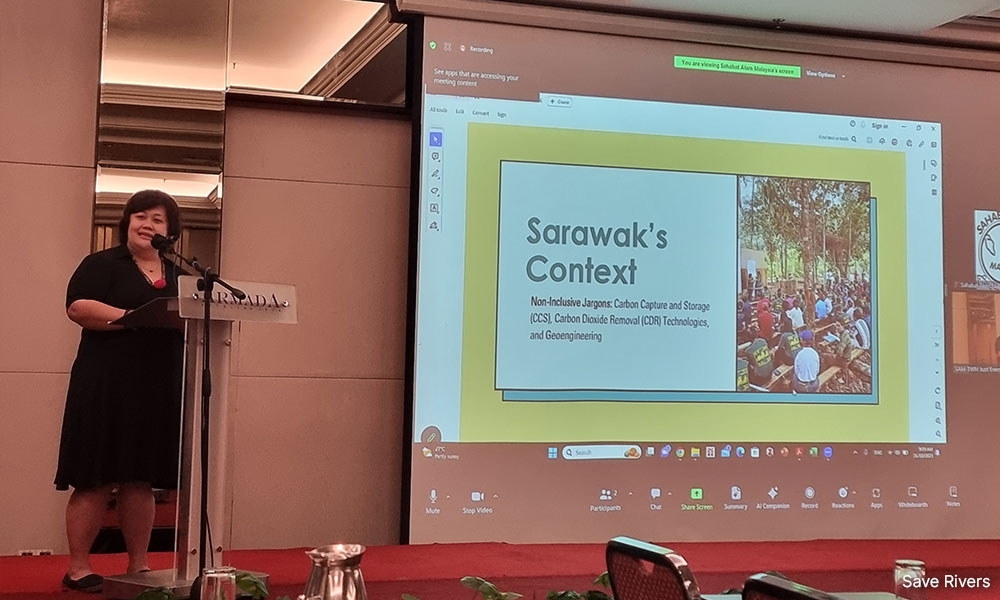
Save Rivers manager Celine Lim

Indigenous groups, she said, were concerned about carbon storage projects, and how they might impact them, but were told not to be concerned because the federal government has not released any policy or framework for this.

However, these concerns arose again when Sarawak amended the land code, including the terms carbon and carbon storage, in the code allowing it to lay claims to carbon capture rights, she added.

Carbon sequestration is a controversial process of capturing and storing atmospheric carbon dioxide, a costly method which experts said has not been proven to effectively sequester carbon to the levels claimed.

Petronas has announced the Kasawari carbon capture and storage (CCS) project to store carbon under the sea 200km off Bintulu - a project which is to be the largest of its kind in the world.

Malaysia is also in talks with countries like Japan, to store Japan's carbon dioxide emissions from its power plant in Malaysia, with the aim of sending the first shipment in 2028.

Crocodiles or electricity

Lim said how this will impact indigenous groups is unclear but the attitude of the Sarawak government does not give comfort.

For example, she said, while officiating Regata Baram 2023 last month, Sarawak premier Abang Johari Openg said when opposing projects like big hydroelectric dams, indigenous people have to choose if they want "crocodiles or electricity".

Lim said his comments raised concerns over whether plans for the mega Baram hydroelectric dam - which was shelved after community resistance - would be revived.

At the same time, the Sabah government committed two million hectares of rainforest to a 100-year carbon credit conservation project, but rights groups said indigenous people were not consulted.

"Where we're at now, looking at what happened in Sabah, we're nervous on our end," she added. - Mkini