


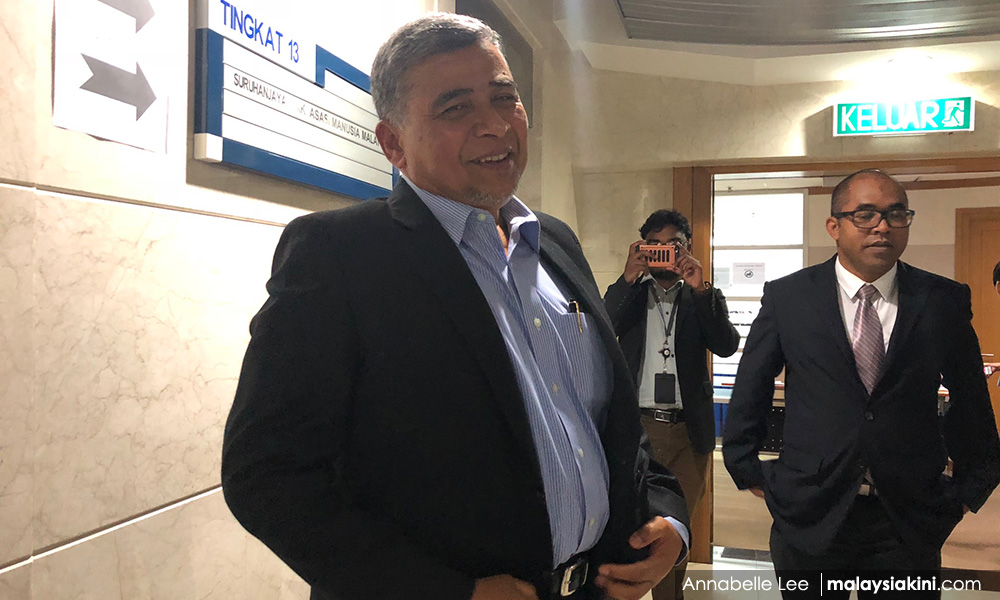
SUHAKAM INQUIRY | During his tenure as inspector-general of police, Khalid Abu Bakar had instructed his force to assist religious authorities in enforcing fatwas against Syiah believers and activities.
He also believed that there was a national fatwa outlawing Syiah practices which had legal implications.
Khalid said this when cross-examined during the Human Rights Commission’s (Suhakam) inquiry into the disappearance of social activist Amri Che Mat today.
“The Syiah problem is not a police problem, but we have an understanding with Islamic departments that we will help them when it comes to any wrongdoing under state syariah laws.
“From time to time, I would give instructions to my officers when I received information on activities that were not in line with Islamic teachings [...] and I would tell them to help the Islamic department in their investigations.
“[...] We would also provide personnel to ensure the security of Islamic department officials during enforcement activities,” he said at the Suhakam headquarters in Kuala Lumpur this morning.
Khalid added that police also assisted religious authorities to nab Syiah followers.
“If they (the religious department officers) want to catch someone and need our assistance to catch the person, we will assist in catching the person.
“We will also assist them in rehabilitation, we will send officers into prisons and help authorities explain security and safety (issues) but not in terms of religion (issues),” he said.
According to Khalid, the National Fatwa Council had previously released a fatwa outlawing Islamic beliefs other than the Sunnah Wal Jamaah.
“In my view, fatwas have legal implications.
“[...] To my understanding, (a fatwa outlawing Syiah beliefs) was gazetted by the Perak Islamic Department and thus it has legal implications,” he added during the cross-examination.
In response, Suhakam commissioner Aishah Bidin corrected Khalid and said the Muzakarah of the Fatwa Committee of the National Council for Islamic Affairs was tasked with making fatwas, and that the edicts did not have legal implications nationwide.
The former IGP later clarified that he could have “misunderstood” the existence of a National Fatwa Council but maintained he had been informed that a fatwa against Syiah activities would be gazetted into law in all states.
No knowledge about Amri
Amri disappeared on Nov 24, 2016 in Kangar, Perlis when Khalid was still the IGP.
Former Bukit Aman social extremism division chief Awaludin Jadid previously revealed that his unit had been monitoring Amri prior to his disappearance, and further viewed Amri’s NGO Perlis Hope as a front for Syiah proselytisation activities.
Today, Khalid maintained that the police were merely following “government policy” on Syiah, and were responsible for ensuring the people did the same.
However, he could not confirm if Amri was indeed being monitored, because Awaludin had not reported directly to the IGP and he thus did not have detailed knowledge about the case.
“I can’t confirm that he was being surveilled, I do not know much about this case.
“[...] I have not been updated about this case and before I retired (in Sept 2017) I did not know the cause (of his disappearance),” he said.
Today’s proceeding was led by Suhakam commissioner Mah Weng Kwai together with Aishah and Nik Salida Suhaila Nik Saleh.
Suhakam is investigating if Amri’s disappearance, as well as that of two others, were “enforced or involuntary” as defined by the International Convention for the Protection of All Persons from Enforced Disappearance (ICPPED).
Malaysia is not a signatory to the ICPPED, which was adopted by the UN General Assembly in 2006.
Enforced disappearance is defined as the arrest, detention, abduction or any other form of deprivation of liberty by agents of the state or by persons, or groups of persons acting with the authorisation, support or acquiescence of the state. - Mkini

No comments:
Post a Comment
Note: Only a member of this blog may post a comment.