


There are many unanswered questions over the second 5G network awarded to U Mobile, which is now going ahead with China’s Huawei to roll out the Peninsular Malaysia part, and another Chinese firm, ZTE, taking on Sabah and Sarawak.
However, U Mobile chairperson Vincent Tan’s announcement was rather sketchy and scanty and devoid of necessary details, with no solid deadlines mentioned at all, and mentioning the usual platitudes and thanks to the Madani government and the MCMC.
“Our goal is to build a Next Gen 5G network that drives growth, sparks innovation, and sets new benchmarks for Malaysia’s digital economy,” said Vincent Tan, chairperson of U Mobile, in a series of empty cliches.
Communications Minister Fahmi Fadzil, who was present at the signing ceremony, lent a face but offered no answers to the many questions that have previously been raised over the second 5G network.
Unnecessary network
The second network is an unnecessary one and appears to be politically motivated, especially since the original 5G network was designed to be a single one and promoted by a wholly government-owned corporation, Digital Nasional Berhad (DNB).
It was envisaged that DNB, set up in March 2021 when Muhyiddin Yassin headed the government, would eventually be owned by the major telecom companies, solving the problem of preferential access and reducing fees for the customers.
It had already incurred the capital expenditure necessary for this at RM16.5 billion, and by the end of Dec 31, 2023, its 5G coverage was already over 80 percent. What then was the need for the second network? None. For a detailed examination, read this article.
The pertinent question now is, who is going to compensate DNB? The sad truth is that the consumer will bear the cost - you, me and the millions of others - just to keep a needless new second 5G network alive. Why?
And why choose U Mobile as the second network provider when other better, stronger telecom companies such as CelcomDigi and Maxis had also bid? The only possible answer is politics and patronage.
CelcomDigi and Maxis were much better positioned to undertake and roll out the 5G network, as shown by the chart below, extracted from that article on political factors.
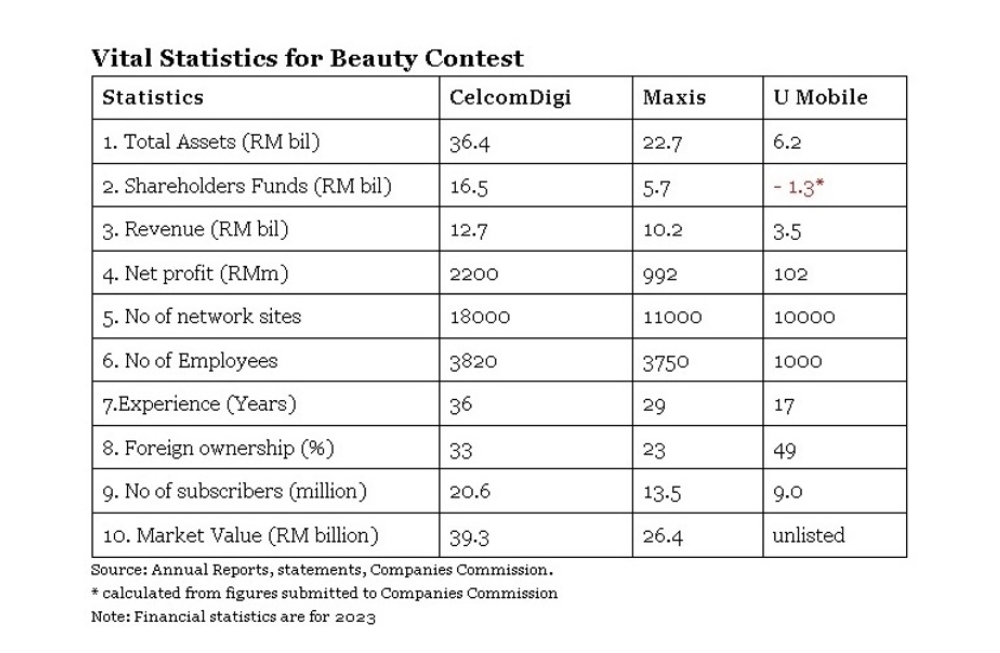
All right, the Johor royalty has a minority stake of 22.3 percent in U Mobile, but surely that cannot be the sole reason. My analysis of the shareholding structure and an announcement by a Singapore government company indicate that at the time the 5G award was made, the Singapore government owned at least 70 percent of U Mobile.
What about spectrum value?
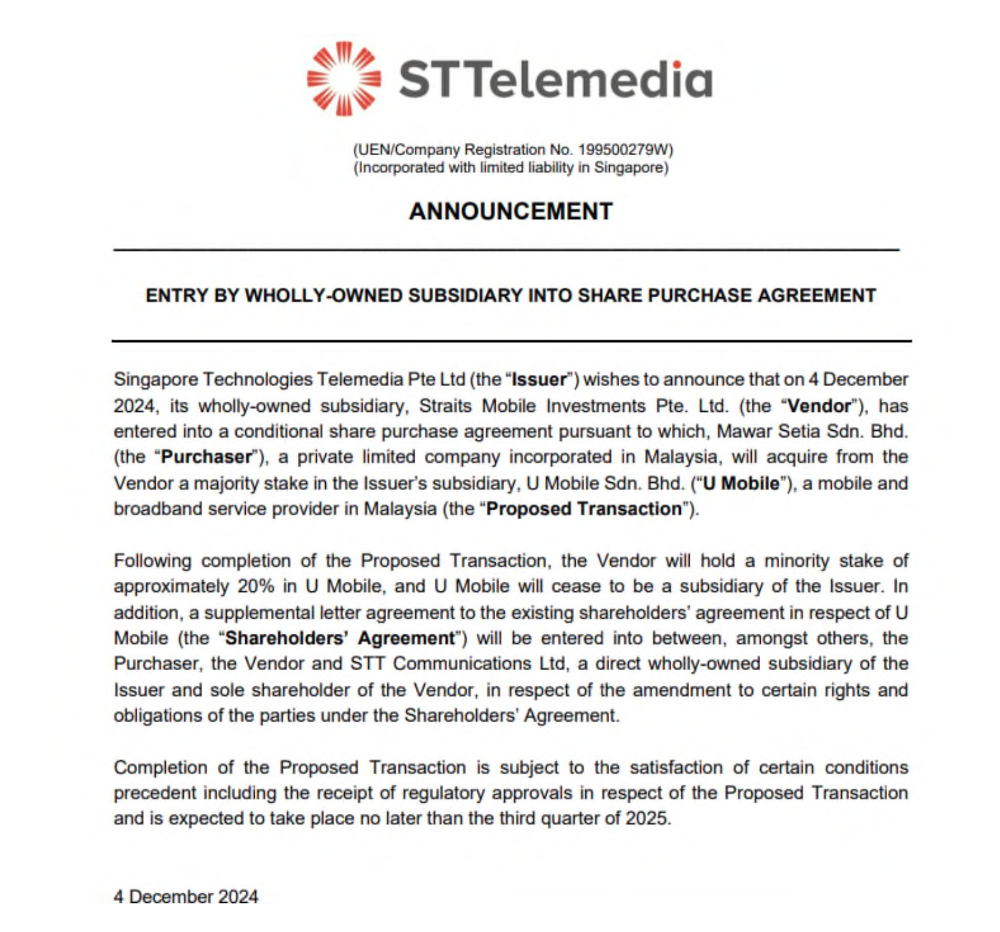
ST Telemedia, which is a wholly owned subsidiary of Singapore government-owned Temasek Holdings, said that its wholly owned subsidiary Straits Mobile Investments Pte Ltd signed a conditional agreement with Mawar Setia Sdn Bhd for the sale of a majority stake in its subsidiary U Mobile.
After the sale of the stake, U-Mobile ceased to be a subsidiary, clearly implying it was a subsidiary before that.
According to reports, Mawar Setia is 70 percent owned by tycoon Vincent Tan and 30 percent owned by Johor ruler’s daughter Tunku Aminah Sultan Ibrahim.
All these remain unanswered. Neither ST Telemedia nor the purchasers, Mawar Setia, disclosed the price. This is important because if the value of the spectrum is taken into account, as it surely would have been, the sale price would have been worth billions. A former minister estimated the spectrum could be worth between RM6 billion and RM15 billion!
By just flipping that 50 percent stake post the award of the spectrum and the second 5G contract, the Singapore government could have made billions - based on a value of RM6 billion at the low end, that would have been worth 50 percent of that or RM3 billion! And without any work having been done, even on 5G.
Highly irresponsible
It is highly irresponsible for this Madani government not to disclose the relevant details and full explanations of outstanding issues before allowing this highly questionable deal to proceed. If it can’t explain it, kill it.
Increasingly, it looks like this deal was not a normal one and was made out of political, patronage and dubious considerations, the costs of which will eventually be borne by the consumer to enable a few - and that includes Singapore - to make a lot of money.
Remember, the award of a spectrum brings immediate value of billions into the company receiving it, especially when there are no restrictive provisions. That would just be a gift to private parties if there are no safeguards, in the same way that many others before made billions from the government’s and the people’s wealth.
This deal makes Prime Minister Anwar Ibrahim’s pledge to cut corruption and patronage rings rather hollow and loud. Why do we keep giving our assets to those who are already very rich? Is that not the source of most of our corruption and something that Anwar fought against previously? - Mkini
P GUNASEGARAM says that the public must now resign itself to higher charges because of so-called efficiency improvements, but in fact, the actual reverse. Remember the electricity tariff hikes post-privatisation?
The views expressed here are those of the author/contributor and do not necessarily represent the views of MMKtT.

No comments:
Post a Comment
Note: Only a member of this blog may post a comment.