


“The exercise of such powers (of the courts to affirm constitutional supremacy) not just protects and preserves democracy but guarantees its continued existence. I would therefore urge such parties not to be afraid of them and seek to curtail them, but to uphold them.” - former chief justice Tengku Maimun Tuan Mat at a legal conference in Malta earlier this year.
With the new chief justice appointed yesterday, it is time to reflect anew on the state of judicial independence in Malaysia and Prime Minister Anwar Ibrahim’s role in it.
As the main person who decides who becomes judges in the higher courts, he has, by his decisions, systematically undermined and perhaps destroyed judicial independence for now, potentially causing great harm to the country.
Anwar’s refusal to recommend the extension of the former CJ by six months, delay in appointments, and poor choice of candidates, ignoring seniority and meritocracy amongst others, has betrayed the established tenets of independence of the judiciary, returning it to the dark ages of extreme judicial control by Umno, and in particular, Dr Mahathir Mohamad.
This is surprising considering that the judicial system under Mahathir and Najib Abdul Razak, both former prime ministers, was used to systematically hound Anwar and imprison him on trumped-up charges, only receiving pardons after the 2018 election, in which Pakatan Harapan, Anwar’s creation, won.

This was a betrayal of judicial independence, which the Harapan government, ironically under Mahathir, the person designated interim PM, sought to restore following the 2018 election when Richard Malanjum and then Tengku Maimun Tuan Mat (May 2019) were appointed chief justice and Tommy Thomas as attorney-general.
Anwar’s choices criticised
Anwar’s choice of the attorney-general, his three extensions of the MACC chief’s tenure, even the inspector-general of police, and the current crop of judges have all come under criticism.
By doing this, he has sympathetic ears in all branches involved in the administration of justice, a comfortable place to be in.
Tengku Maimun, especially, led a resurgence of judicial independence with her astute leadership, courage and bold initiatives to reassert judicial independence, resisting all pressures to conform.
Thomas prosecuted those who thought they would never be brought to court.
A necessary and important cornerstone of a functioning democracy is the independence of the entire judicial system, which helps to maintain a poised and delicate balance between the legislative and executive on the one hand and the judiciary on the other.
Without this balance, the judiciary cannot check the unbridled power of the executive, especially when it controls the legislature as Umno of old and new did with their two-thirds majority in Parliament. The system was considerably abused.
That enabled them to amend the Constitution at least 60 times over a similar number of years, involving a total of over 700 amendments, according to legal scholars.
This is an astonishing figure, surpassing amendments to the US Constitution, a document in existence for some 250 years, against our 68 years.
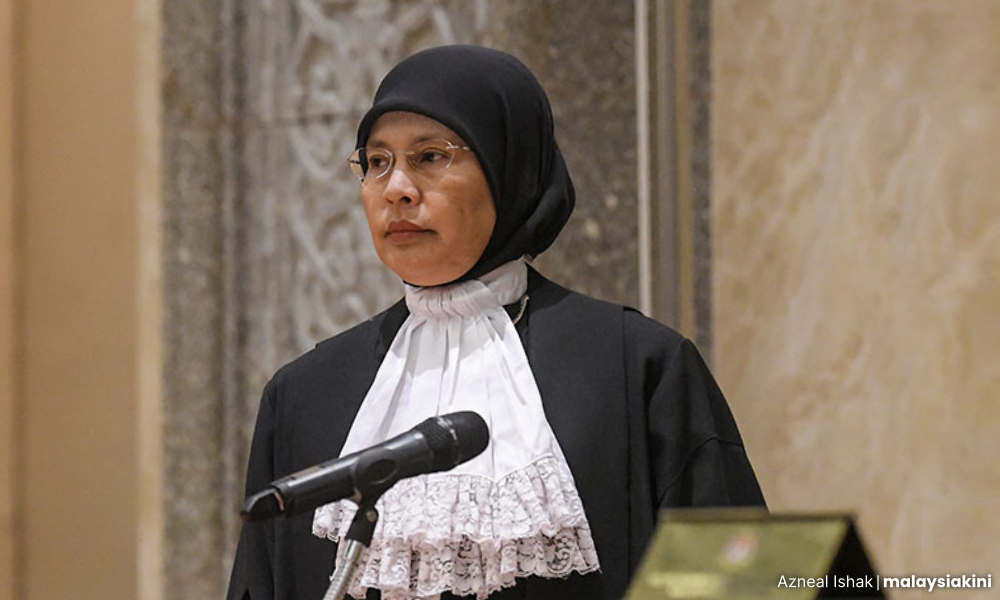
Tengku Maimun’s position is best reflected in her keynote speech at a conference in Kuala Lumpur on March 8, 2023. This is required reading for anyone who wants to know how she did it in detail and her position.
Challenging times
Some excerpts: “I stepped in as the chief justice of Malaysia at a challenging time when the courts’ image had been battered with disgraceful allegations of abuse of power and also controversies involving top judges.
“The allegation against the judiciary then was that the judiciary was subservient and beholden to the executive. I therefore made it my mission, upon my appointment in 2019, to defend the independence of the Malaysian judiciary.”
She asserted that the power of constitutional judicial review is ingrained in Article 4(1) of the Federal Constitution of Malaysia, which states: “This Constitution is the supreme law of the Federation and any law passed after Merdeka Day which is inconsistent with this Constitution shall, to the extent of the inconsistency, be void.”
Tengku Maimun goes on to explain: “If a law is found to be unconstitutional, the judiciary has a duty to strike it down as being void to ensure that Malaysia’s Federal Constitution remains the supreme law of the land.”
She further pointed out that in 2022, the Federal Court handed down two important judgments declaring “ouster clauses” to be unconstitutional.
An “ouster clause” is a provision included in legislation which seeks to limit or exclude judicial review of acts or measures undertaken by the executive.
That effectively meant that any provision that excludes the courts from looking at the constitutionality of any law or order is invalid.
This is the position in Malaysia now. It did not always used to be so.
Anwar has been remiss
Anwar has been remiss in a number of areas. He allowed key judicial appointments to be delayed, causing unnecessary uncertainty, concern, and actual delays in proceedings because of insufficient judges.
In the appointment of the chief justice, as I explained here, the new top judge jumped over an unprecedented nine Federal Court judges and 24 more senior Court of Appeal judges - 33 positions in all - to be appointed, with no solid showing of why he deserved to jump so high.
In addition, lawyers privately talk about his lack of any major landmark judgments and his relative inexperience, mindful of the fact that they may have to face the Federal Court in future.
Malaysiakini reported in a recent article that the newly appointed Chief Justice Wan Ahmad Farid Wan Salleh, Court of Appeal President Abu Bakar Jais, and Chief Judge of the High Court of Sabah and Sarawak Azizah Nawawi appear to be more conservative in their approach.

Wan Farid, in the High Court in May 2023, had ruled that the unilateral conversion of Hindu mother Loh Siew Hong’s three children to Islam by her former husband was valid.
However, a three-person Federal Court bench, chaired by then chief justice Tengku Maimun, ruled the children will remain non-Muslims, reiterating the 2018 ruling that conversion of a child to Islam requires the consent of both parents.
It’s hard to believe that Anwar’s choice of judges is not influenced by their track record and their conservatism when it comes to religious affairs and other factors, given the happenings in this short but significant space of time.
Umno-style control
As I explained here, Anwar has a sworn duty under the Judicial Appointments Act to uphold judicial independence and, among other things, must have regard to:
The need to defend that independence;
The need for the judiciary to have the support necessary to enable it to exercise its functions;
The need for public interest to be properly represented regarding matters relating to the judiciary, the administration of justice and related matters.
His actions have not shown that he is helping to preserve judicial independence and indeed may not even have appointed those recommended by the Judicial Appointments Commission.
It is an irony beyond belief that a person who was the repeated victim of a jaundiced judiciary has decided to take the path of Umno in the past to put sympathetic and like-minded judges in important positions, leapfrogging them over many more senior and more competent judges.
That is a betrayal of judicial independence and the judicial process itself, where appointments of the attorney-general, the IGP, and the MACC head have been called into question, too.
It reeks of old-school Umno-style attempts to take charge of judicial processes, an unwelcome, intrusive development for a person who is prime minister now but was before a victim of judicial misconduct because of his reformist sloganeering. - Mkini
P GUNASEGARAM is disappointed over the way reformasi has turned out, as with most people.
The views expressed here are those of the author/contributor and do not necessarily represent the views of MMKtT.

No comments:
Post a Comment
Note: Only a member of this blog may post a comment.