


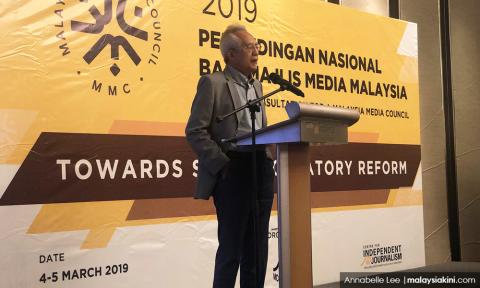
The Malaysian Media Council needs to be set up this year, veteran journalist A Kadir Jasin said today.
This was especially as both the Communications and Multimedia Ministry and the Attorney-General’s Chambers (AGC) had stated their commitment to the initiative.
“I think if we fail, at least within this year, to set up a media council, then I believe we have not actually done what we should.
“And it’s going to be disfavour for the media industry (and) for journalists,” he said during his keynote address at the National Consultation for a Malaysia Media Council conference at Impiana Hotel, Kuala Lumpur this morning.
Kadir, who is the special advisor to Prime Minister Dr Mahathir Mohamad for communications and media affairs, stressed that the Pakatan Harapan government had the political resolve to ensure the industry was free to regulate itself, despite failing to repeal the Printing Presses and Publications Act 1984 (PPPA) since coming into power in May last year.
“I think this government has made a commitment that that (repealing the PPPA) will be done.
“I think there aren’t any more major hurdles that will stop us from proceeding with the formation of the Malaysian Media Council,” he said.
Malaysian media has been advocating a self-regulatory body since 1974, similar to the legal profession’s Bar Council and the medical profession’s Medical Council.
Bill proposal almost ready
Later, Malaysiakini CEO Premesh Chandran shared a proposal for a media council legislation which had been crafted following discussions among a diverse range of editors and publishers.
The proposed bill would require the council to provide a code of conduct, professional development opportunities and accreditation for journalists. It would also provide a media complaints mechanism and media literacy education for the public.
It also pressed for the PPPA as well as Sections 211 and 233 of the Communications and Multimedia Act 1998 to be repealed to pave way for the council.
It further mooted that the council be chaired by a politically neutral former judge or eminent person, and comprise 24 members - 12 from online, print and broadcast media publishers; four from media associations; four journalists and four members of the public appointed by the council exco.
At least three of the publishers and one journalist would need to be from East Malaysia. All would serve three-year terms.
“The timeline given was they (the government) want the changes made by May this year, their first anniversary (since winning the general election).
“So we have been working towards that timeline. The bill is just about ready,” Premesh said, adding that it will next be presented to Kadir and the communications ministry.
‘Lack of transparency’
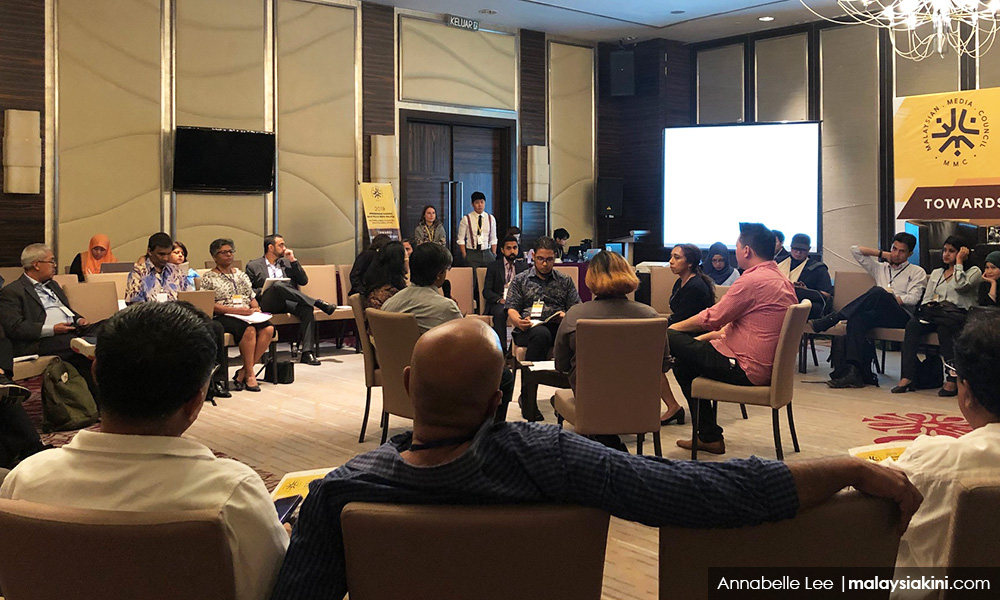
Today’s conference was attended by representatives from the communications ministry, Election Commission, Bersih, universities and journalist groups like the National Union of Journalists (NUJ), Institute of Journalists (IOJ), the Foreign Correspondents Club of Malaysia (FCCM) and local media watchdog Geramm.
Notably absent were Malay, Chinese and Tamil news outlets, both in attendance and coverage.

Co-organiser Centre for Independent Journalism’s director Sonia Randhawa (photo) told Malaysiakini that invitations had been issued to all media about a month ago.
In a challenging media business environment, she admitted that she had found it challenging to mobilise support for the media council, especially for a proposed bill that few had access to.
“The only people who have a draft (of the media council proposal) are editors and publishers. That draft has not been made public.
“Premesh presented the major points (earlier) but he hasn’t shared it with the NUJ, the IOJ or with any of the journalism associations,” Sonia remarked.
“The process now is not transparent enough. How can we have a transparent media council if the draft bill is not being shared?” she asked.
Nevertheless, Sonia hoped that more newsrooms would cover the second day of the conference.
“We need to make sure that the conversation (about the media council) is reaching as many journalists as possible, so they can kick start their own conversations in the newsroom.
“And (we need) to engage the public as the public buy-in is also important,” she said.
Tomorrow, participants will discuss what a code of ethics for journalists would include and further chart a roadmap for the Malaysian Media Council. - Mkini

No comments:
Post a Comment
Note: Only a member of this blog may post a comment.