


As the debate over the Unified Examination Certificate (UEC) resurfaces on the political stage, two veteran figures have described the discourse as increasingly muddled by rhetoric and political manoeuvring, with little progress towards resolution.
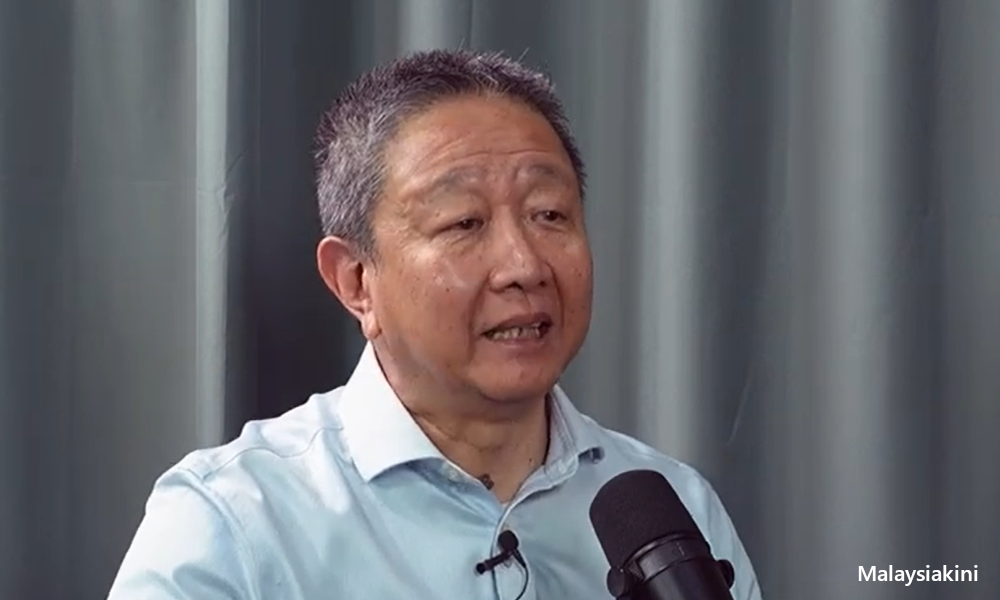
Former Unified Examination Certificate Task Force chairperson Eddin Khoo likened the issue to a descent into Alice in Wonderland, where confusion prevails, and substantive policy discussions are drowned out.
“It’s like we fall into a rabbit hole and, once inside, we encounter two figures who fundamentally disagree with each other yet look the same - Tweedledee and Tweedledum.
“As long as we remain stuck in the debate between Tweedledee and Tweedledum… we will not get anywhere,” he said as a guest on KiniTV's "Explain Sikit" podcast.
According to Khoo, what is essentially a complex but technical issue has been deliberately politicised, amplified by emotionally charged language such as framing UEC recognition as a “betrayal”.
This, he said, has turned the debate into a “political ghost”, where fear and symbolism overshadow facts and feasibility.
“I think this issue is indeed haunted by politics. I have to reveal that when I was serving in the taskforce, there was a great deal of provocation from politicians.
“I believe this issue, which I continue to emphasise, is a technical matter that has long become a point of contention and a political ghost.
“So, the rhetoric surrounding it has also taken on that character,” he said.
‘Report never presented’
Khoo said that during his tenure, the task force had prepared a comprehensive report following engagements with multiple stakeholders, including Dong Zong and Ikatan Muslimin Malaysia.
“I had pointed out that most members of such committees tend to be quite detached from the issue. They do not engage directly with those who are involved in it. So I tried to follow the practices of other committees.
“We tried to engage with stakeholders. Academic experts were invited, as well as groups that had voiced opinions (such as) Dong Zong and Isma (Ikatan Muslimin Malaysia),” said Khoo.
“We also organised two town hall sessions, where all these groups came together face-to-face for discussions.
“Those who were essentially adversaries sat together at the Education Ministry in Putrajaya,” he added.
However, the report was never formally presented due to changes in government and disruptions caused by the Covid-19 pandemic.
The absence of an official platform to table the findings, Khoo said, allowed political narratives to dominate while sidelining technical solutions that had already been explored.
Pakatan Harapan had pledged in the last general election’s manifesto to recognise the UEC for entry into public universities, provided applicants obtained a credit in SPM-level Bahasa Malaysia, with the UEC assessed as equivalent to existing general entry qualifications.
Khoo also maintained that UEC recognition does not infringe the Federal Constitution, arguing that the supreme law is deliberately framed to allow for multiple interpretations on certain matters.
Article 152 of the Constitution
DAP veteran Teng Chang Kim, who also appeared on KiniTV's podcast, echoed Khoo's view and rejected arguments that cited Article 152 to oppose UEC recognition.
“If we look at it, many people refer to Article 152 of the Federal Constitution, but they do so without actually reading it.
“In fact, Article 152 not only protects and elevates Bahasa Melayu as the national language; it also safeguards the rights of other languages to be preserved by the government.
“Preservation, in this sense, does not merely mean maintenance in form, but also recognition, because we want to preserve these languages at a standard that is acceptable internationally, not just at our own local level.
“Therefore, in my view, this does not contradict Article 152 at all. In fact, it is protected by it,” Teng said.
Article 152, which affirms Bahasa Melayu as the national language, has frequently been cited by critics of UEC recognition as evidence that the certificate undermines the constitutional status of the language.
Teng rejected this notion, saying the Chinese community has taken a pragmatic approach by incorporating the national language into its education system.
He noted that about 95 percent of UEC students pass Bahasa Melayu in the SPM examination, which he said shows that mastery of the national language has not been neglected and continues to strengthen among younger non-Malay generations.
Ball tossing
Both Teng and Khoo agreed that resolving the issue requires a rational and grounded approach rather than short-term political calculations.
“Many are focused on how they can maximise support by turning this issue into a political tool. To me, this is deeply embarrassing for us as a nation,” Teng said, adding that such a prolonged debate was unbecoming of a country that has been independent for decades.
He described the issue as a “ball” tossed between rival coalitions during election cycles to mobilise voter support, while avoiding sustained policy engagement.
Khoo said this dynamic is what keeps the country trapped in an endless rabbit hole of debate.
Instead of addressing technical questions on university entry requirements and national education goals, he said, the discussion repeatedly collapses into political theatre, leaving a decades-old issue unresolved despite the existence of workable and constitutionally sound pathways forward.
Critics had accused the DAP of reviving the UEC recognition issue following the party's wipeout from Sabah at the last state election, largely due to a rejection by its mostly urban Chinese voter base.
On Dec 12, Prime Minister Anwar Ibrahim, who responded to the UEC recognition issue, reminded all parties that any demands touching on religious, racial, or ethnic sensitivities must consider the constitutional position of the national language. - Mkini

No comments:
Post a Comment
Note: Only a member of this blog may post a comment.