`


THERE IS NO GOD EXCEPT ALLAH
read:
MALAYSIA Tanah Tumpah Darahku

LOVE MALAYSIA!!!


Tuesday, September 30, 2025

AI and crime: Malaysia on the edge

 misinformation

THE age of artificial intelligence (AI) has arrived and not just in innovation, but in crime.

A recent report by the Centre for Emerging Technology and Security (CETaS) in the United Kingdom, titled “AI and Serious Online Crime” lays out how AI is already transforming criminal activities, enabling fraud, impersonation, and psychological manipulation at unprecedented scale.

While the report focuses primarily on the UK and international threats, the Malaysian experience echoes its warnings. With rising cases of deepfake scams, voice cloning, and AI-powered fraud schemes, it’s clear Malaysia is not just catching up with global trends but it is already living them.

AI crime: Not the future, but the present

The CETaS report outlines a dangerous new landscape where generative AI is used to deceive, defraud, and manipulate.

Criminals are exploiting tools like deepfake video and voice, chatbots, and AI image generators to create more believable scams. These tactics allow them to reach more victims, disguise their tracks, and operate across borders.

In Malaysia, these risks are no longer hypothetical. The first quarter of 2025 alone saw over 12,000 online scam cases, with losses nearing RM574 mil, according to the National Scam Response Centre. Many of these scams were powered, directly or indirectly, by AI.

Real cases, real losses

(Image: Medium)

Consider the deepfake video scams now circulating on Malaysian social media platforms. In one recent case, a video featuring a well-known local entrepreneur was manipulated using AI to promote a fake investment platform.

With a convincing voice and gestures, the video looked authentic leading many to fall for it without question. Some lost thousands.

AI-generated voice impersonation is another rising threat. A woman in Penang was conned out of RM4,800 after receiving a phone call from someone who sounded exactly like her brother. The voice was cloned using short voice samples and deployed in a moment of emotional urgency.

In a more extreme case, a 72-year-old retiree in Selangor lost RM5 mil in a fake investment scheme run via an AI chatbot that communicated with him daily through a fraudulent app. What felt like a legitimate customer service experience turned out to be an algorithmic con job.

These examples are not outliers but they represent a growing trend in which AI doesn’t just make scams more convincing, but harder to detect and easier to scale.

The enforcement challenge

One of the CETaS report’s core findings is that enforcement agencies globally are struggling to keep up with AI-enabled crime. Malaysia is no exception.

The Malaysian Communications and Multimedia Commission (MCMC) has reported over 400 takedown requests for AI-generated scam content, including deepfake videos and impersonations.

However, platform compliance is uneven. Some platforms act swiftly; others ignore or delay removal, leaving harmful content online for days or even weeks.

Moreover, current laws in Malaysia do not specifically address AI misuse. While general cybercrime and fraud laws apply, there is a legal grey area when it comes to offences like synthetic voice fraud or deepfake identity theft. This gap leaves victims exposed and enforcement agencies under-equipped.

Lessons from CETaS: What Malaysia must do
(Image: The Legal Wire)

The CETaS report makes several recommendations that Malaysia would do well to adopt.

First, establish a national AI crime taskforce. This specialised unit should focus on AI-driven fraud, bringing together cybersecurity experts, forensic analysts, and financial crime investigators.

Similar to how the NSRC coordinates scam responses, this taskforce should be forward-looking and tech-enabled.

Second, update the law. Malaysia needs legislation that clearly defines and criminalises deepfake impersonation, AI-assisted fraud, and misuse of AI for deception. Without legal clarity, prosecution becomes difficult and deterrence is weakened.

Third, hold digital platforms accountable. Social media companies and content hosts must be legally required to remove harmful AI-generated content quickly: ideally within 24 to 48 hours of verified notice. Transparency reports on content moderation should be mandatory.

Fourth, launch widespread public awareness campaigns. Many Malaysians, especially the elderly and less digitally savvy, remain unaware of how realistic AI fakes have become.

National campaigns should educate the public on spotting signs of synthetic content and avoiding scams.

Lastly, invest in AI detection and forensics. Law enforcement must be equipped with tools to detect deepfakes, trace their origins, and collect admissible evidence. Collaboration with local universities and AI labs can support this capability.

Time to act

AI is not inherently dangerous but in the wrong hands, it is already proving to be a powerful tool for deception and exploitation. The CETaS report warns that, left unregulated, AI will supercharge fraud and overwhelm criminal justice systems.

Malaysia still has time to mount an effective response but the window is closing fast. If we fail to act, we risk normalising a future where anyone’s face, voice, or identity can be hijacked by an algorithm, and where the line between reality and fiction is increasingly blurred.

It’s not just a matter of catching criminals but it’s about safeguarding trust in our digital future. 

R.Paneir Selvam is the principal consultant of Arunachala Research & Consultancy Sdn Bhd, a think tank specialising in strategic national and geopolitical matters.

The views expressed are solely of the author and do not necessarily reflect those of  MMKtT.

- Focus Malaysia.

Beware, Netanyahu, Israel can be destroyed in replay of biblical history


IN biblical times, the Israelites could depend on divine help to conquer and seize territories belonging to ancient people like the Philistines.

Based on what the Bible narrates, they occupied a special place in biblical history because they were described as the chosen people of God.

Today, the Israelis are under the illusion that they are still under divine protection and that they could continue with their murderous campaign against the modern people that goes by the name of Palestinians.

Perhaps, Prime Minister Benjamin “Bibi” Netanyahu takes the Holy Bible too much to heart where it described how God had, in many instances, paved the way for his ancestors to occupy land that rightfully belonged to other ancient people.

The Bible also tells us how the Israelites, small in numbers, fought and subdued more powerful tribes or nations, grabbed their land and, in many instances, killed them all—innocent men, women and children.

They showed no mercy in their relentless campaigns of what could be described as ethnic cleansing, which today we call genocide.

Now, Netanyahu sees in all these biblical events as a continuation of the current war in Gaza in which more than 65,000 Palestinians have been killed.

But Netanyahu must not take for granted that the God of Israel is on his side as he wages a brutal campaign in a biblical land.

Thousands of innocent lives were unnecessarily cut short and many thousands more are languishing under the hideous shadow of famine. Is Netanyahu stone-deaf to the pitiable cry for help?

Granted, Israel had to retaliate when its own citizens were massacred senselessly. But that does not mean that Israel must commit a greater crime against humanity with its savage acts against the civilian population.

One wonders whether God had appeared to him in a dream instructing him to invade that strip of land to make Israel greater.

Or did one of the modern-day prophets in Jerusalem came rushing to his office with this message: “Bibi, Bibi, God tells me to tell you that you can proceed with your plans to expand the borders of your country.”

In biblical times, God would give words of encouragement to the Israelites to attack their enemies with the guarantee that victory would be theirs.

Many times the Israeli kings would enter the Temple—the abode of God—to consult and seek permission to unleash their military (mis)adventures.

Today, this new “king” Netanyahu seemed to have obtained “permission” from God through reading of the Bible to justify the onslaught on Gaza.

Perhaps, Netanyahu had highlighted all the biblical verses that spoke favourably about Israel and that gave him the justification to unleash the carnage in Gaza.

For Netanyahu, the Holy Book has become his military guidebook in his battle against the Palestinians. He listens to nobody, not even to the United Nations.

Or perhaps he went to the Wailing Wall in Jerusalem and prayed for divine intervention and assumed that he had been given the green light to bomb Gaza to smithereens by merely touching those ancient wall in the belief that he is in the presence of God.

But “King Bibi” must realise that the Lord God of Israel had also punished his ancestors for disobeying God’s laws.

In those days, the Israelites had committed many sins like worshipping false gods for which they were severely punished: their Protector withdrew His shield and caused outside nations to attack them and even sacked Jerusalem.

In these modern times, Israel had committed another mortal sin by spilling innocent blood on the killing fields of Gaza. It is unlikely that God had sanctioned these atrocious crimes by communicating directly with the prime minister of Israel.

Beware, Netanyahu, biblical history can repeat itself and Israel will suddenly find itself surrounded by more powerful armies of other nations.

At this critical turn of events, Israel will then realise that it had angered the Divine Being and, this time, the punishment will see the chosen people probably banished and scattered to become slaves forever in foreign countries.

And in a biblical re-enactment, you, Mr Netanyahu, will be captured, stripped naked, chained, your eyes plucked out, and you will be paraded down the streets of Ankara, or Cairo, or Riyadh, or Kabul, or Jakarta or in any of the capital cities of the Muslim world.

Your people will never return to their homeland because Israel will no longer exist on the map of the world.

Phlip Rodrigues is a retired journalist.

The views expressed are solely of the author and do not necessarily reflect those of  MMKtT.

- Focus Malaysia.

Was enforcement by JPJ lax or lacking?


SELANGOR Road Transport Department (JPJ) director Azrin Borhan disclosed that action had been taken against 143 illegal taxi operators from January to Sept 15 this year at the Kuala Lumpur International Airport (KLIA) Terminal 1 and 2, and found that 108 were using cars that were rented or borrowed.

Those caught were fined a total of RM419,200 and their cars seized, with the ownership of one car already forfeited.

The fate of the rest would be decided in magistrate court hearings. In any case, seizing vehicles used for carrying fare-paying passengers without a permit is the most effective deterrent to curb this illegal activity.

But such efforts will be negated if JPJ were quick to release the seized vehicles, officially or otherwise, upon being persuaded by illicit operators.

If so, appeals or settlements ought to be declined, and there should be no big hurry to schedule an early magistrate date so that the gravity of the law sinks in on the delinquents.

Daily, hundreds of private cars, vans and multi-purpose vehicles are being used to send fare-paying passengers to and from airports nationwide. The majority may not be involved in touting or offering illegal taxi service at the airport.

Still, they are taking away business from legitimate companies operating licensed tourism vehicles.

Selangor JPJ director Azrin Borhan (Image: Bernama)

Commenting on private taxi service, Azrin  said these activities are illegal and dangerous and that it is not known how well the vehicles used are maintained or if they have valid road tax and insurance.

If an accident occurs, he said, how will they be responsible for their passengers? The short answer is illegal operators couldn’t care less.

Any general insurance company will confirm that only licensed vehicles such as taxis, buses, tour vans and e-hailing cars are covered for legal liability to fare-paying passengers, and private vehicles are not.

Injured passengers would have to sue to get compensation for their injuries, medical expenses, and loss of income.

The amount of compensation will be decided by the court and the motor insurance company is liable to pay. But if there is no valid legal liability to passenger cover and the other driver has no means to pay, the claimant may win only a paper judgement with no monetary compensation, which is as good as no insurance cover.

It is compulsory for all motor vehicles on public roads in the country to be covered for causing third party injuries, and the standard third-party motor insurance policy includes property damage as well.

However, these covers are only valid if the many terms and conditions in the motor insurance policy are adhered to.

Also, there is no cover if a vehicle was driven under the influence of drugs or alcohol. Therefore, should you be involved in a collision, there is less than a fifty-fifty chance that the other party has valid motor insurance cover.

If you consider the above statement preposterous, then look at the data provided by the Malaysian Vehicle Theft and Accident Reduction Council, which includes the General Insurance Association of Malaysia, Ministry of Transport, JPJ, PDRM, Customs, Bank Negara, Puspakom, takaful, automotive and loss adjuster associations.

The council estimated that nine million motorcyclists in the country are riding without valid licences, and these riders lack formal training in riding techniques, knowledge of traffic regulations, and road safety awareness.

For example, between January and November 2024, a total of 850,000 summonses were issued to motorcyclists.

About 300,000 were without a valid licence. However, transgressions are not limited to the B20 in Malaysia.

While the bottom 20% income group may throw caution to the wind, the T15 are more likely to evade taxes. This top 15% income group was referred to as maha kaya in the 2025 Budget, but their conduct can be shameful.

Those who have accumulated wealth from dubious sources are more likely to pay minimal or no tax for their income or road tax.

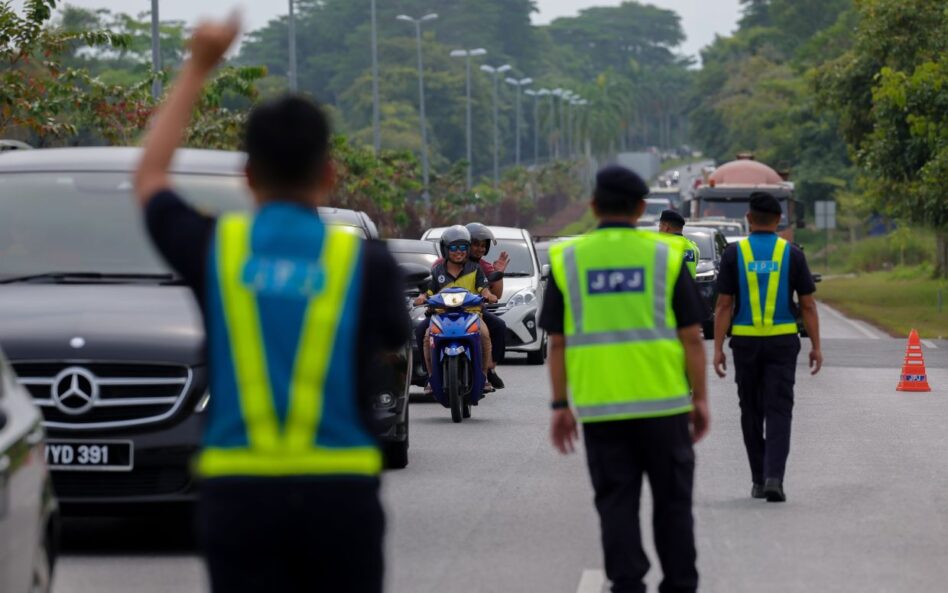
All this while, JPJ should be in the know but for reasons best known to itself, has only taken action recently by seizing some of the expensive cars found to be without road tax in roadside operations.

(Image: Bernama)

The top five brands of high-end cars with high capacity internal combustion engines with unpaid road tax were found to be Porsche (4,308 units owing RM13,751,078), Bentley (660 units/RM7,055,197), Rolls Royce (345 units/RM6,455,563), Ferrari (675 units/RM4,718,395), and Lamborghini (372 units/RM3,761,345).

The total amount from 6,360 cars is RM35.7 mil. Have all road tax collected went into our country’s coffers or some are siphoned off?

The various sources of income by tax evaders should be investigated if the Malaysian Anti-Corruption Commission (MACC) is not stretched too thin by too many cases, both pending and yet to start.

As for JPJ, enforcement has been lax or lacking over the years. Is it finally waking up from its slumber or still stuck in the culture caused by lack of political will in the government and Transport Ministry over the past decades?

Apart from nine million motorcyclists riding without licence, most of them ignore traffic lights, and speed along spaces between vehicles as their rightful lanes.

Some do not put on helmets or wear them improperly, or carry more than one pillion rider, which can be two or three children hanging or balancing precariously for dear life. 

YS Chan is the master trainer for Mesra Malaysia and Travel and Tours Enhancement Course. He is an Asean Tourism Master Trainer and also a tourism and transport business consultant.

The views expressed are solely of the author and do not necessarily reflect those of MMKtT. 

- Focus Malaysia.