


CORONAVIRUS | Covid-19 is so highly transmissible that patients of the virus are not allowed any visitors throughout their treatment, not even their closest family members.
It is no different for the Covid-19 patients under the care of intensive care doctors, who are known as intensivists, in the country's intensive care units (ICU).
But Dr Shanti Rudra Deva, a senior intensivist at Hospital Kuala Lumpur (HKL), said communicating with families of patients admitted to the ICU has always been an integral part of the care for the critically ill.
“For patients admitted with Covid-19, families were not allowed to visit.
“So we dedicate a particular doctor and time to make a (phone) call, including video calls, which allow family (members) to see and talk to their loved ones, and update the family on the (patient's) progress.
“Families look forward to that phone call,” Shanti said to Malaysiakini in an email interview.
As of yesterday, Health Ministry director-general Dr Noor Hisham Abdullah announced that there are 37 Covid-19 patients in the ICU, with 17 requiring ventilators.
It is also not just the patients who cannot physically be with their families.
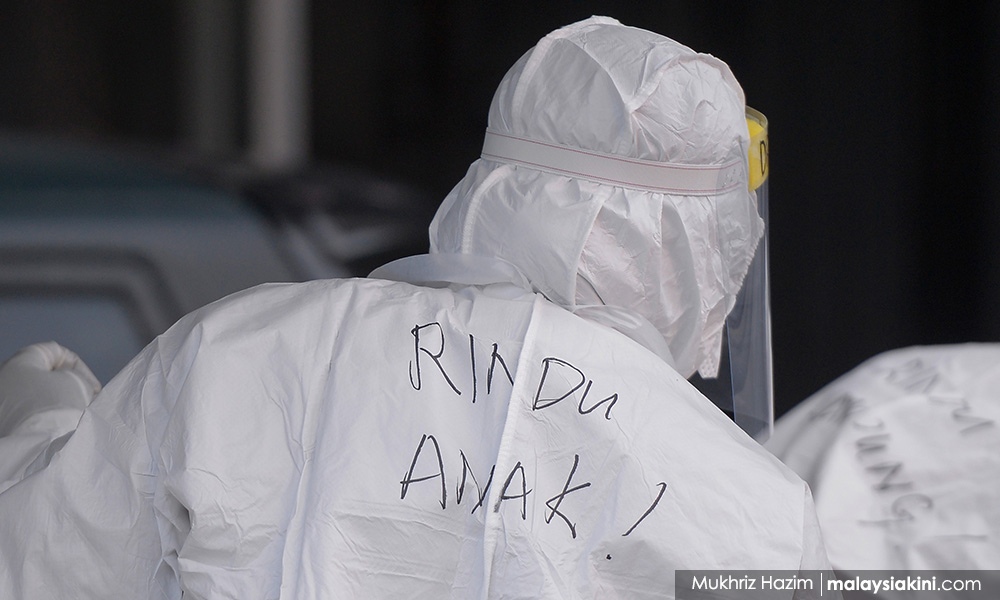
Shanti said some intensivists, who work with Covid-19 patients in the ICU, are fearful of infecting their family as they have young children at home.
“Some have self-isolated themselves and sent their children to live with others or they are not visiting their elderly parents.
“This is a new respiratory disease that is infectious. It’s at the back of everyone’s mind. The concern is always there at work, and we all bring that worry home,” she said.
However, she said, to overcome these fears, it is vital to have knowledge based on facts as well as thorough preparation.
“We had at least a few weeks following the outbreak in China to begin preparations, including the training of personnel and the acquisition of personal protective equipment (PPEs).
“Continuous feedback on the processes necessary to maintain staff protection and confidence was continually discussed and improved upon, both at the national and hospital levels,” Shanti said.
Boosting staff morale
On top of that, at the hospital level, there are mental health psychosocial support services (MHPSS) offered to all involved while the Health Ministry also has formulated a Covid-19 mental health kit.
According to the Health Ministry's website, the kit can be used as a resource to address mental health issues during the Covid-19 crisis.
Meanwhile, Shanti said no ICU staff in HKL has been involved in the care of Covid-19 patients who have been infected by the virus over the course of their duties.
“This is important and this fact is reassuring in that what we are doing has been adequate,” she said.
Noor Hisham has also repeatedly stressed that there have been no healthcare workers on duty in Covid-19 wards or in the treatment of Covid-19 patients who have been infected.
On Sunday, he said about 80 percent of healthcare workers who tested positive for Covid-19 acquired the virus through community transmission such as attending weddings.
These healthcare workers then inadvertently brought the virus into hospitals when they returned to work, he said.
Aside from that, Shanti also said it is important to boost staff morale as they may be affected by the various factors related to Covid-19.
This includes the various constraints of working when wearing personal protection equipment (PPE), compared with doing the same work without PPE. Other issues affecting morale are fatigue, anxiety over the effectiveness of the PPEs and transmission of infection as well as concern for the well-being of family members.
“It is important to boost staff morale by providing emotional support, encouragement and appreciation,” she said. - Mkini

No comments:
Post a Comment
Note: Only a member of this blog may post a comment.