


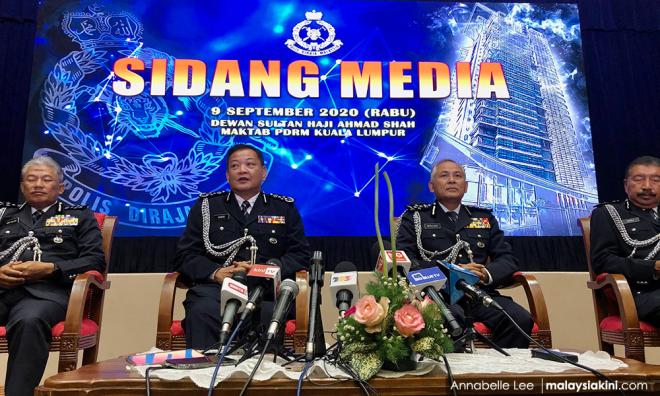
Inspector-General of Police Abdul Hamid Bador says he is satisfied with the government's proposed Independent Police Conduct Commission (IPCC) and believes it will be able to hold police officers accountable.
Tabled as a bill for its first reading in the recent Dewan Rakyat sitting, the IPCC has been criticised as a watered-down version of its predecessor - the Independent Police Complaints and Misconduct Commission (IPCMC) Bill 2009.
Critics are especially concerned about the IPCC's lack of disciplinary powers and its independence as commissioners can be police officers and government appointees.
Speaking to the media today, Hamid noted the IPCC's inability to take disciplinary action but said it still served a purpose.
"I was satisfied when I looked at the contents of the IPCC.
"I can see the IPCC's role as an oversight body. Only disciplinary powers (lacking). The IPCMC had disciplinary powers, but this does not have them.
"It acts as an oversight body," he said.
He believed that the IPCC captured the "spirit" of those who wanted the police to be subject to more accountability, especially how it mandated officers to report deaths, injuries and sexual offences in custody to the commission.
Hamid said he left it to MPs to debate and finetune the IPCC in the next parliament session, maintaining he would accept "whatever" they decided.

"For me, I will accept whatever it is.
"The only thing is, with the IPCC, issues that caused objections before this and concerns that the police had have been addressed in this law.
"We are satisfied," he added.
Hamid further shared that efforts were being made to communicate the IPCC to the entire force.
Unlike the IPCMC, the new IPCC is unable to review complaints lodged against officers who flout rules or standard operating procedures.
Under the IPCC, officers have the right to refuse to disclose "sensitive information" deemed "prejudicial to national security or national interests". It also prevents commissioners from obtaining classified documents or information deemed prejudicial to national security.
The number of commissioners has been reduced from 10 under the IPCMC to seven.
The Human Rights Commission (Suhakam), human rights NGO Suaram, political party PSM, the Malaysian Bar have all voiced concerns about the IPCC.
The IPCMC was tabled last year during the Pakatan Harapan administration but was retracted by the Perikatan Nasional government last month.
The IPCMC was first mooted 15 years ago by the Royal Commission to Enhance the Operation and Management of the Royal Malaysia Police.
However, the police force objected to the idea when the Abdullah Ahmad Badawi administration brought it up in 2006. - Mkini

No comments:
Post a Comment
Note: Only a member of this blog may post a comment.