


The lack of support for Pakatan Harapan among Malay voters, as recently highlighted by incumbent PKR deputy president Rafizi Ramli, is seen as a signal that the coalition must adopt more effective strategies to reverse its declining support.
Analysts told Malaysiakini that while the trend is unsurprising, it underscores the significant responsibility the new PKR leadership will bear in rebuilding and consolidating the party’s voter base.
Associate professor Yusri Ibrahim, a political analyst, said Rafizi’s remarks are consistent with previous findings by his team, including data from the 15th general election (GE15) in 2022, and the six state elections in 2023.
He noted that his past studies indicated Malay voter support for Harapan averaged only around 25 percent.
“That situation has remained largely unchanged until now. Malay support is quite static, roughly similar to levels seen in 2022 and 2023.
“There has been a slight increase in support for the government from the Malay community, particularly via Umno, following its entry into the government. In fact, Malay support for Harapan has not shifted significantly for some time. It has simply plateaued,” Yusri said.
He added that during the Pakatan Rakyat era, particularly in the 2008 and 2013 GEs, Malay support largely stemmed from PAS supporters, which was then aligned with PKR and DAP. When Harapan was later formed and contested in the 2018 GE, support shifted to Bersatu, driven largely by the popularity of figures such as Dr Mahathir Mohamad.
Previously, Rafizi, in his campaign to retain the PKR deputy presidency, revealed that his party and Harapan are currently not in a strong position to win the next general election.

The economy minister referenced data showing that Malay support for the coalition remains insufficient, while support from Chinese and Indian voters has declined sharply.
He said Malay support for Harapan stood at 27 percent as of last month, a modest increase from 20 percent in August 2020.
Yusri, who is also chief researcher at Ilham Centre, stressed that Harapan must urgently strengthen its Malay-based parties, such as Amanah, while also reinforcing ties with other influential Malay parties, such as Umno.
Retain policies favouring Malays
“Harapan also needs to retain as much of its existing core Malay vote as possible through economic and administrative policies that are favourable to them. For instance, a significant portion of the Malay support previously came from the middle and upper classes, including the T20 group.
“Government policies under Harapan should be seen as friendly to these groups, particularly regarding taxes and subsidies. If policies appear to disadvantage them, they may gradually drift away from Harapan,” Yusri explained.
On non-Malay voters, he noted they remain the largest ethnic group supporting Harapan in recent elections. However, he said that based on field feedback, many feel that current economic policies are not favourable to them.
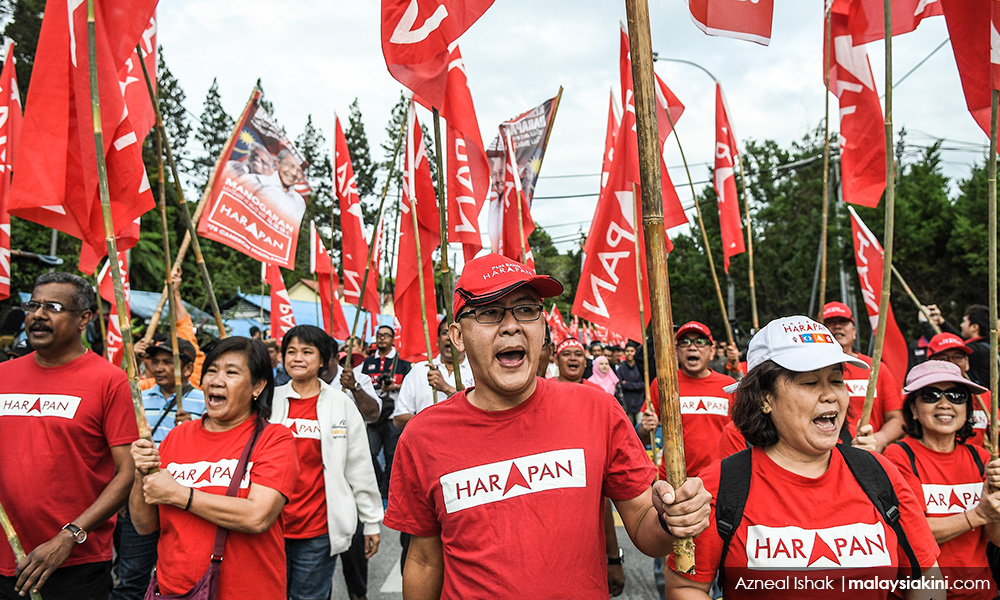
“There is evident frustration among Chinese voters, particularly towards Harapan.
“That said, Harapan is still relatively fortunate, as these voters currently see no viable alternative. They are not yet drawn to Perikatan Nasional’s political agenda. But if a more appealing alternative emerges, support could shift,” he added.
Yusri, who is with Universiti Malaysia Terengganu, said that for now, many may still vote for Harapan, but with less enthusiasm, with some may even choose to abstain.
Support during by-elections
Mazlan Ali, a political analyst from Universiti Teknologi Malaysia, agreed that Malay support for Harapan has historically been low. However, he noted a modest increase in recent by-elections since Anwar Ibrahim took office as prime minister.
“That’s why Harapan struggles in Malay-majority areas, particularly in the East Coast, the north, and even parts of Selangor such as Hulu Selangor and Sabak Bernam. Harapan lost in these places because many Malay voters shifted to PN.
“But fundamentally, since Anwar became prime minister, there has been an uptick in support for parties within the government. Evidence of this can be seen in several by-elections; in Kuala Kubu Bharu, Nenggiri, Mahkota, and most recently, Ayer Kuning.
“There has been a noticeable shift in Malay and broader public support towards the Harapan-led Madani government. Support for the government has increased overall, thanks in part to Umno now being part of Harapan,” Mazlan said.
Universiti Malaya’s professor Awang Azman Awang Pawi said Rafizi’s findings reflect serious challenges facing the Harapan coalition, as it approaches GE16, which must be addressed urgently.
He said the issues which were brought up should not be treated lightly, and must form part of a forward-looking agenda, rather than becoming a reason to mudsling.

“The failure to strengthen support among Malay and non-Malay voters and the failure to rebuild trust in anti-corruption efforts could lead to the loss of parliamentary seats and defeat in GE16.
“That’s why Rafizi warned that without changes in strategy and a more effective approach, Harapan risks the same fate as BN in GE14.”
Awang said Rafizi’s early warning to PKR and Harapan should be viewed in the broader context of the coalition’s future, rather than merely as part of the contest for the PKR deputy president post.
Convincing the undecided voters
Political analyst professor Sivamurugan Pandian from Universiti Sains Malaysia emphasised that any study on Harapan’s influence and voter support should serve as a guide for policy and strategy interventions.
He suggested that Harapan’s election manifesto must now be translated into visible outcomes.
“After 26 months in power, some segments of the public still haven’t felt the full impact, especially in terms of economic issues, cost of living, taxes, and subsidies. This also applies to how policies affect the T20, M40, and B40 income groups.
“As Harapan is now part of the government, and many of these policies come from the Economy Ministry, urgent and short-term strategies are needed to boost support, especially considering the 26 percent of undecided voters who need to be convinced.
Sivamurugan said that the government must ensure that information about opportunities such as jobs, business support, and financial aid reaches all layers of society. - Mkini

No comments:
Post a Comment
Note: Only a member of this blog may post a comment.