


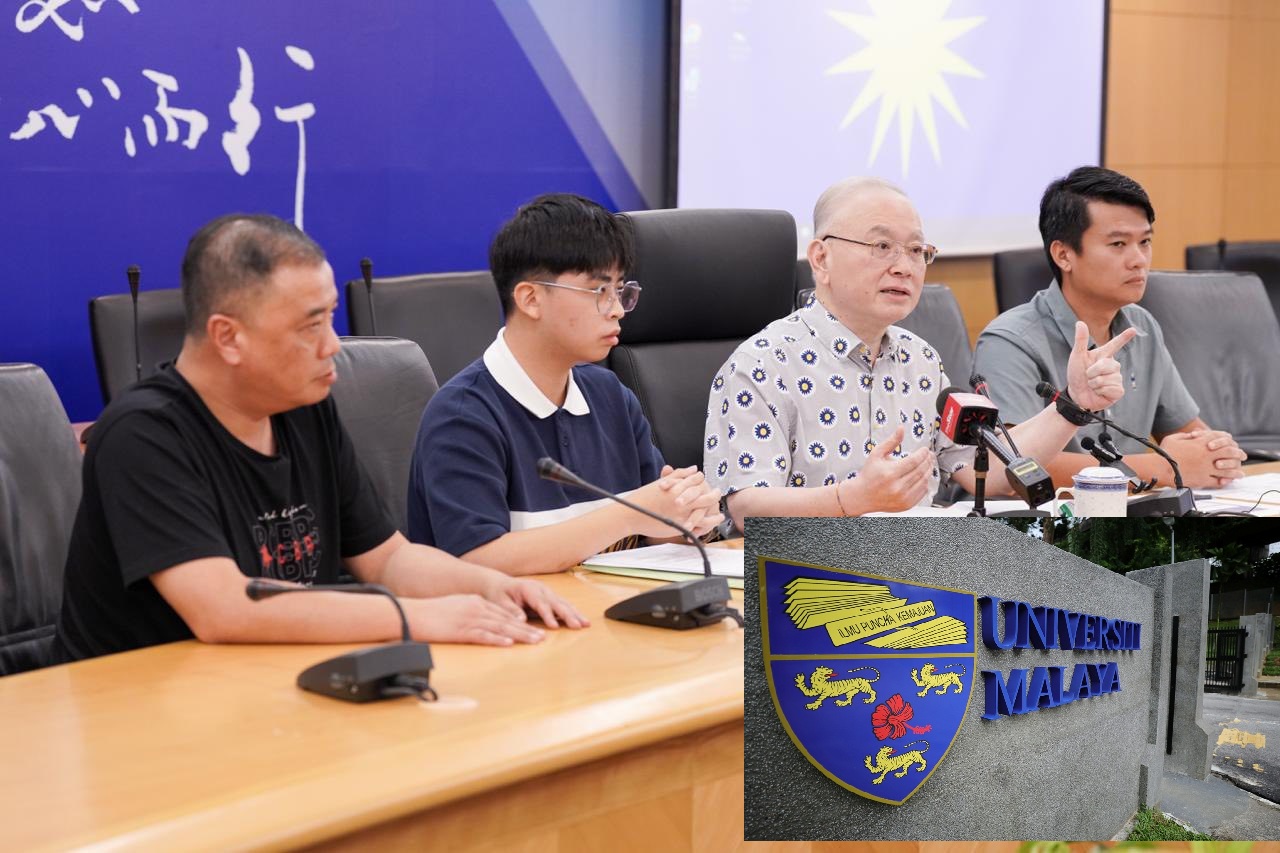
Editor’s Note: Former political science academician in Universiti Kebangsaan Malaysia (UKM) Prof Ramasamy Palanisamy feels compelled to offer his two sen on the plight of Edward Wong Yi Xian who failed to secure his dream accountancy course in Universiti Malaya despite achieving a perfect 4.0 CGPA and 99.9% for co-curricular activities.
Currently, MCA president Datuk Seri Wee Ka Siong along with his team have pledged to do their best to help Wong as well as other Malaysian children who face the same situation seek justice.
“If our system is flawed, then it must be corrected for the sake of our children – the future leaders of our nation,” reiterated the five-term Ayer Hitam MP.
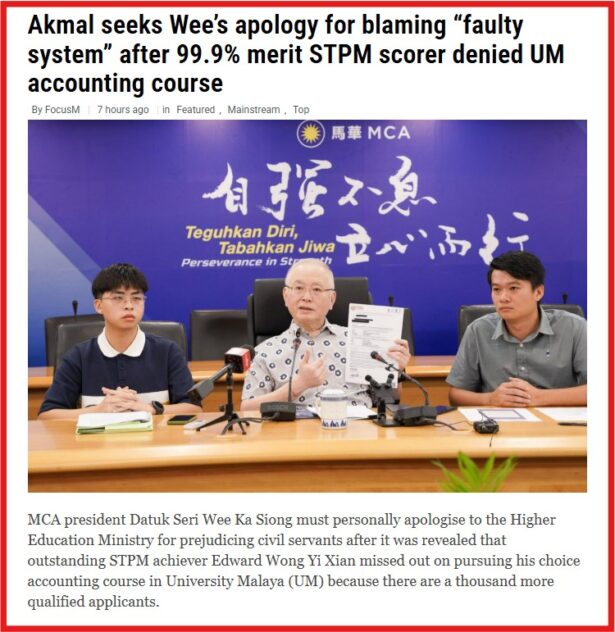
IT IS both annoying and frustrating that the Higher Education Ministry continues to repeat the untruth that admissions to public universities are based on merit.
According to the ministry, 90% of admission is determined by academic achievement with the remainer 10% by performance in extracurricular activities.
But how can the subjective assessment of extracurricular involvement be legitimately regarded as merit?
The whole world knows that Malaysia’s education system is lopsided in the admission of students from different ethnic origins.
The so-called 9:1 ratio which supposedly balances academic performance with extracurricular activities may look defensible on paper.
But in practice, admissions are skewed in favour of students from one ethnic group, often at the expense of other ethnic groups with equally – if not more – impressive qualifications.
‘Controversial entry pathway’
The Higher Education Ministry conveniently forgets to explain why this weighting is tilted in favour of one ethnicity while insisting on calling the process “merit-based.”
If affirmative action is being applied, then why hide it? Why not admit openly that ethnicity is a determining factor in university entry?
Consider the matriculation programme. Is it truly based on merit when about 90% of places are reserved for Malays with Chinese and Indian students allocated a mere 10%?
This programme has effectively become a privileged pathway to higher education for one community despite public universities being funded by taxpayers of all ethnic backgrounds.
Adding to this imbalance is the controversial introduction of a second entry pathway into public universities.
Under the conventional entry system, students pay subsidised fees for their studies. However, under the new second-tier system, fees are much higher and non-subsidised.
‘Meritocracy is non-existent’
Alarmingly, students with excellent grades who would normally qualify for the first pathway are sometimes denied entry and instead pushed into this costly second track.
This is a cruel irony for poor but deserving students who may gain admission but are saddled with unbearable financial burdens.
How can this dual-track system possibly be reconciled with the ministry’s claim of meritocracy? Instead of enhancing fairness, it undermines it further, revealing deep cracks in the credibility of the admissions process.
Every year, countless students with excellent pre-university qualifications are denied entry into public universities.
And yet, almost ritualistically, the ministry repeats its half-truths about admissions being based on meritocracy.
These hollow claims – now echoed under the leadership of Education Minister Fadhlina Sidek – insult the intelligence of Malaysians as though the public can be easily fooled into swallowing these fabrications wholesale.
The truth is plain to see: university admissions in Malaysia are not based on meritocracy. They are disproportionately weighted in favour of Malays, marred by ethnic quotas and riddled with contradictions such as dual entry systems.
As long as these realities are denied, the ministry’s proclamations of “merit-based admissions” remain nothing more than a convenient myth.
Former DAP stalwart and Penang deputy chief minister II Prof Ramasamy Palanisamy is chairman of the United Rights of Malaysian Party (Urimai) interim council.
The views expressed are solely of the author and do not necessarily reflect those of MMKtT.
- Focus Malaysia.

No comments:
Post a Comment
Note: Only a member of this blog may post a comment.