


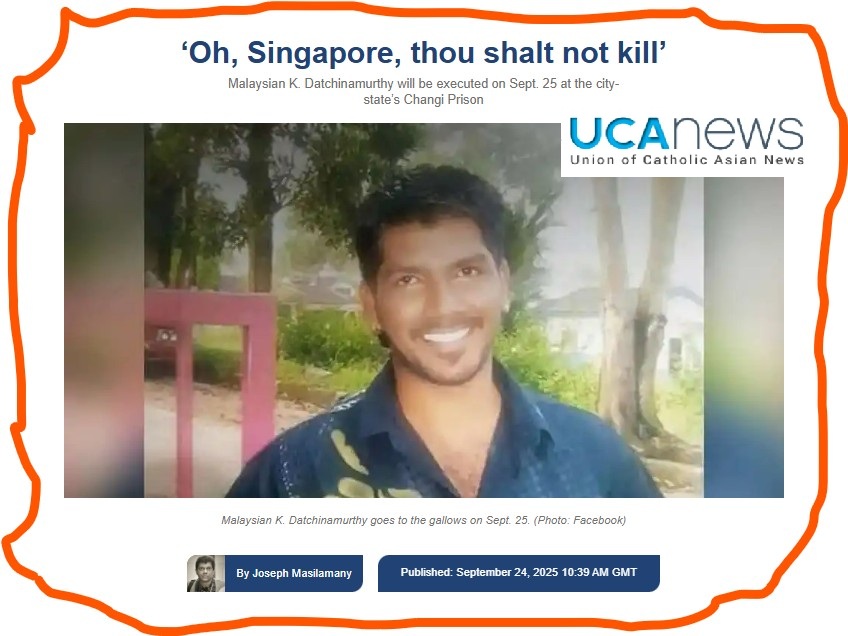
Editor’s Note: Lawyers for Liberty adviser N. Surendran has told Free Malaysia Today (FMT) that K. Datchinamurthy’s family received a call from Changi prison after midnight today (Sept 25) that his execution initially scheduled to take place this morning has been halted.
Arrested in 2011 and sentenced to death in 2015. Datchinamurthy was scheduled to be executed in 2022 but obtained a stay of execution pending a legal suit against the Singapore government over his death sentence.
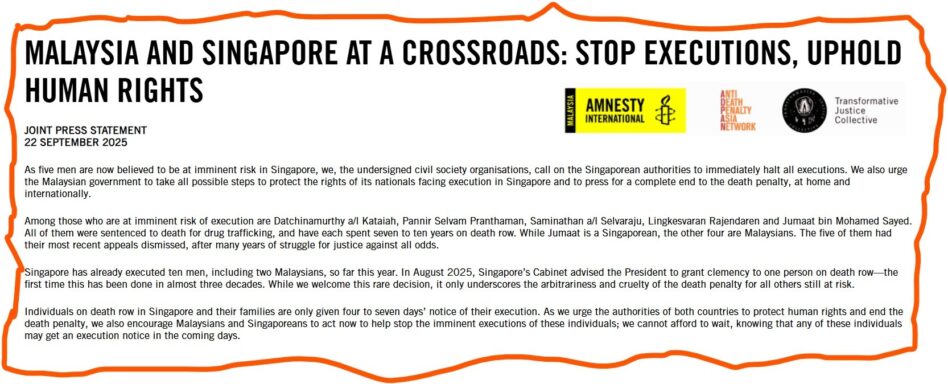
He is one of four Malaysians on death row in Singapore whom the Human Rights Commission of Malaysia (SUHAKAM) has urged the government to intervene in their executions.
The other three are P. Pannir Selvam, S. Saminathan and R. Lingkesvaran.
SINGAPORE is often regarded as one of the world’s most modern and advanced city-states. It boasts state-of-the-art infrastructure, efficient governance and amenities that are arguably unmatched by most countries.
Politically, the government is highly stable with the ruling party consistently returned to power.
Despite regular competitive elections, parliamentary debates and a judiciary known for its toughness in delivering sentences, democracy in Singapore exists largely in a formal sense. In practice, it is nearly impossible to bring a successful legal case against the government.
Singapore is also an attractive place to work and visit. More than 500,000 Malaysians are employed there with most commuting daily from Johor Bahru while thousands more have migrated permanently.
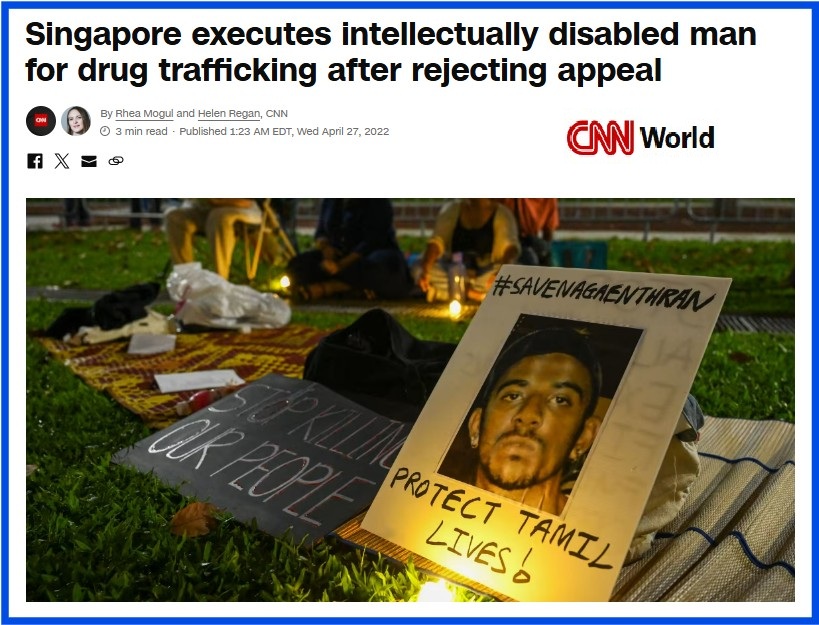
The republic stands as a model for economic growth, development and high living standards. Crime rates remain minimal due to stringent law enforcement, further cementing Singapore’s global reputation for order and efficiency.
Yet, despite these remarkable achievements, Singapore remains deeply preoccupied with enforcing the mandatory death penalty.
Go after syndicates, masterminds!
Malaysia – its closest neighbour – has not abolished the death penalty outright but has granted judges discretion to impose alternative sentences. Singapore, however, continues to insist on mandatory capital punishment, particularly for drug-related offences.
Most executions in Singapore involve cases of drug possession or trafficking. Unfortunately, the law makes little distinction between small-time couriers and the syndicates that control the trade.
Those convicted are often drug mules from disadvantaged socio-economic backgrounds while the masterminds remain untouched. Appeals against such sentences almost always prove futile.
There is no doubt about the need for tough laws to combat drug trafficking. Singapore’s strict enforcement has set high standards globally.
But what is urgently needed is reform – removing the mandatory aspect of the death penalty and allowing judicial discretion as Malaysia has done.
Despite its small size, Singapore is a leader in many areas, admired worldwide for its efficiency, prosperity, and governance.
However, its rigid insistence on mandatory capital punishment tarnishes its otherwise stellar reputation. The “little red dot” would gain far more respect by demonstrating compassion and humanitarianism rather than executing vulnerable individuals who are often pawns in the drug trade.
Sentencing drug mules to death has not stopped syndicates from operating. If Singapore wishes to continue “punching above its weight,” it should do so in ways that inspire admiration – not condemnation.
Former DAP stalwart and Penang deputy chief minister II Prof Ramasamy Palanisamy is chairman of the United Rights of Malaysian Party (Urimai) interim council.
The views expressed are solely of the author and do not necessarily reflect those of MMKtT.
- Focus Malaysia.

No comments:
Post a Comment
Note: Only a member of this blog may post a comment.