


Muda will be holding its first-ever internal election this Saturday, four years after the party was registered.
There is no available data for its current membership, but party officials cite 85 registered divisions - one in each parliamentary seat - out of 222 nationwide.
A total of 125 delegates will vote for 31 candidates who will be vying for 25 posts on the party's central executive committee (CEC). The CEC will then elect its office-bearers, similar to how DAP elections are held.
Muda's founding president, Syed Saddiq Syed Abdul Rahman, will not be contesting, paving the way for fresh leadership to chart the party’s direction ahead of looming state elections and the general election.
Ahead of the Muda polls, Malaysiakini interviewed nine candidates, asking them the same five questions focusing on coalition strategy, electoral survival, funding, talent retention, and plans to revive the party’s momentum.
Here are select answers to the questions posed. They have been edited for brevity.
The answers by all nine candidates interviewed are attached at the bottom of the article.
Malaysiakini: Assuming Muda wins any seats in the next election, and its support is critical to forming a government, with whom should Muda align? Pakatan Harapan or Perikatan Nasional?
Putrajaya Muda incumbent information chief Syahmie Fayyadh Jaafar: If Muda finds itself in the position of kingmaker, the absolute worst thing we could do is arbitrarily pick a colour.
Our alignment should not be based on legacy loyalties, but on a strict, publicly signed Confidence and Supply Agreement (CSA) centred entirely on institutional reform.
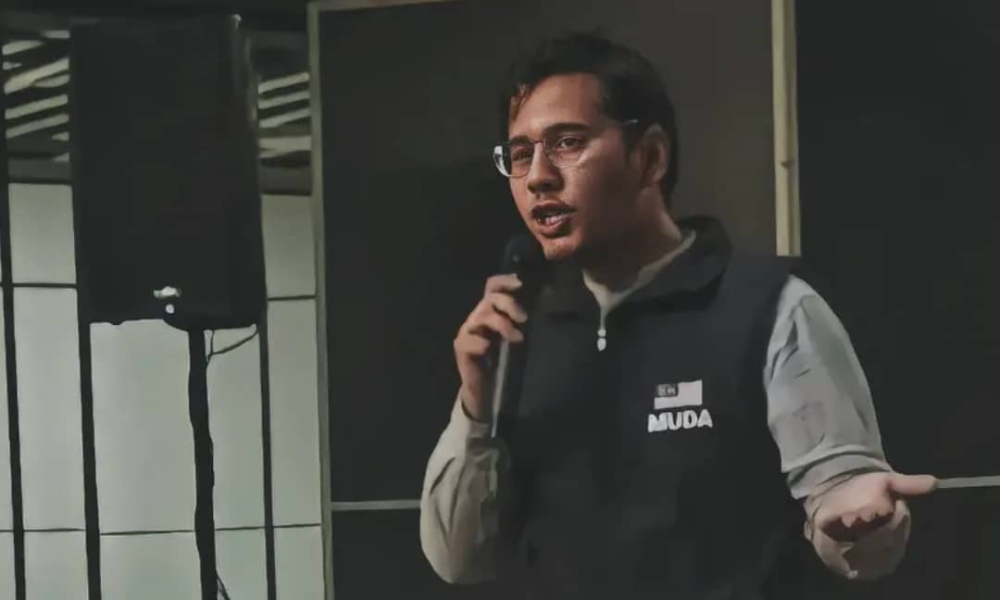
We align with whoever agrees, in black and white, to pass a comprehensive Political Financing Act, to separate the attorney-general from the public prosecutor’s office, to establish the Independent Police Complaints and Misconduct Commission (IPCMC) with actual teeth, and to restructure the MACC so it reports directly to Parliament.
We fundamentally reject the divisive politics of race and religion and demand a zero-tolerance stance on corruption.
If neither coalition has the spine to commit to these foundational reforms, they will be left to claw their way through a minority government alone.
Muda incumbent vice-president Dobby Chew: I believe Muda will adhere to the previous decision that we are willing and open to working with either coalition or any other parties with a shared policy agenda, but with clear red lines that Muda will not cross.
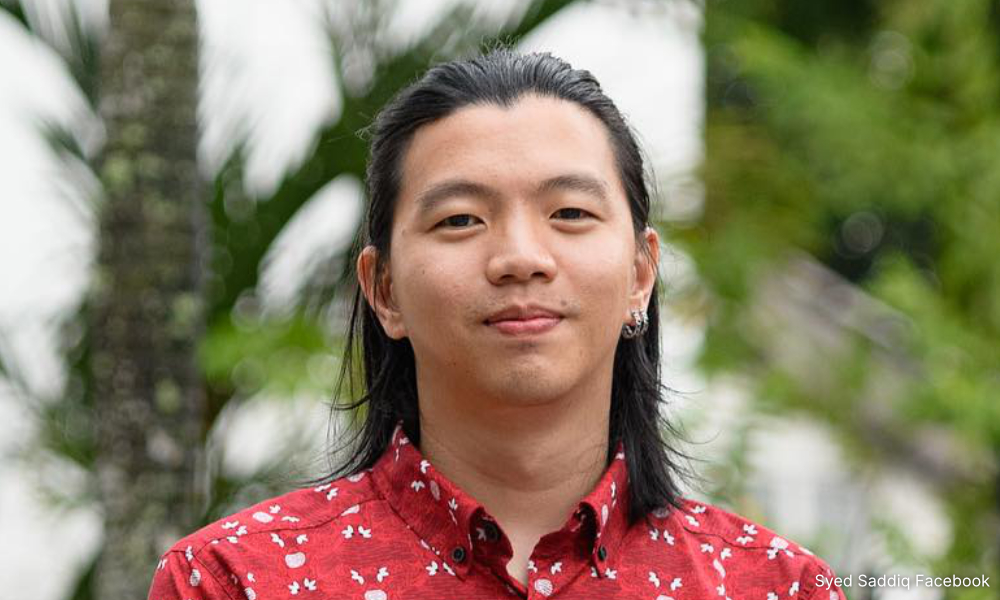
As PN is in the opposition, they were naturally more inclined to build rapport and alliance with others, but that does not mean Muda is more inclined to cooperate with them.
Perak Muda incumbent chief VKK Raja: Muda should not go into an election already tied to either bloc. The correct answer is neither by default, and both only on terms. If Muda holds the balance, it should back the side that is prepared to sign on to a clear reform agenda with timelines and accountability.
That means institutional reform, a stronger Parliament, clean political financing, an independent MACC, fair economic opportunity, and a genuine youth agenda.
The question is not “who do we like more?” The question is “who is willing to govern better and be held to it?”
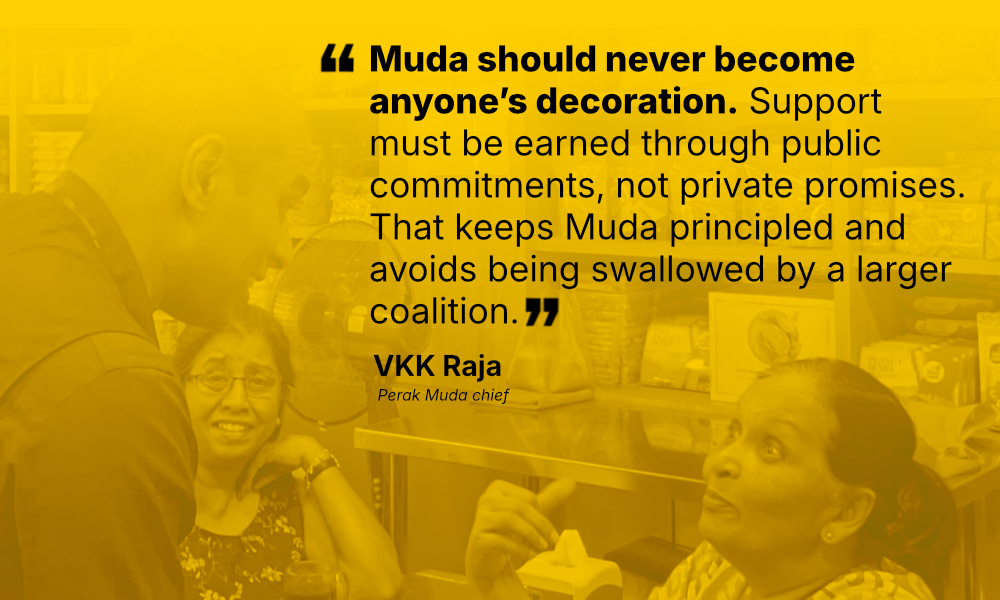
Politically, Harapan is the more natural reform space for Muda than PN, but Muda should never become anyone’s “decorative piece”. Support must be earned through public commitments, not private promises. That keeps Muda principled and avoids being swallowed by a larger coalition.
The only time Muda has won seats is when it had a deal with Harapan. Do you think Muda should pursue a similar formula with one of the big coalitions for GE16?
Raja: The hard truth is yes, Muda should seriously consider a smart electoral understanding for GE16. Malaysia’s first-past-the-post system punishes small parties in multi-cornered fights. A party can have energy, ideas, and visibility, but still lose badly if the reform vote is split.
That does not mean surrendering Muda’s identity. It means negotiating from strength. Muda should seek targeted seat arrangements only in constituencies where it has built a real base, has a credible candidate, and can add value to a broader reform contest.
The earlier Harapan arrangement mattered because it reduced three-cornered damage. Muda’s best-known electoral success came under that broader cooperation model, while later solo contests were much harder.
So, my answer would be: cooperate, but do it selectively, transparently, and with dignity. No blank cheque. No symbolic seats. No deal without policy substance.
Ampang Muda incumbent deputy chief Emir Syazwan Medan: Our country operates under a first-past-the-post electoral system. The reality of that system is that electoral cooperation is often necessary to avoid unnecessary multi-cornered fights.
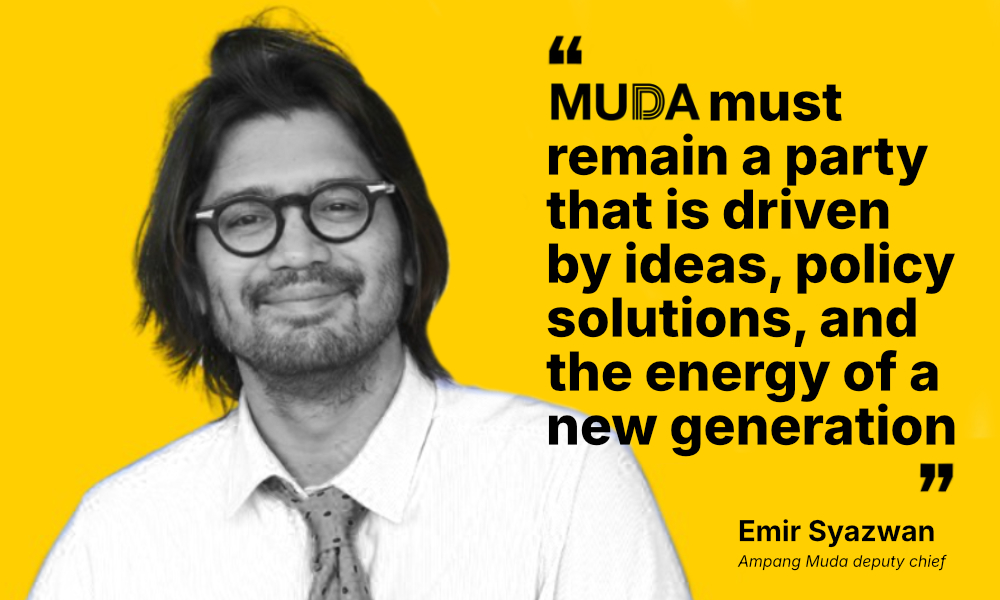
Our experience in the last election showed that strategic cooperation can produce results. That is something we should acknowledge honestly. However, cooperation should not mean losing our identity or our principles. Muda must remain a party that is driven by ideas, policy solutions, and the energy of a new generation.
What I would like to explore is the possibility of a coalition of equals among progressive and reform-minded forces. This could include individuals and groups across the political landscape who share a commitment to better governance and meaningful reform.
There are reform-minded leaders within PKR, specifically Rafizi Ramli and the other 10 PKR MPs who have consistently advocated institutional reform. There are also parties like Pejuang and PSM, as well as other groups and progressive voices, who have long championed issues of integrity, accountability, and justice.
If we can find a way to cooperate strategically without overlapping or undermining one another, I believe that would give Malaysians a stronger and more credible alternative to what we clearly see today.
Fayyadh: For GE16, the focus must shift from negotiating pacts - which are frankly just political speed-dating with a lot more awkward silences - to building our own traditional political machinery of professional cadres and grassroots mobilisers.
If we focus all our energy on institutionalising our presence in specific constituencies now, any future negotiation we enter will be from a position of undeniable strength, backed by our own fixed deposit of voters.
We need to walk into those rooms carrying our own weight, not just a begging bowl and the optimistic hope that the old guard remembers that one time we were very helpful. We've matured past the “helpful intern” stage.
The electoral pact formula was a “pragmatic” choice for maximum impact and resource consolidation, which is apparently essential when you're the new kid at the political lunch table.
We secured those seats by offering a compelling, fresh alternative that, surprisingly, resonated with voters looking for change. The pact simply provided a clear field to prove we weren't just wasting everyone's time.
However, a political party cannot rent a house forever; eventually, you have to lay your own bricks. Or, at least, stop sleeping on your couch in the living room.
How does Muda plan to fund its election campaign?
Muda incumbent secretary-general Ainie Haziqah Shafii (Ainie): I believe that there are so many more out there who believe in the struggle that Muda carries and brings. We have previously run campaigns with minimal cost but with effectiveness.
At the end of the day, we want to get the message out.
When elections come, we will also stick to minimal costs with effective messaging and, at the same time, remain creative in finding funds, just as we did in our previous campaigns.
Let's be realistic, yes, of course, elections cost a lot. But we must also remember that Muda's struggle resonates with many ordinary citizens who aspire to see Malaysia prosper, and we must not let them down.
Emir: One of the things I will emphasise in my manifesto is the need to build sustainable financial and organisational capacity within the party. This means moving beyond ad hoc fundraising and towards a more structured approach.
We should build a national fundraising programme that includes small-donor participation, digital micro-donation platforms, and initiatives that enable ordinary citizens to contribute directly to the political process.
At the same time, the party needs a stronger professional secretariat that can manage resources responsibly and deploy them effectively during election campaigns.
Transparency will be central to this effort. If we ask Malaysians to support us financially, then we must also demonstrate that we manage those resources with integrity and accountability.
Muda mobilisation bureau chief Rahmat Amran: Muda believes politics should not depend on a handful of wealthy donors. Our approach is people-powered fundraising, creative campaigns, community events, collaborations with different cultural and social groups, and small donations from supporters.
This model is not just about money. It is about building ownership in the movement.
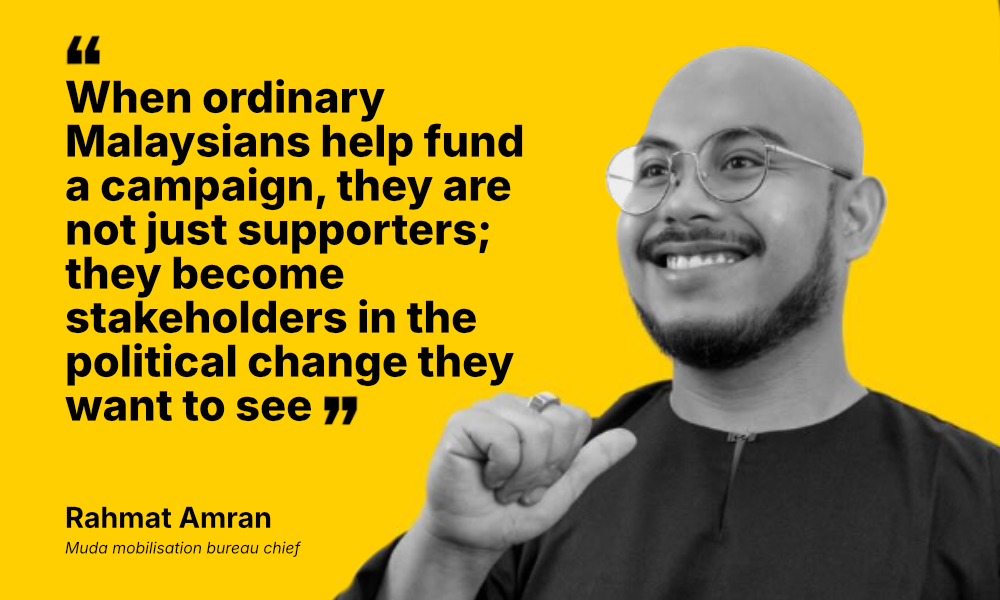
When ordinary people help fund a campaign, they are not just supporters; they become stakeholders in the political change they want to see.
Muda appears to have trouble retaining talent; many of your election candidates are no longer active members. If you were party president, what would you do to fire up the party, keep a strong pool of talent, so that the public is also excited about Muda?
Ainie: I can't really seem to agree with this. Our previous election candidates are still mostly active with us. But, understandably, most of us juggle family commitments, day-to-day work, and also Muda.
That being said, this struggle is real, especially for the younger people. They definitely aspire to do more for the country, as they truly connect with its needs, and many would like to be involved in politics.
Hence, we must continue to inspire and push them to give the best for the country as well. Politics is like a marathon, not a sprint. We can't expect to run everything in one or two days. There are processes that are required of us.
I understand that public expectations of Muda have always been very high. Hence, I also believe Muda must continue to reach out and inspire not just the youth, but the public at large, for a better Malaysia.
Other than that, external support is also important. We thank you, media friends, civil society organisations (CSOs), and activists, for consistently including Muda in your journeys. We look forward to more.
Raja: Talent does not leave only because of ideology. Talent leaves when there is no pathway, no structure, no mentorship, and no sense that effort will be rewarded. If I were elected, I would focus on four things.
First, we need to create a real leadership pipeline. Not vague motivation, but a system. Branch to state to national - policy to communications to elections. Members must know how they can grow and where they can contribute.
Second, we should professionalise candidate development. We should train future candidates on policy, media, constituency work, fundraising, and discipline, two to three years before an election, not a few weeks before nomination day.
Third, we should decentralise responsibility. Too much of Muda’s public energy has sat around a few national figures. That is risky. A serious party must produce many recognisable leaders, not one or two stars. This matters especially now, when recent reports still say Syed Saddiq remains the party's main face.
Fourth, we should give talented members meaningful work between elections. Research units, legal teams, youth economic programmes, and local issue taskforces. If people only matter during campaigns, they will not stay. If they are building something real, they will.
Muda seems to be less vibrant of late, compared to the energy it showed during the early days of the party’s establishment. Why is this so? And should you be elected to lead Muda this coming election, what is your plan to make Muda great again?
Chew: Political fatigue sets in for everyone. After the general election and the series of state elections, the public appetite for broad politicking declined, and rightly so.
With new governments in place, governance is the next focus, which brings discussions to policy levels that aren’t of interest to all segments of the public unless something significant (for example, MACC chief commissioner Azam Baki’s case) occurs. Muda remains very active and engaged on those issues, but they are not the kind of things that are publicly captured all of the time.
Going into the next election, the leadership needs to be guided by what drove Muda in the first place.
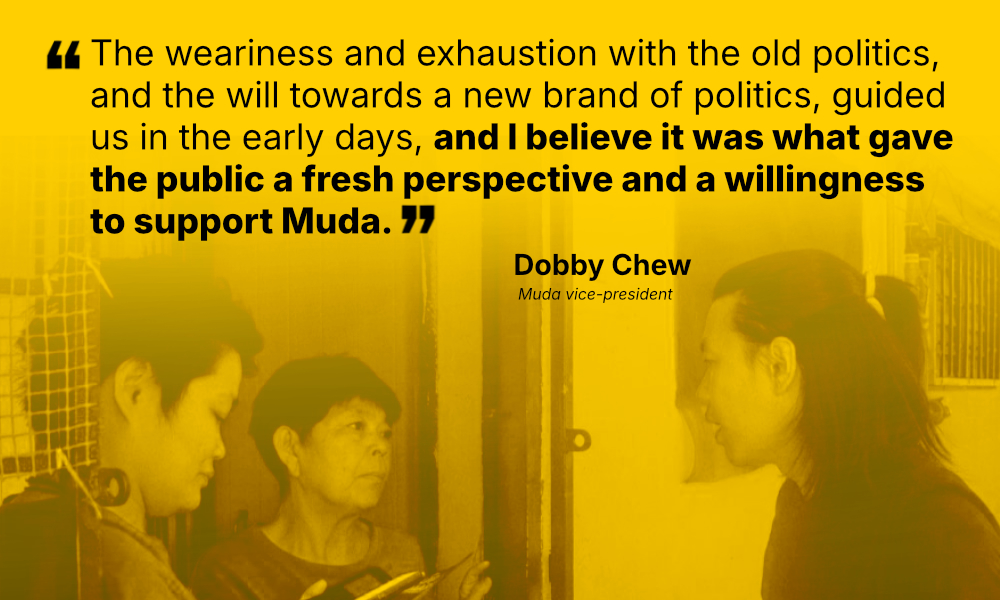
The weariness and exhaustion with the old politics, and the will towards a new brand of politics, guided us in the early days, and I believe it was what gave the public a fresh perspective and a willingness to support Muda.
Holding fast to those beliefs while navigating the uncertainty of the current political alliances will be critical to make Muda a kingmaker in the politics to come.
Fayyadh: Muda was never designed to be another polyester suit in the political wardrobe.
The suggestion that we simply need to "be more vibrant" to attract voters misunderstands our structural dilemma: we cannot, and will not, operate as a traditional party.
The path forward requires us to transition from a punk movement fueled by crisis adrenaline to a collective of professional operators. This means our core competency must be technical proficiency - deep dives into parliamentary procedure, policy, finance, and jurisdictional law, and not just compelling social media content.
We must be the “quiet assassins” of institutional malaise [...] We need to be the party that understands both the Public Accounts Committee reports and the nuances of the local DIY (do it yourself) music scene. What this requires is a deliberate effort to culturalise democracy and democratise culture.
Politics is currently treated as a sterile, obligatory chore. By embedding our principles into the lifestyle, art, and conversations of modern subcultures, we transform politics from a transaction into an identity.
Muda must stop being merely a political party and start becoming a self-sustaining culture - a critical mass of competence and conviction that is recognised, respected, and imitated, well beyond the next election cycle.
The vibrancy observers crave will follow, but it will be a deep, permanent resonance, not just viral noise.
- Mkini

No comments:
Post a Comment
Note: Only a member of this blog may post a comment.