


The Institute for Democracy and Economic Affairs (Ideas) has flagged 238 political appointments to federal statutory bodies (FSB) and government-linked companies (GLC) under Prime Minister Anwar Ibrahim’s administration.
In its report, titled “Who Sits at the Table: From Political to Public Appointees in Malaysia’s Federal Statutory Bodies”, the think tank found that 222 political appointments were to FSBs, while another 16 were to GLCs.
The appointments, which occurred between August and October 2025, signal continuity of the practice despite reformist pledges, it said in the report launched last night.
“Although the number of appointments is lower than under immediate predecessors, the figures indicate continuity rather than rupture.
“Despite reformist rhetoric, political appointments remain embedded within Malaysia’s governance architecture,” the group noted in its report.
Recurring governance issues
Governance issues in government-linked entities have drawn increasing scrutiny in recent years.

In February 2025, Anwar announced that the National Audit Department would conduct audits on nearly 2,000 GLCs following concerns over misconduct and weak oversight, The Star reported.
The audits were prompted by recurring issues, such as poor monitoring of key performance indicators, financial losses, and major decisions made without proper board approval, highlighting broader concerns about governance standards within public-linked entities.
Anwar ranked third-highest, Dr M lowest
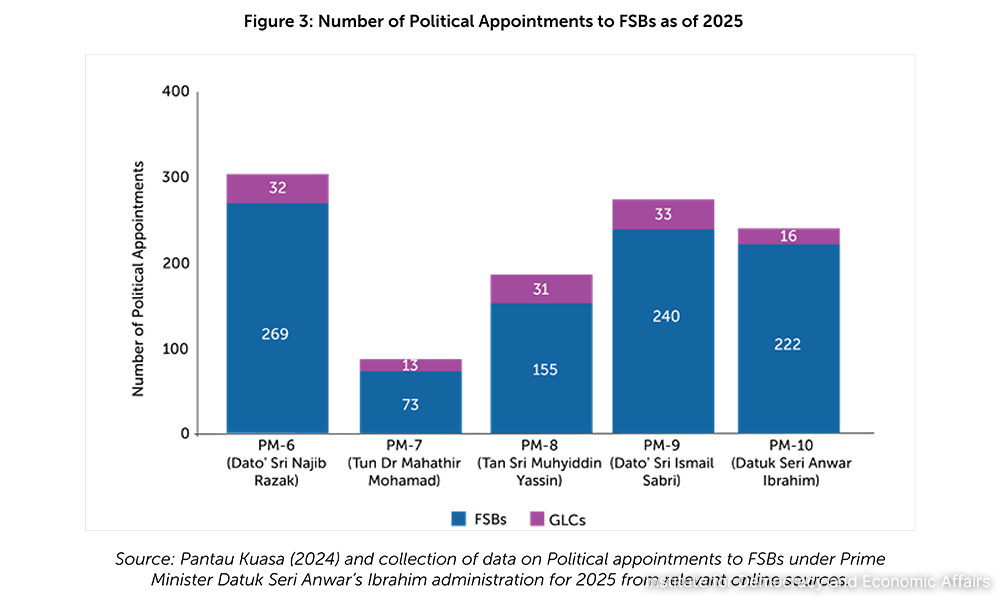
According to data compiled by Ideas from 2012 to 2025, 1,084 political appointments had been made under five prime ministers, underscoring the entrenched and cross-administrational nature of the practice.
Compared to his predecessors, Anwar’s government recorded the third-highest number of appointments.
Former prime minister Najib Abdul Razak made 301 appointments under his decade-long administration, while Ismail Sabri Yaakob oversaw 273 appointments over 16 months.
The report cautioned that the figure for appointments under Najib’s administration is likely an underestimation, since the dataset may not fully reflect appointments made before 2012, when data collection began. Najib became prime minister in 2009.
This pattern of appointments, Ideas said, appeared to reflect each premier’s political circumstances and their need to consolidate patronage and support.
During long tenures such as Najib, FSB and GLC appointments were made to curry favour and systematically embed loyalists across statutory bodies.
Meanwhile, politically fragile administrations led by Ismail Sabri and Muhyiddin Yassin recorded a large number of appointments despite their short terms in office, as they sought to maintain stability and keep their governments afloat.
“Both administrations faced urgent pressures to secure loyalty, resulting in the rapid appointment of supporters despite limited tenure.
“Critically, neither leader assumed office without a clear first- past-the-post electoral mandate, relying instead on post-election realignment, which heightened incentives to distribute board positions as political rewards,” it added.

By contrast, the Pakatan Harapan government under Dr Mahathir Mohamad recorded the least political appointments, with 86 between 2018 and 2020, reflecting the coalition’s reform commitments at the time.
Researchers also highlighted the scale of political involvement in statutory bodies more broadly.
From 2015 to July 2021, 74 percent of FSBs had active or recently active politicians sitting on their boards, serving as chairpersons, deputy chairpersons, or directors.
Appointments blur public and political interest
Appointments were heavily concentrated in ministries with greater discretionary influence, particularly the Prime Minister’s Department, the Rural and Regional Development Ministry, the Higher Education Ministry, and the Transport Ministry.
Such appointments are often used as a form of political capital, allowing those in power to place allies in positions overseeing public institutions and resources.
The report warns that such practice blurs the lines between public service and political interest.
“The board of an FSB should be filled by public appointments that are accountable in a formal relationship of transparent communication to the responsible ministry and minister.
“The proper role of politicians would be to exercise their duty of oversight through scrutinising the board appointments and the achievements of the boards and the FSBs via select committees,” the think tank noted.

The report argues that politicians serving on FSB boards are placed in an “irreconcilable and permanent conflict of interest”, as they may simultaneously be involved in policymaking and operational decisions within public institutions.
It recommends introducing clear, merit-based criteria for board appointments, including minimum requirements for education, professional experience, and integrity.
Researchers also proposed setting up an independent pre-screening committee to assess candidates’ qualifications and potential conflicts of interest, as well as stronger parliamentary oversight of appointments.
- Mkini

No comments:
Post a Comment
Note: Only a member of this blog may post a comment.