


Tiong Hiew King, the founding leader of Media Chinese International Limited (MCIL), a company dual-listed in Malaysia and Hong Kong, passed away on Nov 11, 2025.
Public attention, particularly in Hong Kong, swiftly turned to whether his heirs might divest the group’s media assets there, notably the Ming Pao Group.
Less than 100 days after Tiong’s death, its Canadian operation, the 33-year-old Ming Pao Daily News (Canada), published its final print edition on Jan 16, 2026, officially ceasing publication on Jan 17 and winding up operations by the end of the month.
In an article I published on Nov 18, 2025, entitled “‘Chinese Murdoch’ takes final bow - what’s next for Ming Pao?”, I opined that the first question to consider in assessing whether MCIL will divest from its Hong Kong operations following Hiew King’s death was to what extent does his daughter, Tiong Choon, or other members of the Tiong family, possess the passion to continue operating Chinese-language newspapers regardless of profit or loss.
The ceasing of Ming Pao Daily News (Canada) has already offered a telling hint.
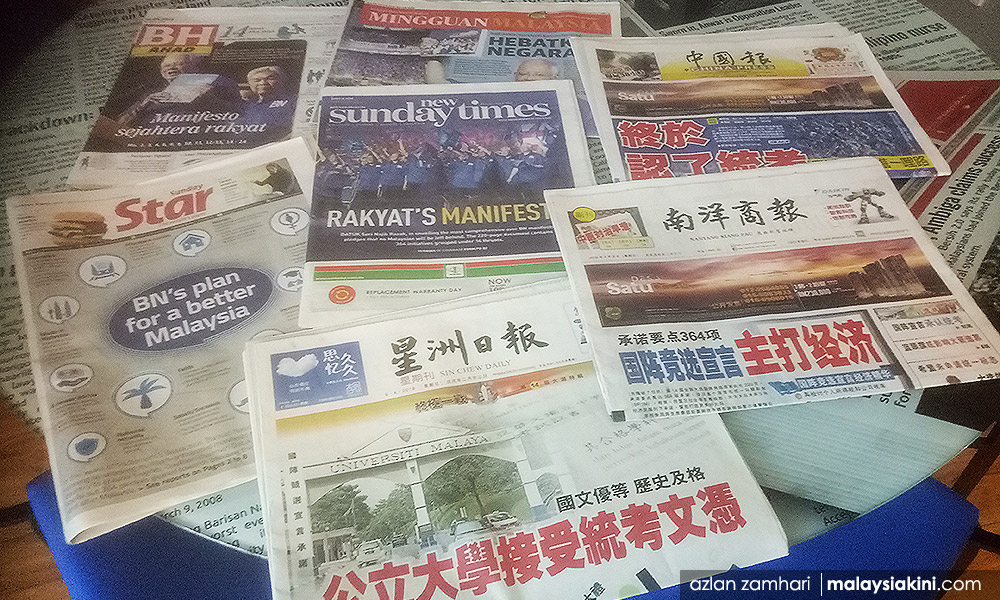
Compared with Malaysian Chinese readers, Hong Kong audiences are naturally more concerned with the future of Ming Pao and Yazhou Zhoukan.
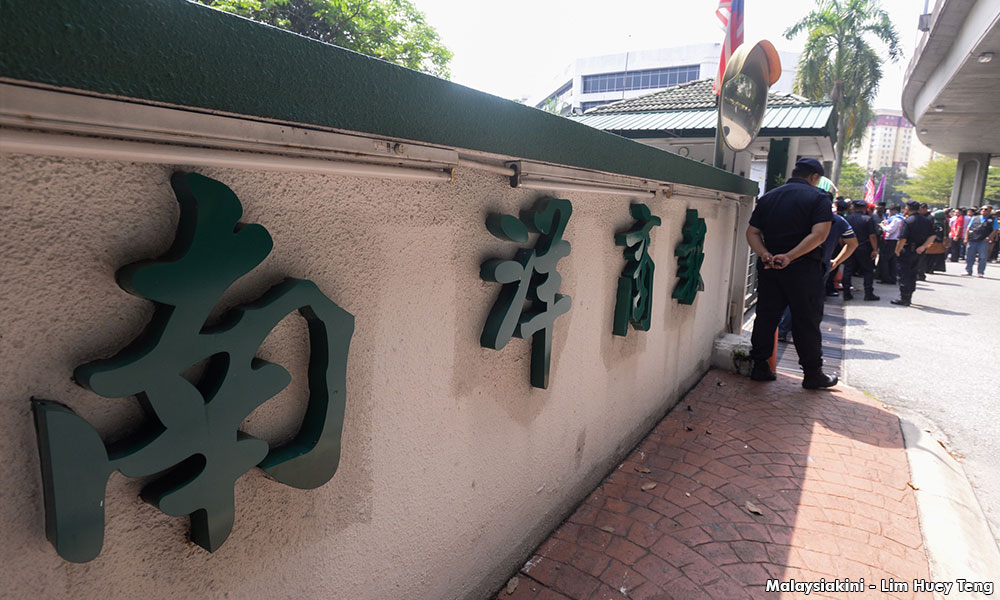
In contrast, within the Malaysian Chinese community, attention is focused on whether Nanyang Siang Pau, which celebrated its centenary in 2023, will itself become history. Or, to pose the question differently: how many years remain before it does?
From heyday to bare survival: A century‑old newspaper
MCIL owns four newspapers in Malaysia, founded respectively as follows: Nanyang Siang Pau (1923), Sin Chew Daily (1929), China Press (1946), and Guang Ming Daily (1987).
In terms of longevity within Malaysia’s Chinese‑language press, Nanyang Siang Pau is second only to Kwong Wah Yit Poh, founded in Penang in 1911 by Sun Yat‑sen and today recognised as the world’s oldest surviving Chinese‑language newspaper.
Nanyang Siang Pau once enjoyed a period of remarkable prominence. Prior to 1992, it was the undisputed leader of Malaysia’s Chinese newspaper market.
In 1986, its average daily readership reached 655,000, accounting for 40 percent of the market. Its closest competitor, Sin Chew Daily, lagged well behind with an average daily readership of 437,000 (Kou Yok Liong, Malaysia Chinese Press in Turbulent Times (1957-2011), Kuala Lumpur: People Publications, 2011, p 139).
In terms of circulation, during the period when Sin Chew Daily was suspended by the government of Dr Mahathir Mohamad amid Ops Lalang in 1987, Nanyang Siang Pau’s circulation exceeded 200,000 copies (Kou Yok Liong, Malaysia Chinese Press in Turbulent Times (1957-2011), Kuala Lumpur: People Publications, 2011, p 142).
When Sin Chew Daily resumed publication in 1988 with a circulation of 84,000 copies, Nanyang Siang Pau still led comfortably with 173,000 copies - double that of its rival - and a readership of 813,000 (Kou Yok Liong, Malaysia Chinese Press in Turbulent Times (1957-2011), Kuala Lumpur: People Publications, 2011, p 277).
I still remember that when I first enrolled on USM’s School of Communication in the early 1990s and asked at the library about archived Chinese newspapers, the Malay librarian instinctively asked: “Nanyang Siang Pau ke?”
However, after Sin Chew Daily’s circulation overtook Nanyang Siang Pau for the first time in 1992, the latter entered a prolonged decline. Its current actual circulation is no longer publicly ascertainable.
The last audited circulation figures released by the Audit Bureau of Circulations Malaysia (ABCM) for Nanyang Siang Pau covered the period from July 1, 2006, to June 30, 2007, reporting a circulation of 114,049 copies.
Since then, no publicly available data has disclosed its circulation.
Nevertheless, its predicament can be inferred from readership statistics. According to data from Nielsen Consumer & Media View cited in MCIL’s AGM presentations, Nanyang Siang Pau’s readership fell from 94,000 in 2013 to 60,000 in 2017 (noted as being “Focus on PMEB only”), a decline of 36.17 percent.
From 2018 onwards, MCIL’s AGM presentations up to 2025 ceased to provide readership figures for the group’s four newspapers.
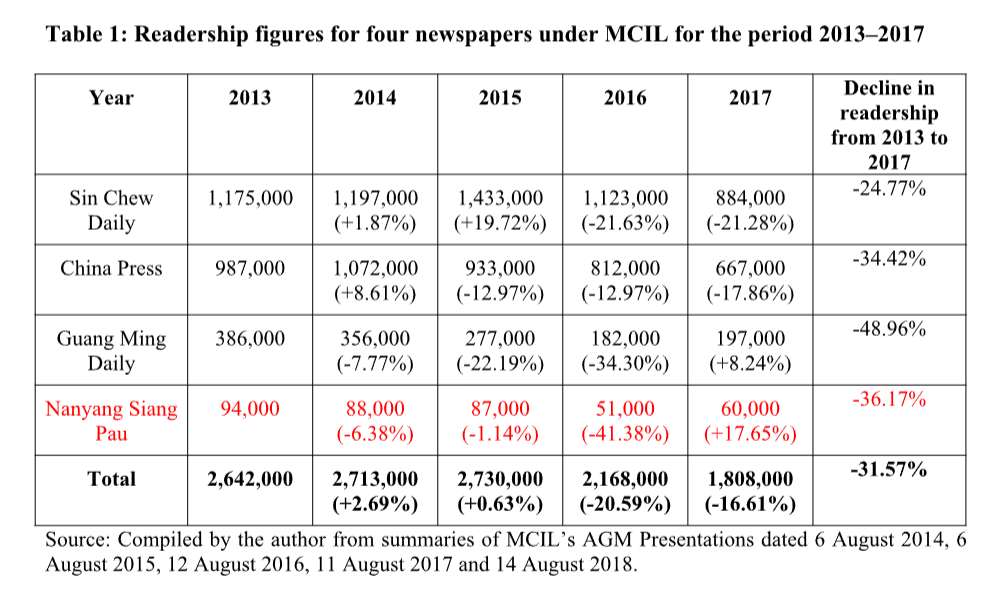
The available data indicate that Nanyang Siang Pau consistently ranked last among MCIL’s four Malaysian newspapers in terms of readership.
Between 2013 and 2017 alone, its readership shrank by over a third. Although this decline was less severe than that experienced by Guang Ming Daily (48.96 percent), the latter’s readership in 2017 still exceeded Nanyang Siang Pau’s by nearly 70 percent.
Traditionally, Malaysia’s newspaper industry estimated that each copy was shared by four readers. On this basis, Nanyang Siang Pau’s circulation in 2017 would have been approximately 15,000 copies.
However, contemporary residential patterns and lifestyles now rarely involve such sharing. Even under an optimistic assumption of two readers per copy, circulation would have amounted to only around 30,000 copies.
As a national newspaper with offices across states, Nanyang Siang Pau has gradually closed some offices in smaller townships or consolidated them with China Press to reduce operating costs.
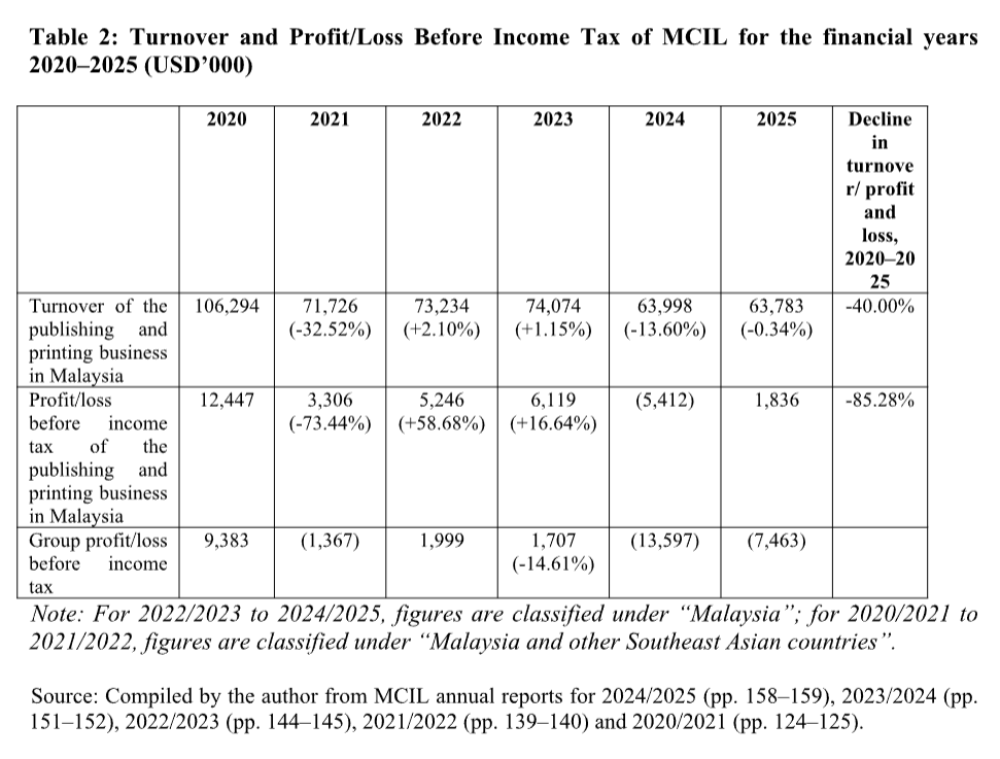
Yet MCIL’s financial data from the 2020 to 2025 financial years paint a stark picture. Over those six years, revenue from publishing and printing operations in Malaysia fell by 40 percent, while profits before income tax from the same segment plunged by 85.28 percent.
The group recorded losses before income tax in both 2024 and 2025.
Given Nanyang Siang Pau’s meagre readership and circulation, it is highly unlikely to be contributing positively to MCIL’s earnings; instead, it has become a financial burden.
From a purely commercial standpoint, Nanyang Siang Pau is now a liability for the group.
Thus, the question of whether MCIL might one day allow Nanyang Siang Pau to pass into history is no longer mere alarmism.
In today’s challenging media environment, the prospect of another Malaysian firm or investor investing heavily to acquire Nanyang Siang Pau is exceedingly slim.
Foreign capital is likewise excluded, as the Malaysian government does not permit foreign control of local newspapers.
Final tug‑of‑war between culture and capital
With divestment effectively ruled out, four possible futures remain for Nanyang Siang Pau:
(1) Complete closure
The newspaper could cease publication entirely, bringing a century‑long history to an end.
During Hiew King’s lifetime, this option was relatively unlikely. Nanyang Siang Pau is not only historically significant but was also founded by Tan Kah Kee (1874-1961), the famed “rubber magnate” celebrated for “sacrificing his family fortune to promote education” and for establishing Jimei Schools and Xiamen University.

Whether out of personal cultural sentiment or concern for the “cultural entrepreneur” (or ru shang) image he cultivated after acquiring Sin Chew Daily, allowing Nanyang Siang Pau to close would have been an unwise move for Tiong.
The question now is whether Hiew King’s daughter, Choon (or other members of the Tiong family), bears a similar cultural burden or possesses sufficient passion for the Chinese‑language press to continue regardless of financial loss.
As I noted previously, given her age, education, experience, and past performance, there is little indication that she possesses the same Chinese cultural ideals.
Since becoming a non‑executive director of MCIL in 2013, chair of the board in 2022, and president of the Chinese Language Press Institute in 2018, she has yet to articulate a clear vision or ambition for running Chinese‑language media.
(2) Ending print while retaining the digital platform
Under this scenario, the print edition of Nanyang Siang Pau would cease, while eNanyang (enanyang.my) would continue as a digital‑only news outlet.
Malaysia offers several precedents:
(i) Founded on Dec 1, 1896 - earlier than Nanyang Siang Pau - the Malay Mail, then the oldest surviving local English-language newspaper in Malaysia, published its final print edition on Dec 1, 2018, and shifted its focus the following day to online news operations (www.malaymail.com).

(ii) The English-language The Edge Financial Daily, launched in 2007, ceased print publication on April 21, 2020, and focused on its online platform (www.theedgemalaysia.com).
(iii) The Chinese-language Oriental Daily, founded in 2002, became the first Chinese-language newspaper in Peninsular Malaysia to discontinue its print edition on April 16, 2021, concentrating thereafter on its news website (www.orientaldaily.com.my).
(iv) The Chinese-language International Times of Sarawak, founded in 1968, ceased print publication on October 16, 2018, while retaining its news website (www.intimes.com.my).
A digital‑only strategy would dramatically reduce staffing and operational costs while preserving the Nanyang Siang Pau brand and legacy, potentially even restoring modest profitability.
(3) Full transformation into a financial weekly
While this might appear to align with the paper’s original mission in 1923, Malaysia’s business community primarily operates in English, and the market for Chinese‑language financial publications is extremely limited.
Even The Edge Financial Daily recorded a circulation of only 4,545 copies in early 2017. The Chinese‑language financial weekly Busy Weekly, launched in 2009 by the owners of Oriental Daily News, earned an excellent reputation but still ceased publication in June 2023 after 14 years.

(4) Merger with Sin Chew Daily
This would echo Singapore’s 1983 consolidation into Sin Chew-Nanyang Lianhe Zaobao‑style joint publications, potentially rebranded as Sin Chew-Nanyang United Daily, or relegating Nanyang Siang Pau to a financial supplement within Sin Chew Daily.
The likelihood of the former option is extremely slim, as it would risk damaging both venerable brands.
Singapore’s merger was orchestrated by then-prime minister Lee Kuan Yew with political considerations and state authority.
Not to mention that 43 years on, only Lianhe Zaobao remains, with the names “Sin Chew” and “Nanyang” having largely faded from public memory.
As for the latter option, it would amount to nothing less than shutting down Nanyang Siang Pau.
Which of these scenarios will ultimately define Nanyang Siang Pau’s fate depends on how Hiew King’s successors position themselves amid the final struggle between cultural sentiment and capitalist rationality. - Mkini
CHANG TECK PENG is a journalist-turned communications academic. He is an associate professor at TAR UMT.
The views expressed here are those of the author/contributor and do not necessarily represent the views of MMKtT.

No comments:
Post a Comment
Note: Only a member of this blog may post a comment.