


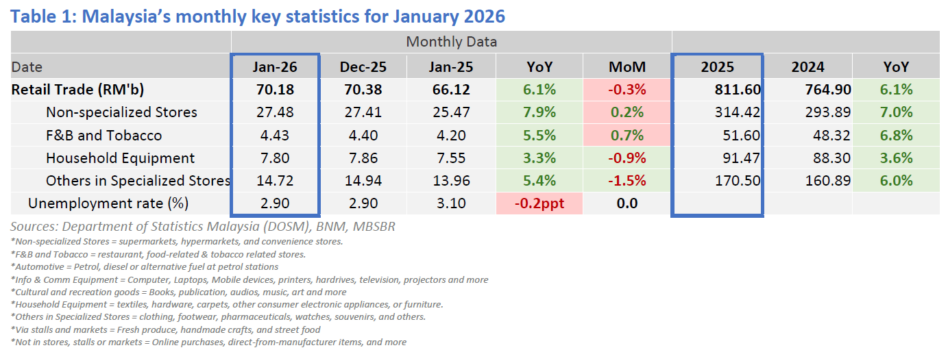
SPENDING should remain supportive, Underpinned by a tight labour market, manageable inflation and continued fiscal support under the Ekonomi MADANI framework.
According to MBSB Research, enhanced STR and SARA allocations in Budget 2026, alongside tourism tailwinds ahead of Visit Malaysia 2026, should sustain mass-market consumption and support retail and F&B activity.
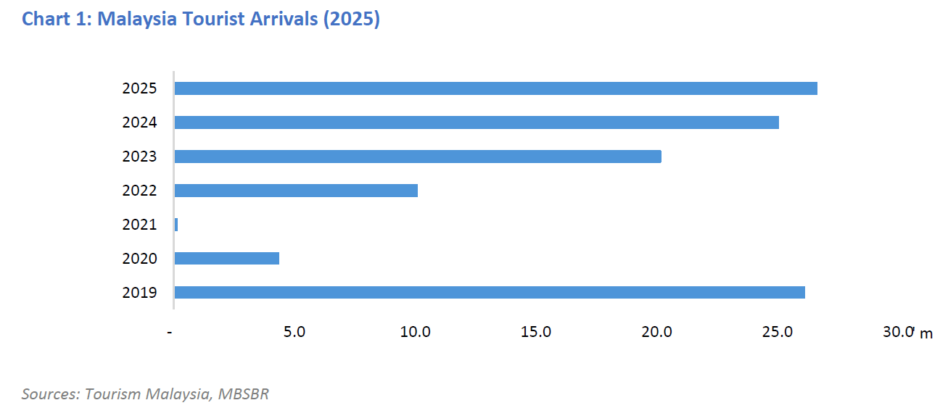
Malaysia welcomed 26.61 mil tourist arrivals in 2025, representing a +6.3% year-on-year (yoy) increase and +1.9% above the 26.1 mil recorded in 2019, signalling a full recovery, and slight expansion, beyond pre-pandemic levels.
The sustained rebound reflects continued regional travel normalization, stronger connectivity and Malaysia’s positioning as a competitive value-for-money destination in Southeast Asia as the country prepares for Visit Malaysia 2026.
Commodity trends in Feb-26 were largely softer on a year-on-year basis, providing a generally favourable cost backdrop for consumer producers despite some short-term volatility.
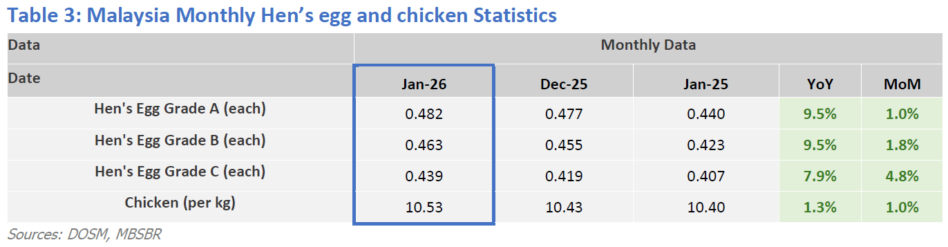
Retail egg prices continued to trend higher, with Grade A (+9.6%yoy), Grade B (+9.5%yoy) and Grade C (+7.9%yoy) all recording firm gains, reflecting resilient demand and tighter supply conditions.
“Meanwhile, average retail chicken prices also edged higher (+1.3%yoy), pointing to steady consumption trends and improving pricing traction,” said MBSB.
Overall, poultry pricing remains constructive, with both eggs and chicken registering moderate increases amid stable demand conditions.
Feed cost pressures for poultry producers remain manageable, with the sharp year-on-year decline in corn helping offset the recent uptick in soybean meal prices.
Following the escalation in Iran, the key issue for the consumer sector is the transmission of higher energy prices into raw materials, fertiliser, freight and packaging costs.
Oil and gas sit across the cost stack through fuel used in cultivation, processing and transportation, through petrochemical feedstocks used in packaging, and through natural gas as a critical input in fertiliser production.
“The Strait of Hormuz is therefore increasingly relevant as it is a major artery for fertiliser trade and related inputs into the global agricultural chain,” said MBSB.
In sum, Malaysia’s consumer sector outlook remains broadly constructive, supported by resilient domestic spending, recovering tourism and manageable cost pressures.
While geopolitical developments and potential energy price pass-throughs could introduce volatility in input costs, the overall demand environment appears firm. — Focus Malaysia

No comments:
Post a Comment
Note: Only a member of this blog may post a comment.